Triangles — Class 10 Maths PYQs

146 previous-year board questions (2023–2025) with marking-scheme solutions, grouped by topic and marks.

Try each question first, then press (or tap Show Solution) to reveal the answer. Press again for the next question.

Similarity of Shapes

1 Mark Questions
11 Mark · March 2025 · Standardopen ↗
Which of the following statements is incorrect?
  • (a)Two congruent figures are always similar.
  • (b)A square and a rhombus of the same area are always similar.
  • (c)Two equilateral triangles are always similar.
  • (d)Two similar triangles need not be congruent.
Show SolutionHide Solution
(B) A square and a rhombus of the same area are always similar.
21 Mark · March 2025 · Standardopen ↗
Which of the following statements is
textbf{incorrect}?
  • (a)Two congruent figures are always similar.
  • (b)A square and a rhombus of the same area are always similar.
  • (c)Two equilateral triangles are always similar.
  • (d)Two similar triangles need not be congruent.
Show SolutionHide Solution
(B) A square and a rhombus of the same area are always similar.
31 Mark · March 2025 · Standardopen ↗
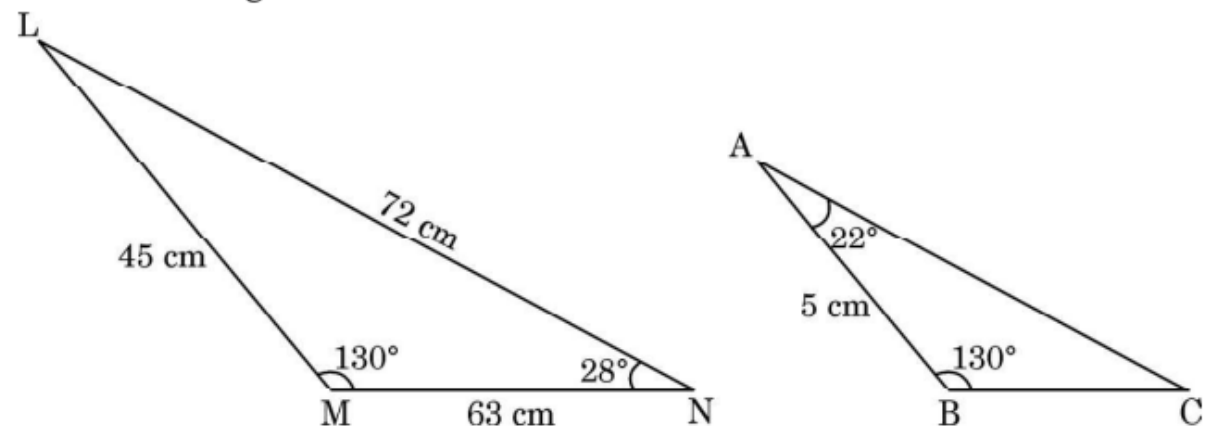
The measurements of $\triangle LMN$ and $\triangle ABC$ are shown in the figure given below. The length of side AC is :
figure for this question
  • (a)$16 \operatorname{cm}$
  • (b)$7 \operatorname{cm}$
  • (c)$8 \operatorname{cm}$
  • (d)$4 \operatorname{cm}$
Show SolutionHide Solution
Sol. (C) $8 \operatorname{cm}$
41 Mark · March 2025 · Standardopen ↗
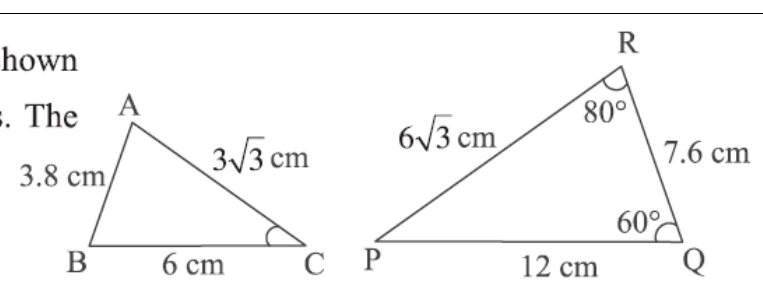
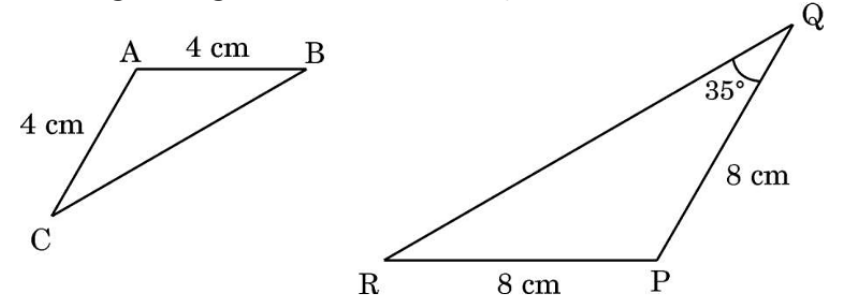
$\triangle ABC$ and $\triangle PQR$ are shown in the adjoining figures. The measure of $\angle C$ is :
figure for this question
  • (a)$140^\circ$
  • (b)$80^\circ$
  • (c)$60^\circ$
  • (d)$40^\circ$
Show SolutionHide Solution
(d) $40^\circ$
51 Mark · March 2025 · Standardopen ↗
E and F are points on the sides AB and AC respectively of a $\triangle ABC$ such that $\frac{AE}{EB} = \frac{AF}{FC} = \frac{1}{2}$. Which of the following relation is true ?
  • (a)$EF = 2BC$
  • (b)$BC=2EF$
  • (c)$EF = 3BC$
  • (d)$BC = 3 EF$
Show SolutionHide Solution
(d) $BC = 3 EF$
61 Mark · March 2025 · Standardopen ↗
Which of the following statements is false?
  • (a)Two right triangles are always similar.
  • (b)Two squares are always similar.
  • (c)Two equilateral triangles are always similar.
  • (d)Two circles are always similar.
Show SolutionHide Solution
(A) Two right triangles are always similar.

BPT & Converse

1 Mark Questions
71 Mark · July 2023 · Standardopen ↗
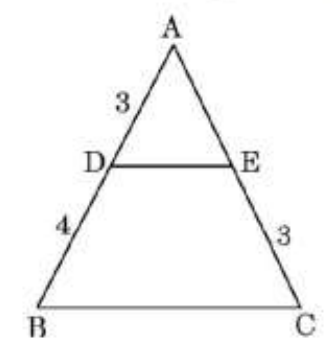
In the given figure, DE $\| $ BC and all measurements are given in centimetres. The length of AE is :
figure for this question
  • (a)$2$ cm
  • (b)$2.25$ cm
  • (c)$2.5$ cm
  • (d)$2.75$ cm
Show SolutionHide Solution
(b) $2.25$ cm
81 Mark · July 2023 · Standardopen ↗
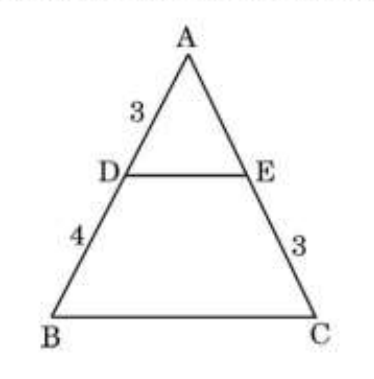
In the given figure, $\text{DE} \parallel \text{BC}$ and all measurements are given in centimetres. The length of $\text{AE}$ is:
figure for this question
  • (a)$2$ cm
  • (b)$2.5$ cm
  • (c)$2.25$ cm
  • (d)$2.75$ cm
Show SolutionHide Solution
(b) $2.25$ cm
91 Mark · July 2023 · Standardopen ↗
E and F are points on the sides PQ and PR respectively of a $\triangle PQR$. If EF $||$ QR and PE = $4$ cm, QE = $3$ cm and EF = $4$ cm, then the length of QR is :
  • (a)$3$ cm
  • (b)$4$ cm
  • (c)$7$ cm
  • (d)$6$ cm
Show SolutionHide Solution
Ans. (c) $7$ cm
101 Mark · March 2023 · Standardopen ↗
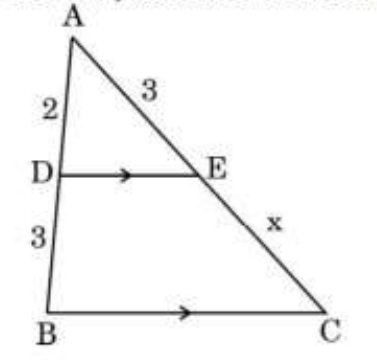
In the given figure, DE $\|\|$ BC. If AD = $2$ units, DB = AE = $3$ units and EC = $x$ units, then the value of $x$ is:
figure for this question
  • (a)$2$
  • (b)$3$
  • (c)$5$
  • (d)$\frac{9}{2}$
Show SolutionHide Solution
(d) $\frac{9}{2}$
111 Mark · March 2023 · Standardopen ↗
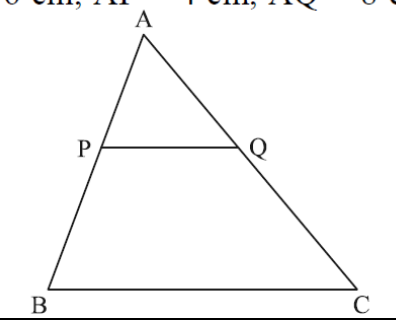
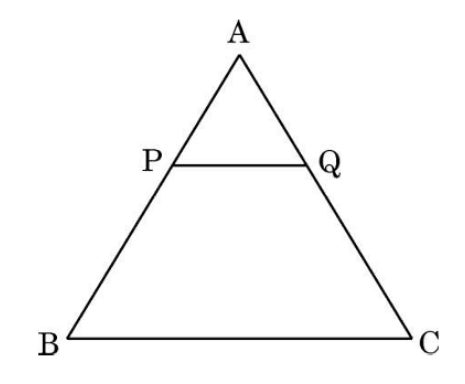
In $\Delta ABC$, $PQ \parallel BC$. If $PB = 6$ cm, $AP = 4$ cm, $AQ = 8$ cm, find the length of $AC$.
figure for this question
  • (a)$12$ cm
  • (b)$20$ cm
  • (c)$6$ cm
  • (d)$14$ cm
Show SolutionHide Solution
Sol. (b) $20$ cm
121 Mark · March 2023 · Standardopen ↗
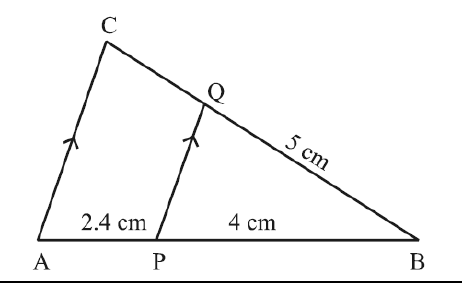
In the given figure, $PQ \parallel AC$. If $BP = 4$ cm, $AP = 2.4$ cm and $BQ = 5$ cm, then length of BC is :
figure for this question
  • (a)$8$ cm
  • (b)$3$ cm
  • (c)$0.3$ cm
  • (d)$\frac{25}{3}$ cm
Show SolutionHide Solution
(a) $8$ cm
131 Mark · March 2023 · Standardopen ↗
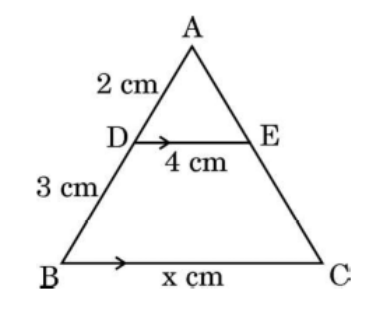
In the given figure, $DE \parallel BC$. The value of $x$ is :
figure for this question
  • (a)$6$
  • (b)$12.5$
  • (c)$8$
  • (d)$10$
Show SolutionHide Solution
(d) $10$
141 Mark · March 2023 · Standardopen ↗
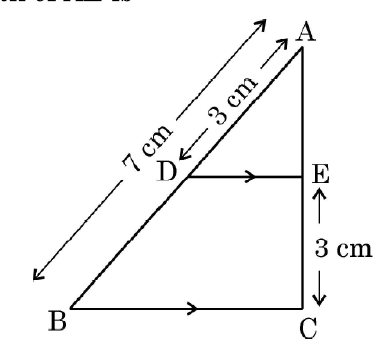
In the given figure, $DE||BC$. If $AD = 3$ cm, $AB = 7$ cm and $EC = 3$ cm, then the length of $AE$ is
figure for this question
  • (a)2 cm
  • (b)3.5 cm
  • (c)2.25 cm
  • (d)4 cm
Show SolutionHide Solution
(B) 2.25 cm
151 Mark · March 2024 · Standardopen ↗
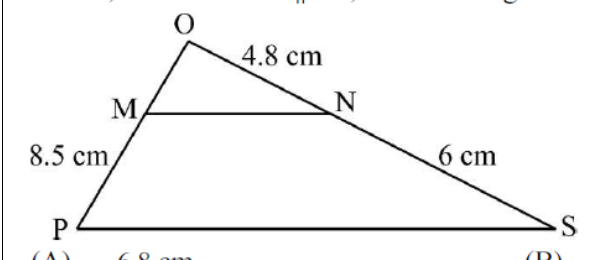
In the given figure, if M and N are points on the sides OP and OS respectively of $\triangle OPS$, such that MN $||$ PS, then the length of OP is :
figure for this question
  • (a)$6.8$ cm
  • (b)$17$ cm
  • (c)$15.3$ cm
  • (d)$9.6$ cm
Show SolutionHide Solution
(C) $15.3$ cm
161 Mark · July 2024 · Standardopen ↗
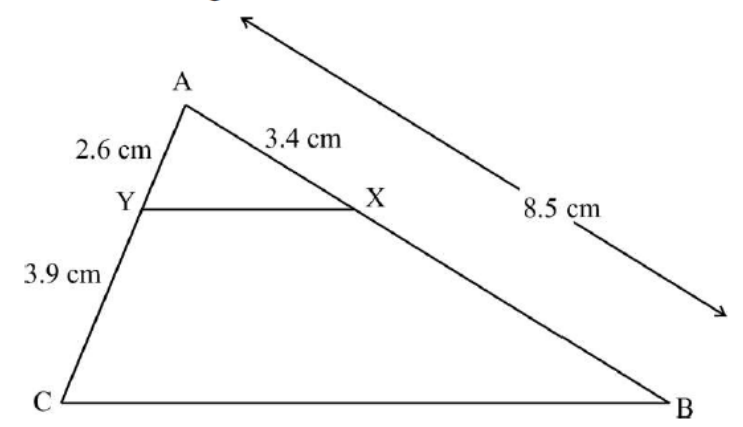
In the figure, X and Y are two points on the sides AB and AC respectively in $\triangle ABC$, such that $AX = 3.4$ cm, $AB = 8.5$ cm, $AY = 2.6$ cm and $YC = 3.9$ cm. Which of the following relation is correct ?
figure for this question
  • (a)$BC = 2XY$
  • (b)$BC$ is not parallel to $XY$
  • (c)$3BC = 2XY$
  • (d)$BC \parallel XY$
Show SolutionHide Solution
(D) $BC \parallel XY$
171 Mark · July 2024 · Standardopen ↗
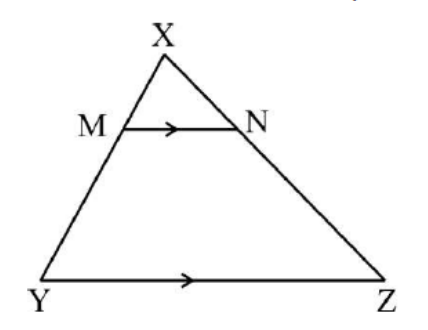
In $\triangle XYZ$, $XY = 6$ cm. If M and N are two points on XY and XZ respectively such that $MN \parallel YZ$ and $XN = \frac{1}{4} XZ$, then the length of XM is :
figure for this question
  • (a)$1.2$ cm
  • (b)$1.5$ cm
  • (c)$2$ cm
  • (d)$4$ cm
Show SolutionHide Solution
(B) $1.5$ cm
181 Mark · July 2024 · Standardopen ↗
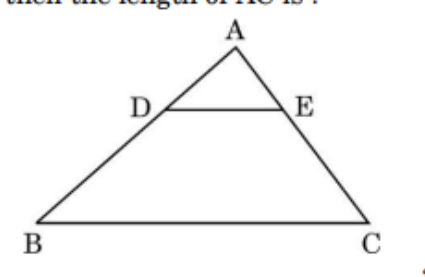
In a $\triangle ABC$, a line DE is drawn parallel to BC to intersect AB at D and AC at E. If AD = $2$ cm, BD = $3$ cm and DE = $4$ cm, then the length of BC (in cm) is :
  • (a)$6$
  • (b)$10$
  • (c)$\frac{8}{3}$
  • (d)$\frac{20}{3}$
Show SolutionHide Solution
Sol. (B) $10$
191 Mark · March 2024 · Standardopen ↗
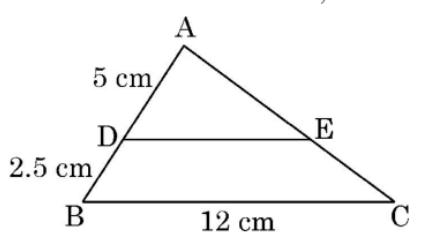
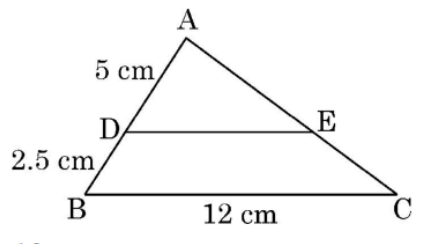
In the given figure $\triangle ABC$ is shown. $DE$ is parallel to $BC$. If $AD = 5$ cm, $DB = 2.5$ cm and $BC = 12$ cm, then $DE$ is equal to
figure for this question
  • (a)$10$ cm
  • (b)$6$ cm
  • (c)$8$ cm
  • (d)$7.5$ cm
Show SolutionHide Solution
(C) $8$ cm
201 Mark · March 2024 · Standardopen ↗
In the given figure $\Delta ABC$ is shown. DE is parallel to BC. If AD = $5$ cm, DB = $2.5$ cm and BC = $12$ cm, then DE is equal to
figure for this question
  • (a)$10$ cm
  • (b)$8$ cm
  • (c)$6$ cm
  • (d)$7.5$ cm
Show SolutionHide Solution
(C) $8$ cm
211 Mark · March 2024 · Standardopen ↗
In the given figure, in $\triangle ABC$, $DE \parallel BC$. If $AD = 2.4 \text{ cm}$, $DB = 4 \text{ cm}$ and $AE = 2 \text{ cm}$, then the length of $AC$ is :
figure for this question
  • (a)$\frac{10}{3} \text{ cm}$
  • (b)$\frac{3}{10} \text{ cm}$
  • (c)$\frac{16}{3} \text{ cm}$
  • (d)$1.2 \text{ cm}$
Show SolutionHide Solution
(C) $\frac{16}{3} \text{ cm}$
221 Mark · March 2024 · Standardopen ↗
A line $l$ intersects the sides PQ and PR of a $\triangle PQR$ at L and M respectively such that LM $||$ QR. If PL = $5.7$ cm, PQ = $15.2$ cm and MR = $5.5$ cm, then the length of PM (in cm) is :
  • (a)$3$
  • (b)$1.8$
  • (c)$2.5$
  • (d)$3.3$
Show SolutionHide Solution
(D) $3.3$
231 Mark · July 2025 · Standardopen ↗
ABCD is a trapezium with AB $||$ DC and the diagonals intersect at O. If AO = $(2x + 1)$ cm, OC = $(5x – 7)$ cm, DO = $(7x – 5)$ cm and OB = $(7x + 1)$ cm, then the value of $x$ is :
  • (a)$2$
  • (b)$3$
  • (c)$4$
  • (d)$1$
Show SolutionHide Solution
(A) $2$
241 Mark · March 2025 · Standardopen ↗
In the given figure, PQ$||$BC. If $\frac{AP}{PB} = \frac{4}{13}$ and AC = $20.4$ cm, then the length of AQ is :
figure for this question
  • (a)$2.8$ cm
  • (b)$5.8$ cm
  • (c)$3.8$ cm
  • (d)$4.8$ cm
Show SolutionHide Solution
(D) $4.8$ cm
251 Mark · March 2025 · Standardopen ↗
E and F are points on the sides AB and AC respectively of a $\Delta ABC$ such that $\frac{AE}{EB} = \frac{AF}{FC} = \frac{1}{2}$. Which of the following relation is true ?
  • (a)$EF = 2BC$
  • (b)$BC = 2EF$
  • (c)$EF = 3BC$
  • (d)$BC = 3EF$
Show SolutionHide Solution
(d) $BC = 3EF$
261 Mark · March 2025 · Standardopen ↗
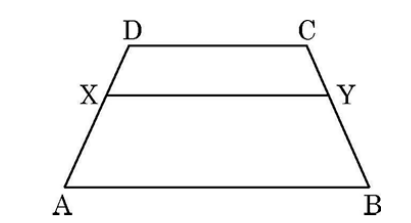
In the adjoining figure, $ABCD$ is a trapezium in which $XY \parallel AB \parallel CD$. If $AX = \frac{2}{3}AD$, then $CY:YB =$.
figure for this question
  • (a)2:3
  • (b)3:2
  • (c)1:3
  • (d)1:2
Show SolutionHide Solution
(D) 1:2
271 Mark · March 2025 · Standardopen ↗
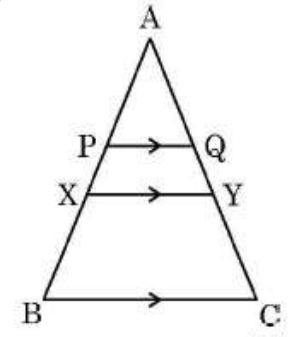
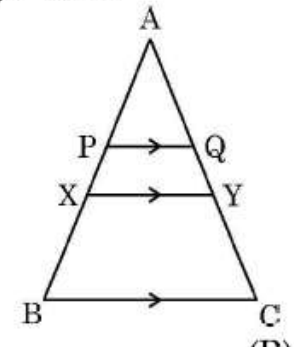
In the adjoining figure, $PQ \parallel XY \parallel BC$, $AP = 2$ cm, $PX = 1.5$ cm and $BX = 4$ cm. If $QY = 0.75$ cm, then $AQ + CY =$.
figure for this question
  • (a)6 cm
  • (b)4.5 cm
  • (c)3 cm
  • (d)5.25 cm
Show SolutionHide Solution
(C) 3 cm
281 Mark · March 2025 · Standardopen ↗
In the adjoining figure, $PQ \parallel BC$, $AP = 2$ cm, $PX = 1.5$ cm and $BX = 4$ cm. If $QY = 0.75$ cm, then $AQ + CY =$.
figure for this question
  • (a)$6$ cm
  • (b)$4.5$ cm
  • (c)$3$ cm
  • (d)$5.25$ cm
Show SolutionHide Solution
(C) $3$ cm
2 Marks Questions
292 Marks · March 2023 · Standardopen ↗
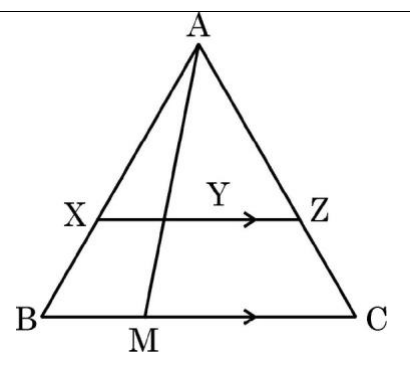
In the given figure, $XZ$ is parallel to $BC$. $AZ = 3$ cm, $ZC = 2$ cm, $BM =3$ cm and $MC = 5$ cm. Find the length of $XY$.
figure for this question
Show SolutionHide Solution
As $XZ \parallel BC$ Therefore $\frac{AX}{XB} = \frac{AZ}{ZC} = \frac{3}{2}$ (i)
$\triangle AXY \sim \triangle ABM$
$\Rightarrow \frac{AX}{AB} = \frac{XY}{BM}$ or $\frac{XY}{3} = \frac{3}{5}$
$\Rightarrow XY = \frac{9}{5}$ or $1.8$ cm
302 Marks · March 2023 · Standardopen ↗
In the given figure, $ABC$ is a triangle in which $DE||BC$. If $AD = x$, $DB = x-2$, $AE = x + 2$ and $EC = x-1$, then find the value of $x$.
figure for this question
Show SolutionHide Solution
In $\triangle ABC$, $DE || BC$
$\therefore \frac{AD}{DB} = \frac{AE}{EC} \Rightarrow \frac{x}{x-2} = \frac{x+2}{x-1}$
$x(x - 1) = (x + 2)(x - 2)$
$x^2 - x = x^2 - 4 \Rightarrow x = 4$
312 Marks · July 2024 · Standardopen ↗
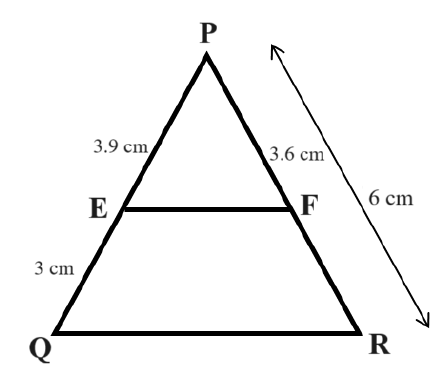
E and F are points on the sides PQ and PR respectively of a $\triangle PQR$. If PE = $3.9$ cm, EQ = $3$ cm, PF = $3.6$ cm and PR = $6$ cm, find whether EF $||$ QR.
Show SolutionHide Solution
Sol.
FR = $6-3.6 = 2.4$ cm
$\frac{PE}{EQ} = \frac{3.9}{3} = 1.3$ and $\frac{PF}{FR} = \frac{3.6}{2.4} = 1.5$
Since $\frac{PE}{EQ} \neq \frac{PF}{FR}$,
therefore EF $||$ QR.
figure for this question
322 Marks · July 2025 · Standardopen ↗
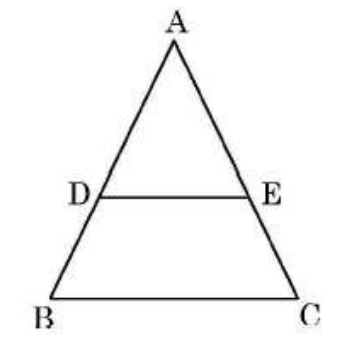
If a line intersects sides AB and AC of $\triangle$ ABC at D and E respectively, and is parallel to BC, prove that $\frac{AD}{AB} = \frac{AE}{AC}$.
Show SolutionHide Solution
$\triangle ADE \sim \triangle ABC$
$\therefore \frac{AD}{AB} = \frac{AE}{AC}$
figure for this question
332 Marks · March 2025 · Standardopen ↗
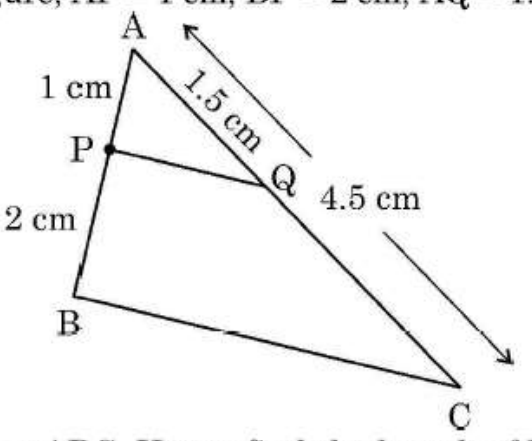
In the adjoining figure, $AP = 1$ cm, $BP = 2$ cm, $AQ = 1.5$ cm and $AC = 4.5$ cm. Prove that $\Delta APQ \sim \Delta ABC$. Hence find the length of $PQ$, if $BC = 3.6$ cm.
figure for this question
Show SolutionHide Solution
$\frac{AP}{AB} = \frac{1}{3}$; $\frac{AQ}{AC} = \frac{1.5}{4.5} = \frac{1}{3}$
$\angle ACP = \angle ACB$
$\Delta APQ \sim \Delta ABC$
$PQ = 1.2$ cm
5 Marks Questions
345 Marks · March 2023 · Standardopen ↗
If a line is drawn parallel to one side of a triangle to intersect the other two sides at distinct points, prove that the other two sides are divided in the same ratio.
Show SolutionHide Solution
Correct Given, to prove, figure, construction
Correct proof
355 Marks · March 2023 · Standardopen ↗
If a line is drawn parallel to one side of a triangle to intersect the other two sides in distinct points, then prove that the other two sides are divided in the same ratio.
Show SolutionHide Solution
Correct given, to prove, figure and construction
Correct Proof
365 Marks · July 2024 · Standardopen ↗
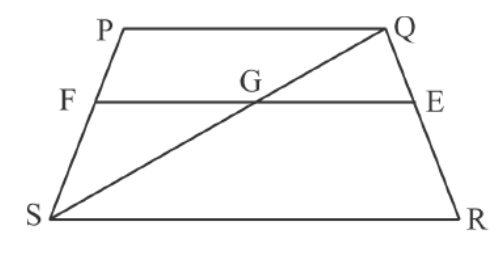
In trapezium PQRS, $PQ \parallel SR$ and $SR = 2 PQ$. A line segment FE drawn parallel to PQ intersects PS at F and QR at E such that $\frac{QE}{ER} = \frac{3}{4}$. Diagonal QS intersects FE at G. Prove that $\frac{FE}{PQ} = \frac{10}{7}$.
figure for this question
Show SolutionHide Solution
GE $\parallel$ PQ and PQ $\parallel$ SR $\Rightarrow$ GE $\parallel$ SR
$\therefore \triangle QGE \sim \triangle QSR$
$\frac{GE}{SR} = \frac{QE}{QR} = \frac{3}{7}$
Given, $SR = 2 PQ$
$\Rightarrow \frac{GE}{PQ} = \frac{6}{7}$ ... (i)
Now, FG $\parallel$ PQ
$\therefore \triangle SFG \sim \triangle SPQ$
$\Rightarrow \frac{FG}{PQ} = \frac{SF}{SP}$
Also, $\frac{SF}{SP} = \frac{RE}{RQ} = \frac{4}{7}$
$\Rightarrow \frac{FG}{PQ} = \frac{4}{7}$ ... (ii)
Adding (i) and (ii), $\frac{FE}{PQ} = \frac{6}{7} + \frac{4}{7} = \frac{10}{7}$
375 Marks · July 2024 · Standardopen ↗
If a line is drawn parallel to one side of a triangle to intersect the other two sides in distinct points, then prove that the other two sides are divided in the same ratio.
Show SolutionHide Solution
Sol. Correct given, to prove.
Correct proof.
385 Marks · March 2024 · Standardopen ↗
If a line is drawn parallel to one side of a triangle to intersect the other two sides in distinct points, then prove that the other two sides are divided in the same ratio.
Show SolutionHide Solution
Sol. Correct figure, given, to prove and construction
Correct proof
395 Marks · March 2024 · Standardopen ↗
If a line is drawn parallel to one side of a triangle to intersect the other two sides in distinct points, then prove that the other two sides are divided in the same ratio.
Show SolutionHide Solution
Correct Given, to prove, figure, construction
Correct proof
405 Marks · March 2024 · Standardopen ↗
State and prove Basic Proportionality theorem.
Show SolutionHide Solution
For correct statement
For correct given, to prove, construction and figure
For correct Proof
415 Marks · March 2025 · Standardopen ↗
If a line is drawn parallel to one side of a triangle intersecting the other two sides in distinct points then it divides the two sides in the same ratio. Prove it. Also, state the converse of the above statement.
Show SolutionHide Solution
Correct figure, given, to prove, construction
Correct proof
Correct statement of converse of given statement
425 Marks · March 2025 · Standardopen ↗
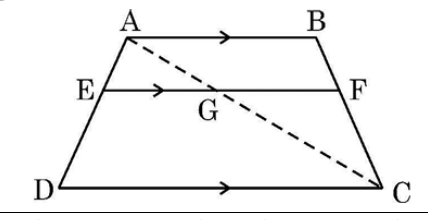
State the converse of basic proportionality theorem. Also find $\frac{BF}{FC}$ in the following figure, given that $AB || DC || EF$ and $\frac{AE}{ED} = \frac{2}{3}$. Also, find the length of EF if $AB = 10$ cm and $DC = 15$ cm.
figure for this question
Show SolutionHide Solution
Correct statement of converse of Basic Proportionality Theorem.
In $\Delta ADC, EG || DC \implies \frac{AE}{ED} = \frac{AG}{GC} = \frac{2}{3}$
In $\Delta ABC, GF || AB \implies \frac{AG}{GC} = \frac{BF}{FC} = \frac{2}{3}$
$\Delta AEG \sim \Delta ADC$
$\implies \frac{AE}{AD} = \frac{AG}{AC} = \frac{EG}{DC} \implies \frac{2}{5} = \frac{EG}{DC} \implies EG = \frac{2}{5} \times 15 = 6$ cm
Similarly, $\Delta CFG \sim \Delta CBA$ and $\frac{FC}{BF} = \frac{3}{2} \implies \frac{FC}{BC} = \frac{GF}{AB} = \frac{3}{5} \implies GF = \frac{3}{5} \times 10 = 6$ cm
$EF = EG + GF = 6 + 6 = 12$ cm
435 Marks · March 2025 · Standardopen ↗
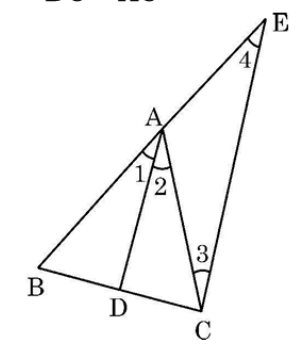
State the basic proportionality theorem. Use the theorem to do the following : In $\Delta ABC$, AD is the angle bisector of angle A. BA is produced to E such that CE $||$ AD. Prove that $\frac{BD}{DC} = \frac{BA}{AC}$.
figure for this question
Show SolutionHide Solution
Correct statement of Basic Proportionality Theorem.
As DA $||$ CE $\implies \frac{BD}{DC} = \frac{BA}{AE}$ --- (1)
$\angle 2 = \angle 3$ & $\angle 1 = \angle 4$. As $\angle 1 = \angle 2 \implies \angle 3 = \angle 4 \implies AC = AE$ --- (2)
From (1) & (2), $\frac{BD}{DC} = \frac{BA}{AC}$
445 Marks · March 2025 · Standardopen ↗
If a line drawn parallel to one side of triangle intersecting the other two sides in distinct points divides the two sides in the same ratio, then it is parallel to third side. State and prove the converse of the above statement.
Show SolutionHide Solution
Correct Statement of BPT (1 mark). Correct figure, Given, To Prove, Construction (2 marks). Correct Proof of BPT (2 marks). NOTE* Given statement in English version is not a correct statement. Full marks may be awarded to any attempt in English medium.
455 Marks · March 2025 · Standardopen ↗
If a line is drawn parallel to one side of a triangle to intersect the other two sides in distinct points, then prove that the other two sides are divided in the same ratio.
Show SolutionHide Solution
Correct Given, To prove and construction
Correct proof

Similarity with Triangles

1 Mark Questions
461 Mark · July 2023 · Standardopen ↗
The perimeters of two similar triangles are $42$ cm and $35$ cm respectively. If one side of the first triangle is $12$ cm, then the corresponding side of the second triangle is :
  • (a)$5$ cm
  • (b)$7.5$ cm
  • (c)$8$ cm
  • (d)$10$ cm
Show SolutionHide Solution
Ans. (d) $10$ cm
471 Mark · March 2023 · Standardopen ↗
If $\triangle ABC \sim \triangle PQR$ with $\angle A = 32^\circ$ and $\angle R = 65^\circ$, then the measure of $\angle B$ is:
  • (a)$32^\circ$
  • (b)$65^\circ$
  • (c)$83^\circ$
  • (d)$97^\circ$
Show SolutionHide Solution
(c) $83^\circ$
481 Mark · March 2023 · Standardopen ↗
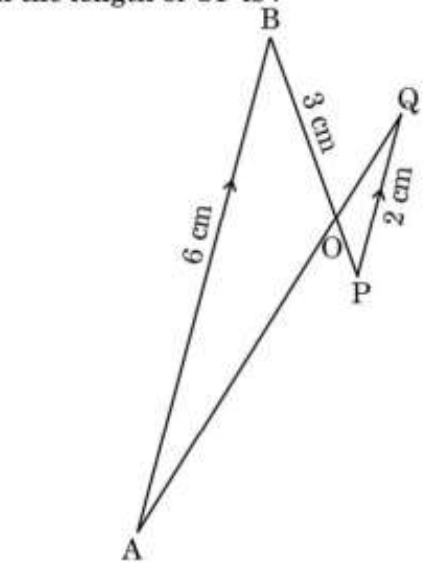
In the given figure, AB $\|\|$ PQ. If AB = $6$ cm, PQ = $2$ cm and OB = $3$ cm, then the length of OP is:
figure for this question
  • (a)$9$ cm
  • (b)$3$ cm
  • (c)$4$ cm
  • (d)$1$ cm
Show SolutionHide Solution
(d) $1$ cm
491 Mark · March 2023 · Standardopen ↗
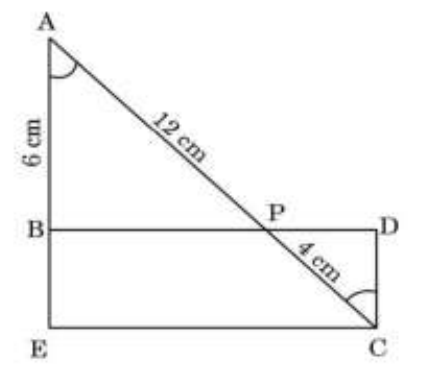
In the given figure, $\angle A = \angle C$, $AB = 6$ cm, $AP = 12$ cm, $CP = 4$ cm. Then length of CD is:
figure for this question
  • (a)$2$ cm
  • (b)$6$ cm
  • (c)$8$ cm
  • (d)$18$ cm
Show SolutionHide Solution
(a) $2$ cm
501 Mark · March 2023 · Standardopen ↗
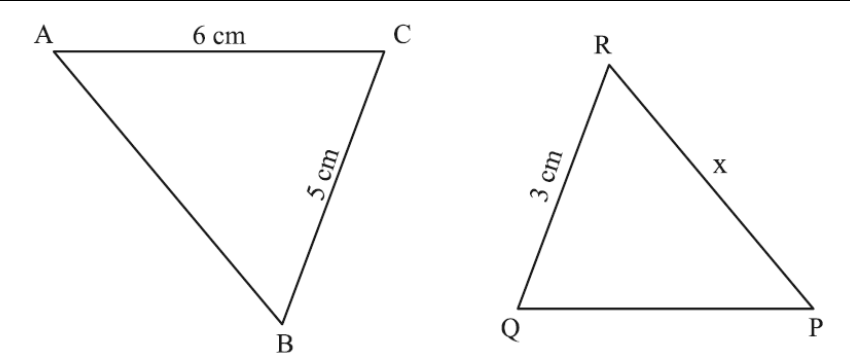
In the given figure, $\Delta ABC \sim \Delta QPR$. If $AC = 6$ cm, $BC = 5$ cm, $QR = 3$ cm and $PR = x$; then the value of $x$ is :
figure for this question
  • (a)$3.6$ cm
  • (b)$2.5$ cm
  • (c)$10$ cm
  • (d)$3.2$ cm
Show SolutionHide Solution
Sol. (b) $2.5$ cm
511 Mark · March 2023 · Standardopen ↗
In $\triangle ABC$ and $\triangle DEF$, $\frac{AB}{DE} = \frac{BC}{FD}$. Which of the following makes the two triangles similar?
  • (a)$\angle A = \angle D$
  • (b)$\angle B = \angle D$
  • (c)$\angle B = \angle E$
  • (d)$\angle A = \angle F$
Show SolutionHide Solution
(b) $\angle B = \angle D$
521 Mark · March 2023 · Standardopen ↗
If $\triangle PQR \sim \triangle ABC$; $PQ = 6$ cm, $AB = 8$ cm and the perimeter of $\triangle ABC$ is $36$ cm, then the perimeter of $\triangle PQR$ is
  • (a)$20.25$ cm
  • (b)$48$ cm
  • (c)$27$ cm
  • (d)$64$ cm
Show SolutionHide Solution
(B) $27$ cm
531 Mark · July 2024 · Standardopen ↗
In two $\triangle$s ABC and PQR, if $\frac{AB}{QR} = \frac{BC}{QP} = \frac{AC}{PR}$, then
  • (a)$\triangle PQR \sim \triangle CAB$
  • (b)$\triangle PQR \sim \triangle ABC$
  • (c)$\triangle PQR \sim \triangle CBA$
  • (d)$\triangle PQR \sim \triangle BCA$
Show SolutionHide Solution
Sol. (C) $\triangle PQR \sim \triangle CBA$
541 Mark · March 2024 · Standardopen ↗
The perimeters of two similar triangles $ABC$ and $PQR$ are $56$ cm and $48$ cm respectively. $PQ/AB$ is equal to
  • (a)$\frac{7}{8}$
  • (b)$\frac{6}{7}$
  • (c)$\frac{7}{6}$
  • (d)$\frac{8}{7}$
Show SolutionHide Solution
(B) $\frac{6}{7}$
551 Mark · March 2024 · Standardopen ↗
In $\triangle ABC$, $DE \parallel BC$ (as shown in the figure). If $AD = 2 \text{ cm}$, $BD = 3 \text{ cm}$, $BC = 7.5 \text{ cm}$, then the length of $DE$ (in cm) is:
figure for this question
  • (a)$2.5$
  • (b)$3$
  • (c)$5$
  • (d)$6$
Show SolutionHide Solution
(B) $3$
561 Mark · March 2024 · Standardopen ↗
In $\triangle ABC$, $DE \parallel BC$ (as shown in the figure). If $AD = 4$ cm, $AB = 9$ cm and $AC = 13.5$ cm, then the length of $EC$ is :
  • (a)$6$ cm
  • (b)$7.5$ cm
  • (c)$9$ cm
  • (d)$5.7$ cm
Show SolutionHide Solution
(B) $7.5$ cm
571 Mark · March 2024 · Standardopen ↗
At some time of the day, the length of the shadow of a tower is equal to its height. Then, the Sun's altitude at that time is :
  • (a)$30^\circ$
  • (b)$45^\circ$
  • (c)$60^\circ$
  • (d)$90^\circ$
Show SolutionHide Solution
(B) $45^\circ$
581 Mark · March 2024 · Standardopen ↗
If in the given figure, $\angle C = \angle D = 90^\circ$, $\angle B = 60^\circ$ and AP = $3$ cm, then the area of the shaded region is :
  • (a)$3\pi$ cm$^2$
  • (b)$6\pi$ cm$^2$
  • (c)$7\pi$ cm$^2$
  • (d)$9\pi$ cm$^2$
Show SolutionHide Solution
(A) $3\pi$ cm$^2$
591 Mark · March 2024 · Standardopen ↗
If in triangles ABC and PQR, $\frac{AB}{QR} = \frac{BC}{PR}$, then they will be similar, when :
  • (a)$\angle B = \angle Q$
  • (b)$\angle A = \angle R$
  • (c)$\angle B = \angle R$
  • (d)$\angle C = \angle Q$
Show SolutionHide Solution
(C) $\angle B = \angle R$
601 Mark · July 2025 · Standardopen ↗
Raina is $1.5$ m tall. At an instant, his shadow is $1.8$ m long. At the same instant, the shadow of a pole is $9$ m long. How tall is the pole?
  • (a)$6.5$ m
  • (b)$7.5$ m
  • (c)$8.5$ m
  • (d)$6.2$ m
Show SolutionHide Solution
(B) $7.5$ cm
611 Mark · July 2025 · Standardopen ↗
In the given figure, $\triangle ABC$ and $\triangle PQR$ will be similar, if :
figure for this question
  • (a)Length of side BC is $4\sqrt{2}$ cm
  • (b)Measure of $\angle A$ is $35^{\circ}$
  • (c)BC : RQ = 2 : 1
  • (d)Measure of $\angle A$ is $110^{\circ}$
Show SolutionHide Solution
(D) Measure of $\angle A$ is $110^{\circ}$
621 Mark · July 2025 · Standardopen ↗
The perimeters of two similar triangles are $25$ cm and $15$ cm respectively. If one side of the first triangle is $9$ cm, then the length of the corresponding side of the second triangle is :
  • (a)$5.4$ cm
  • (b)$6.8$ cm
  • (c)$2.5$ cm
  • (d)$4$ cm
Show SolutionHide Solution
(A) $5.4$ cm
631 Mark · March 2025 · Standardopen ↗
In triangles $ABC$ and $DEF$, $\angle B = \angle E$, $\angle F = \angle C$ and $AB = 3 DE$. Then, the two triangles are:
  • (a)congruent but not similar
  • (b)congruent as well as similar
  • (c)neither congruent nor similar
  • (d)similar but not congruent
Show SolutionHide Solution
(D) similar but not congruent
641 Mark · March 2025 · Standardopen ↗
If in two triangles $\triangle DEF$ and $\triangle PQR$, $\angle D = \angle Q$ and $\angle R = \angle E$, then which of the following is
textbf{not} true ?
  • (a)$\frac{DE}{QR} = \frac{DF}{PQ}$
  • (b)$\frac{EF}{PR} = \frac{DF}{PQ}$
  • (c)$\frac{EF}{RP} = \frac{DE}{QR}$
  • (d)$\frac{DE}{PQ} = \frac{EF}{RP}$
Show SolutionHide Solution
Sol. (D) $\frac{DE}{PQ} = \frac{EF}{RP}$
651 Mark · March 2025 · Standardopen ↗
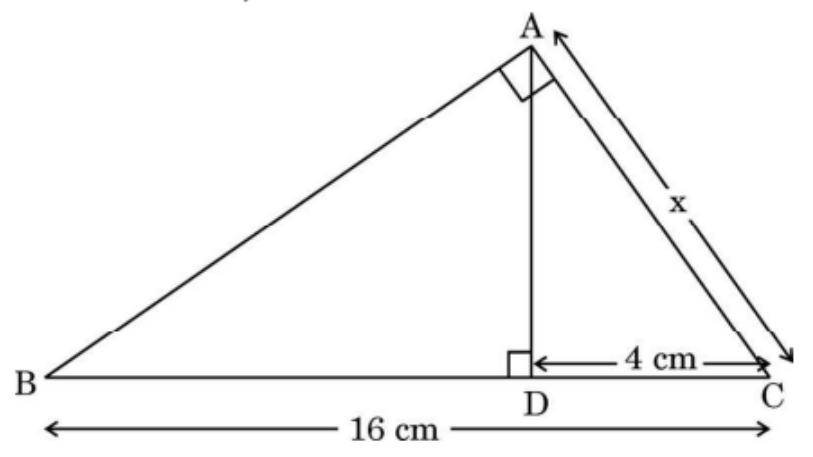
In the given figure, in $\triangle ABC$, $AD \perp BC$ and $\angle BAC = 90^{\circ}$. If $BC = 16 \operatorname{cm}$ and $DC = 4 \operatorname{cm}$, then the value of $x$ is :
figure for this question
  • (a)$4 \operatorname{cm}$
  • (b)$5 \operatorname{cm}$
  • (c)$8 \operatorname{cm}$
  • (d)$3 \operatorname{cm}$
Show SolutionHide Solution
Sol. (C) $8 \operatorname{cm}$
661 Mark · March 2025 · Standardopen ↗
If in two triangles $\triangle DEF$ and $\triangle PQR$, $\angle D = \angle Q$ and $\angle R = \angle E$, then which of the following is not true?
  • (a)$\frac{DE}{QR} = \frac{DF}{PQ}$
  • (b)$\frac{EF}{PR} = \frac{DF}{PQ}$
  • (c)$\frac{EF}{RP} = \frac{DE}{QR}$
  • (d)$\frac{DE}{PQ} = \frac{EF}{RP}$
Show SolutionHide Solution
Sol. (D)$\frac{DE}{PQ} = \frac{EF}{RP}$
671 Mark · March 2025 · Standardopen ↗
Given $\Delta ABC \sim \Delta PQR$, $\angle A = 30^\circ$ and $\angle Q = 90^\circ$. The value of $(\angle R + \angle B)$ is
  • (a)$90^\circ$
  • (b)$120^\circ$
  • (c)$150^\circ$
  • (d)$180^\circ$
Show SolutionHide Solution
(C) $150^\circ$
681 Mark · March 2025 · Standardopen ↗
If $\Delta PQR \sim \Delta PQR$ such that $AB = 6$ cm, $AC = 7$ cm, $QR = 15$ cm and $PQ = 12$ cm, then the sum of lengths of $BC$ and $PR$ is
  • (a)$44$ cm
  • (b)$21.5$ cm
  • (c)$21$ cm
  • (d)$29.5$ cm
Show SolutionHide Solution
(B) $21.5$ cm
2 Marks Questions
692 Marks · July 2023 · Standardopen ↗
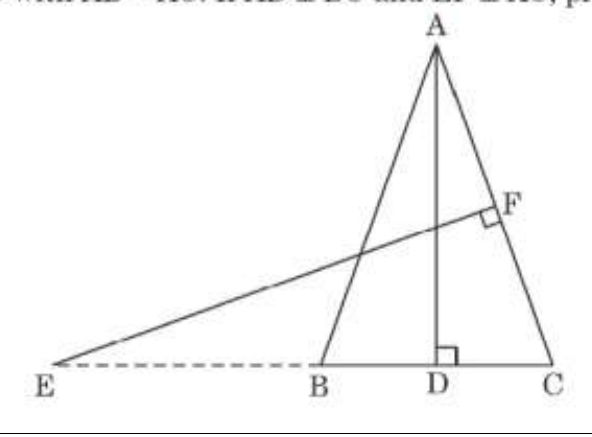
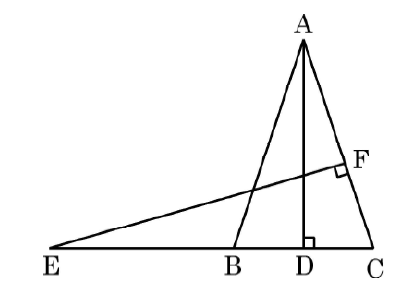
In the figure, E is a point on side CB produced of an isosceles triangle ABC with AB = AC. If AD $\perp$ BC and EF $\perp$ AC, prove that $\triangle ABD \sim \triangle ECF$.
figure for this question
Show SolutionHide Solution
In $\triangle ABC$, $AB = AC$ (Given)
$\therefore \angle ACB = \angle ABC$ ----- (1)
In $\triangle ABD$ and $\triangle ECF$
$\angle ADB = \angle EFC$ (each $90^\circ$)
$\angle ABD = \angle ACD$ (from (1))
$\therefore \triangle ABD \sim \triangle ECF$ (AA rule)
702 Marks · July 2023 · Standardopen ↗
In the given figure, $\frac{AO}{OC} = \frac{BO}{OD} = \frac{1}{2}$ and AB = $5$ cm. Find the length of DC.
figure for this question
Show SolutionHide Solution
Sol. In $\triangle AOB$ and $\triangle COD$
$\frac{AO}{OC} = \frac{BO}{OD}$ (Given)
$\angle AOB = \angle COD$ (V.O.A.)
$\therefore \triangle AOB \sim \triangle COD$ (SAS rule) (1 Mark)
$\frac{AO}{OC} = \frac{AB}{CD}$ (C.P.S.T.)
$\frac{1}{2} = \frac{5}{CD}$
$\Rightarrow CD = 10$ cm (1 Mark)
712 Marks · March 2024 · Standardopen ↗
In $\triangle ABC$, altitudes AD and BE are drawn. If AD = 7 cm, BE = 9 cm and EC = 12 cm then, find the length of CD.
figure for this question
Show SolutionHide Solution
$\triangle BEC \sim \triangle ADC$
$\Rightarrow \frac{BE}{AD} = \frac{EC}{CD}$
$\Rightarrow CD = \frac{12\times7}{9} = \frac{28}{3} \text{ or } 9.33 \text{ cm}$
722 Marks · March 2024 · Standardopen ↗
In the given figure, $\frac{EA}{EC} = \frac{EB}{ED}$, prove that $\triangle EAB \sim \triangle ECD$
figure for this question
Show SolutionHide Solution
In $\triangle EAB$ and $\triangle ECD$
$\frac{EA}{EC} = \frac{EB}{ED}$
$\angle AEB = \angle CED$
$\triangle EAB \sim \triangle ECD$
732 Marks · March 2024 · Standardopen ↗
In the given figure, $\triangle AHK \sim \triangle ABC$. If $AK = 8$ cm, $BC = 3.2$ cm and $HK = 6.4$ cm, then find the length of $AC$.
figure for this question
Show SolutionHide Solution
$\therefore \triangle AHK \sim \triangle ABC$ (given)
$$\begin{aligned}& \therefore \frac{HK}{BC} = \frac{AK}{AC} \\ & \Rightarrow \frac{6.4}{3.2} = \frac{8.0}{AC} \\ & AC = 4 \text{ cm}\end{aligned}$$
742 Marks · March 2024 · Standardopen ↗
In the given figure, $\Delta AHK \sim \Delta ABC$. If $AK = 8$ cm, $BC = 3.2$ cm and $HK = 6.4$ cm, then find the length of AC.
figure for this question
Show SolutionHide Solution
$\therefore \Delta AHK \sim \Delta ABC$ (given)
$$\begin{aligned}& \frac{HK}{BC} = \frac{AK}{AC} \\ & \frac{6.4}{3.2} = \frac{8.0}{AC} \\ & \Rightarrow AC = 4\end{aligned}$$ cm
752 Marks · March 2024 · Standardopen ↗
In a $\triangle ABC$, D and E are points on the sides AB and AC respectively such that BD = CE. If $\angle B = \angle C$, then show that DE $||$ BC.
Show SolutionHide Solution
In $\triangle ABC$, $$\begin{aligned}& \angle B = \angle C \\ & \Rightarrow AC = AB \dots (1) \\ & Given, BD = CE \dots (2) \\ & Subtract (2) from (1), we have \\ & AD = AE \dots (3) \\ & (3) \div (2)\end{aligned}$$, we have $$\begin{aligned}& \frac{AD}{BD} = \frac{AE}{CE} \\ & Therefore, DE \parallel BC\end{aligned}$$.
figure for this question
762 Marks · March 2024 · Standardopen ↗
If $\triangle ABC \sim \triangle DEF$ and AB = $4$ cm, DE = $6$ cm, EF = $9$ cm and FD = $12$ cm, find the perimeter of $\triangle ABC$.
Show SolutionHide Solution
Given, $$\begin{aligned}& \triangle ABC \sim \triangle DEF \\ & \therefore \frac{AB}{DE} = \frac{BC}{EF} = \frac{CA}{DF} \\ & \Rightarrow \frac{4}{6} = \frac{BC}{9} = \frac{CA}{12} \\ & \therefore BC = 6\end{aligned}$$ cm and CA = $8$ cm
Perimeter of $\triangle ABC = 4+6+8=18$ cm
772 Marks · July 2025 · Standardopen ↗
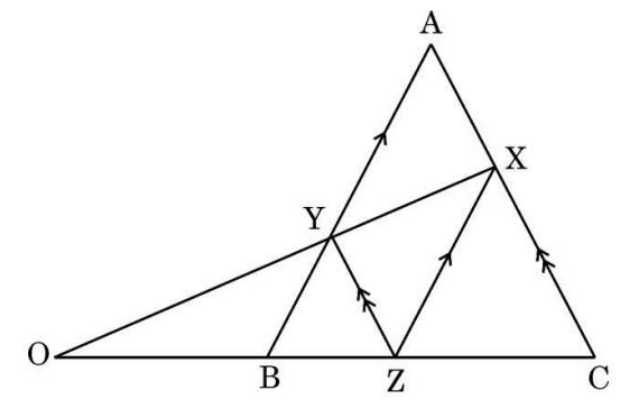
In the given figure, Z is a point on the side BC of $\triangle ABC$ such that XZ $||$ AB and YZ $||$ AC. If XY and CB produced meet at O, then prove that $ZO^2 = OB \times OC$.
figure for this question
Show SolutionHide Solution
In $\triangle OZX$, ZX $||$ BY (As XZ $||$ AB)
$\therefore \frac{OB}{OZ} = \frac{OY}{OX}$ --- (1)
In $\triangle OCX$, ZY $||$ CX (As YZ $||$ AC)
$\therefore \frac{OZ}{OC} = \frac{OY}{OX}$ --- (2)
Using (1) and (2), we get
$\frac{OB}{OZ} = \frac{OZ}{OC}$
$\Rightarrow OZ^2 = OB \times OC$
782 Marks · July 2025 · Standardopen ↗
S and T are points on sides PR and QR of $\triangle$ PQR such that $\angle P = \angle RTS$. Show that $\triangle$ RPQ $\sim \triangle$ RTS.
Show SolutionHide Solution
In $\triangle$ RPQ and $\triangle$ RTS,
$\angle P = \angle RTS$
$\angle PRT = \angle SRT$
$\therefore \triangle RPQ \sim \triangle RTS$
figure for this question
792 Marks · March 2025 · Standardopen ↗
If $\Delta ABC \sim \Delta PQR$ in which $AB = 6$ cm, $BC = 4$ cm, $AC = 8$ cm and $PR = 6$ cm, then find the length of $(PQ + QR)$.
Show SolutionHide Solution
$\frac{6}{PQ} = \frac{4}{QR} = \frac{8}{6} \implies PQ = \frac{9}{2}$ cm or $4.5$ cm and $QR = 3$ cm. $\therefore PQ + QR = 7.5$ cm.
802 Marks · March 2025 · Standardopen ↗
In the given figure, $\frac{QR}{QS} = \frac{QT}{PR}$ and $\angle 1 = \angle 2$, show that $\Delta PQS \sim \Delta TQR$.
figure for this question
Show SolutionHide Solution
In $\Delta PQR, \angle 1 = \angle 2 \implies PR = PQ$. $\therefore \frac{QR}{QS} = \frac{QT}{PR} \implies \frac{QR}{QS} = \frac{QT}{PQ}$. Also, $\angle 1 = \angle 1$. $\therefore \Delta PQS \sim \Delta TQR$.
812 Marks · March 2025 · Standardopen ↗
In the given figure, $\frac{\text{QR}}{\text{QS}} = \frac{\text{QT}}{\text{PR}}$ and $\angle 1 = \angle 2$, show that $\triangle$ PQS $\sim \triangle$ TQR.
figure for this question
Show SolutionHide Solution
In $\triangle$ PQR, $\angle 1 = \angle 2 \Rightarrow \text{PR} = \text{PQ}$ (1/2)
$\therefore \frac{\text{QR}}{\text{QS}} = \frac{\text{QT}}{\text{PR}} \Rightarrow \frac{\text{QR}}{\text{QS}} = \frac{\text{QT}}{\text{PQ}}$ (1/2)
Also, $\angle 1 = \angle 1$ (1/2)
$\therefore \triangle$ PQS $\sim \triangle$ TQR (1/2)
822 Marks · March 2025 · Standardopen ↗
OR
In the given figure, $\frac{QR}{QS} = \frac{QT}{PR}$ and $\angle 1 = \angle 2$, show that $\triangle PQS \sim \triangle TQR$.
figure for this question
Show SolutionHide Solution
In $\triangle PQR$, $\angle 1 = \angle 2 \therefore PR = PQ$
$\frac{QR}{QS} = \frac{QT}{PR} \Rightarrow \frac{QR}{QS} = \frac{QT}{PQ}$
Also, $\angle 1 = \angle 1$
$\therefore \triangle PQS \sim \triangle TQR$
832 Marks · March 2025 · Standardopen ↗
In the given figure, D is a point on the side BC of $\triangle ABC$ such that $\angle ADC = \angle BAC$. Show that $CA^2 = CD.CB$.
figure for this question
Show SolutionHide Solution
In $\triangle ACD$ and $\triangle BCA$
$\angle ADC = \angle BAC$
$\angle ACD = \angle BCA$
$\therefore \triangle ACD \sim \triangle BCA$
So, $\frac{CA}{CB} = \frac{CD}{CA}$
$\Rightarrow CA^2 = CD.CB$
842 Marks · March 2025 · Standardopen ↗
In the given figure, OA . OB = OC . OD. Show that $\angle A = \angle C$ and $\angle B = \angle D$.
figure for this question
Show SolutionHide Solution
Given OA.OB = OC.OD
$\frac{OA}{OC} = \frac{OD}{OB}$
$\& \angle AOD = \angle COB$
$\therefore \triangle AOD \sim \triangle COB$
So, $\angle D = \angle B$ and $\angle A = \angle C$
852 Marks · March 2025 · Standardopen ↗
In the given figure, $\frac{PS}{SQ} = \frac{PT}{TR}$ and $\angle PST = \angle PRQ$. Prove that $\triangle PQR$ is an isosceles triangle.
figure for this question
Show SolutionHide Solution
Given $\frac{PS}{SQ} = \frac{PT}{TR}$
$\Rightarrow ST || QR$ ($1$)
$\therefore \angle PST = \angle PQR$ ($1/2$)
and given, $\angle PST = \angle PRQ$
So, $\angle PQR = \angle PRQ$
$\therefore \triangle PQR$ is an isosceles triangle. ($1/2$)
862 Marks · March 2025 · Standardopen ↗
In the given figure, $\triangle ABE \cong \triangle ACD$. Prove that $\triangle ADE \sim \triangle ABC$.
figure for this question
Show SolutionHide Solution
Given $\triangle ABE \cong \triangle ACD$
$\therefore AE = AD$ or $AD = AE$ ---- (1) ($1/2$)
and $AB = AC$ ---- (2) ($1/2$)
Dividing (1) by (2), we have
$\frac{AD}{AB} = \frac{AE}{AC}$ ($1/2$)
and $\angle DAE = \angle BAC$
$\therefore \triangle ADE \sim \triangle ABC$ ($1/2$)
872 Marks · March 2025 · Standardopen ↗
A $1.5$ m tall boy is walking away from the base of a lamp post which is $12$ m high, at the speed of $2.5$ m/sec. Find the length of his shadow after $3$ seconds.
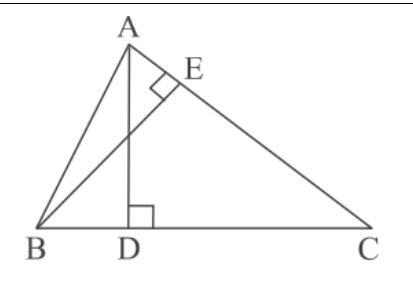
Show SolutionHide Solution
Let AB be the lamp post and CD be the boy $1.5$ m tall.
For correct figure
Let the length of shadow be $x$ m
Speed of boy = $2.5$ m/sec
$\therefore$ Distance covered in $3$ seconds = $7.5$ m
Now, $\triangle ABE \sim \triangle CDE$
$\frac{CD}{AB} = \frac{DE}{BE}$
$\frac{1.5}{12} = \frac{x}{7.5+x}$
Solving, we get $x = \frac{15}{14}$ or $1.07$ approx.
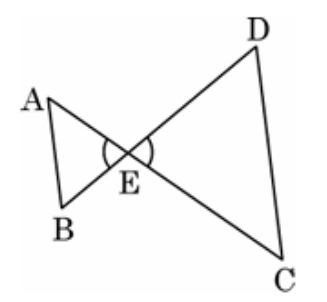
Hence length of shadow is $1.07$ m
figure for this question
882 Marks · March 2025 · Standardopen ↗
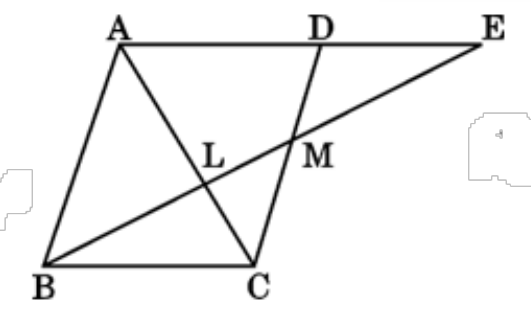
In parallelogram ABCD, side AD is produced to a point E and BE intersects CD at F. Prove that $\triangle ABE \sim \triangle CFB$
Show SolutionHide Solution
For correct figure
In $\triangle ABE$ and $\triangle CFB$,
$\angle AEB = \angle CBF$
$\angle A = \angle C$
$\therefore \triangle ABE \sim \triangle CFB$
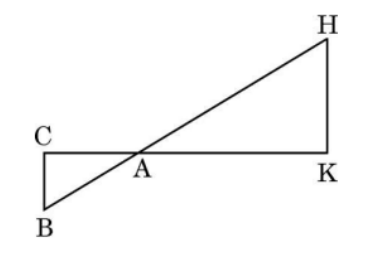
figure for this question
892 Marks · March 2025 · Standardopen ↗
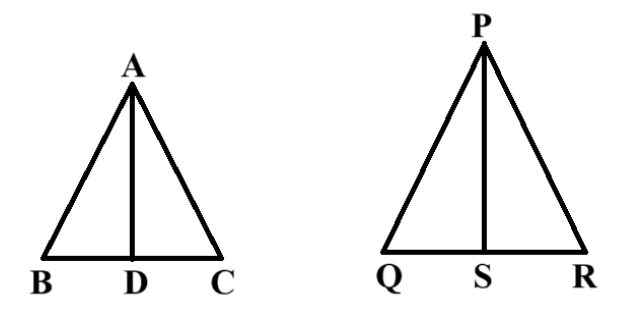
$AD$ and $PS$ are medians of triangles $ABC$ and $PQR$ respectively such that $\Delta ABD \sim \Delta PQS$. Prove that $\Delta ABC \sim \Delta PQR$.
Show SolutionHide Solution
Correct figure
Since $\Delta ABD \sim \Delta PQS$
$\therefore \frac{AB}{PQ} = \frac{BD}{QS}$ or $\frac{AB}{PQ} = \frac{2BD}{2QS}$
$\implies \frac{AB}{PQ} = \frac{BC}{QR}$
$\angle B = \angle Q$
$\therefore \Delta ABC \sim \Delta PQR$
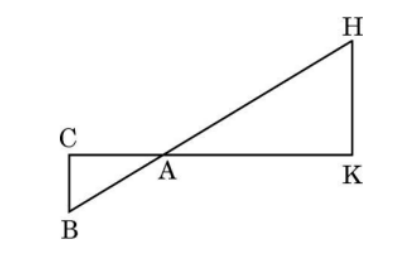
figure for this question
902 Marks · March 2025 · Standardopen ↗
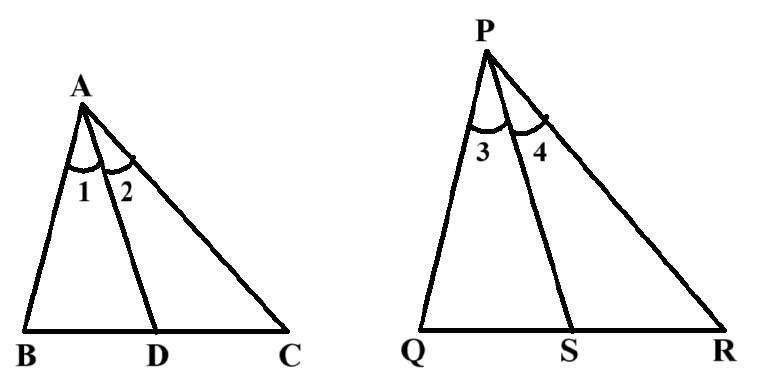
AD and PS are angle bisectors of $\angle A$ and $\angle P$ of triangles ABC and PQR. If $\Delta ABC \sim \Delta PQR$, prove that $\Delta ACD \sim \Delta PRS$.
Show SolutionHide Solution
Correct figure
$\Delta ABC \sim \Delta PQR$
$\therefore \angle BAC = \angle QPR$
$\implies \frac{1}{2} \angle BAC = \frac{1}{2} \angle QPR$
$\implies \angle 2 = \angle 4$ and $\angle C = \angle R$
$\therefore \Delta ACD \sim \Delta PRS$
figure for this question
912 Marks · March 2025 · Standardopen ↗
In $\Delta ABC$ and $\Delta PQR$, AD and PS are altitudes such that $\Delta ABD \sim \Delta PQS$ and $\Delta ACD \sim \Delta PRS$. Prove that $\Delta ABC \sim \Delta PQR$.
Show SolutionHide Solution
Correct figure
$\Delta ABD \sim \Delta PQS \implies \angle B = \angle Q$ --- (1)
$\Delta ACD \sim \Delta PRS \implies \angle C = \angle R$ --- (2)
From (1) & (2), we get $\Delta ABC \sim \Delta PQR$
figure for this question
922 Marks · March 2025 · Standardopen ↗
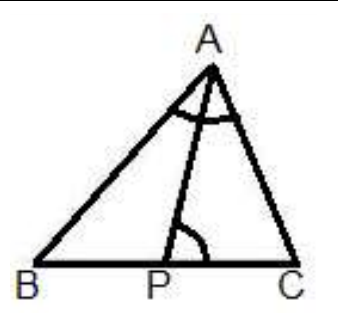
$P$ is a point on the side $BC$ of $\Delta ABC$ such that $\angle APC = \angle BAC$. Prove that $AC^2 = BC \cdot CP$.
Show SolutionHide Solution
Correct figure ($\frac{1}{2}$ mark). $\angle APC = \angle BAC$, $\angle ACP = \angle ACB$ (1 mark). $\therefore \Delta APC \sim \Delta BAC$. $AC^2 = BC \cdot CP$ ($\frac{1}{2}$ mark).
figure for this question
932 Marks · March 2025 · Standardopen ↗
In the adjoining figure, $\frac{AD}{BD} = \frac{AE}{EC}$ and $\angle BDE = \angle CED$, prove that $\Delta ABC$ is an isosceles triangle.
figure for this question
Show SolutionHide Solution
$\frac{AD}{DB} = \frac{AE}{EC} \Rightarrow DE \parallel BC$
$\angle BDE + \angle DBC = \angle CED + \angle BCE$
$\angle DBC = \angle BCE$ or $\angle B = \angle C$
Thus $\Delta ABC$ is an isosceles triangle.
3 Marks Questions
943 Marks · July 2023 · Standardopen ↗
Sides AB and BC and the median AD of a triangle AВС are respectively proportional to the sides PQ and QR and the median PM of $\triangle PQR$. Show that $\triangle ABC \sim \triangle PQR$.
Show SolutionHide Solution
Given $\frac{AB}{PQ} = \frac{BC}{QR} = \frac{AD}{PM}$
Since AD and PM are medians, $BC = 2BD$ and $QR = 2QM$
So, $\frac{AB}{PQ} = \frac{2BD}{2QM} = \frac{AD}{PM} \Rightarrow \frac{AB}{PQ} = \frac{BD}{QM} = \frac{AD}{PM}$
Therefore, $\triangle ABD \sim \triangle PQM$ (SSS similarity criterion)
$\Rightarrow \angle B = \angle Q$ (Corresponding angles of similar triangles)
Now, in $\triangle ABC$ and $\triangle PQR$
$\frac{AB}{PQ} = \frac{BC}{QR}$ (Given)
$\angle B = \angle Q$ (Proved above)
Therefore, $\triangle ABC \sim \triangle PQR$ (SAS similarity criterion)
figure for this question
953 Marks · March 2023 · Standardopen ↗
In the given figure, $CD$ is the perpendicular bisector of $AB$. $EF$ is perpendicular to $CD$. $AE$ intersects $CD$ at $G$. Prove that $\frac{CF}{CD} = \frac{FG}{DG}$.
figure for this question
Show SolutionHide Solution
$\triangle EFG \sim \triangle ADG$
$\Rightarrow \frac{EF}{AD} = \frac{FG}{DG}$
quad (i)
$\triangle EFC \sim \triangle BDC$
$\Rightarrow \frac{EF}{BD} = \frac{CF}{CD}$
$\Rightarrow \frac{EF}{AD} = \frac{CF}{CD}$
quad $\{BD = AD\}$
quad (ii)
Using (i) and (ii)
$\frac{FG}{DG} = \frac{CF}{CD}$
963 Marks · March 2023 · Standardopen ↗
In the given figure, $E$ is a point on the side $CB$ produced of an isosceles triangle $ABC$ with $AB = AC$. If $AD \perp BC$ and $EF \perp AC$, then prove that $\triangle ABD \sim \triangle ECF$.
figure for this question
Show SolutionHide Solution
$ABC$ is an isosceles triangle
$\therefore AB = AC \Rightarrow \angle B = \angle C$
In $\triangle ABD$ and $\triangle ECF$,
$\angle ADB = \angle EFC$
$\angle ABD = \angle ECF$
$\therefore \triangle ABD \sim \triangle ECF$
4 Marks Questions
974 Marks · March 2023 · Standardopen ↗
PA, QB and RC are each perpendicular to AC. If AP = $x$, QB = $z$, RC = $Y$, AB = $a$ and BC = $b$, then prove that $\frac{1}{x} + \frac{1}{y} = \frac{1}{z}$
figure for this question
Show SolutionHide Solution
(a)$\triangle CQB \sim \triangle CPA$
$\Rightarrow \frac{b}{a + b} = \frac{z}{x}$ (i)
Also $\triangle AQB \sim \triangle ARC$
$\Rightarrow \frac{a}{a + b} = \frac{z}{y}$ (ii)
from (i) and (ii) $\frac{z}{x} + \frac{z}{y} = \frac{a + b}{a + b} = 1$
$\Rightarrow \frac{1}{x} + \frac{1}{y} = \frac{1}{z}$
984 Marks · March 2023 · Standardopen ↗
In the given figure, CD and RS are respectively the medians of $\triangle ABC$ and $\triangle PQR$. If $\triangle ABC \sim \triangle PQR$ then prove that:
(i) $\triangle ADC\sim\triangle PSR$
(ii) $AD \times PR = AC \times PS$
figure for this question
Show SolutionHide Solution
(i) $\triangle ABC \sim \triangle PQR$
$\angle A=\angle P$
and $\frac{AB}{PQ} = \frac{AC}{PR}$
$\Rightarrow \frac{2AD}{2PS} = \frac{AC}{PR}$
$\Rightarrow \frac{AD}{PS} = \frac{AC}{PR}$ and $\angle A = \angle P$
Therefore $\triangle ADC \sim \triangle PSR$
(ii)Hence $\frac{AD}{PS} = \frac{AC}{PR}$
$\Rightarrow AD \times PR = AC \times PS$
994 Marks · July 2025 · Standardopen ↗
Case Study – 2
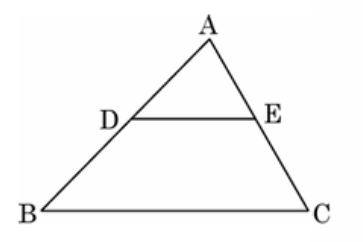
On a road leading to a school, there is a triangle (ABC) shaped board on the road. It is divided into two parts by a line DE, which is parallel to BC. On the upper part, it is written ‘DRIVE SLOW' and on the lower part it is written, ‘SCHOOL AHEAD'.
Based on the information given above, answer the following questions :
(i) If AD = $3$ cm, BD = $5$ cm and AE = $4$ cm, then find the length of AC.
(ii) If $\angle$ ADE = $50^{\circ}$ and $\angle$ DAE = $45^{\circ}$, then find $\angle$ ACB.
(iii) (a) If AD = $4$ cm and BD = $6$ cm, then find $\frac{DE}{BC}$.
OR
(iii) (b) If AD = $3$ cm, BD = $6$ cm and AE = $5$ cm, then find $\frac{AB}{AC}$.
Show SolutionHide Solution
(i) $\frac{3}{3+5} = \frac{4}{AC}$
$\Rightarrow AC = \frac{32}{3}$ cm
(ii) $\angle ACB = \angle AED = 180^{\circ} – (50^{\circ} + 45^{\circ}) = 85^{\circ}$
(iii) (a) $\triangle ADE \sim \triangle ABC$
$\therefore \frac{DE}{BC} = \frac{AD}{AB} = \frac{4}{10}$ or $\frac{2}{5}$
OR
(b) DE $||$ BC
$\therefore \frac{3}{6} = \frac{5}{EC} \Rightarrow EC = 10$
$\frac{AB}{AC} = \frac{3+6}{5+10} = \frac{9}{15}$ or $\frac{3}{5}$
5 Marks Questions
1005 Marks · March 2023 · Standardopen ↗
Sides $AB$ and $AC$ and median $AM$ of a $\triangle ABC$ are proportional to sides $DE$ and $DF$ and median $DN$ of another $\triangle DEF$. Show that $\triangle ABC \sim \triangle DEF$
Show SolutionHide Solution
1 mark for figure
Extend $AM$ to $A'$ so that $AM = A'M$ and $DN$ to $D'$ so that $DN = D'N$. Join $A'C$ and $D'F$.
$$\begin{aligned}& \triangle AMB \sim \triangle A'MC \\ & \Rightarrow AB = A'C\end{aligned}$$.
Similarly, $$\begin{aligned}& DE = D'F \\ & \text{Given } \frac{AB}{DE} = \frac{AC}{DF} = \frac{AM}{DN} \\ & \Rightarrow \frac{AC}{DF} = \frac{A'C}{D'F} = \frac{AA'/2}{DD'/2} \\ & \therefore \triangle AA'C \sim \triangle DD'F \\ & \therefore \angle 1 = \angle 2 \\ & \text{Similarly, } \angle 3 = \angle 4 \\ & \Rightarrow \angle 1 + \angle 3 = \angle A = \angle 2 + \angle 4 = \angle D \\ & \text{Hence } A ABC \sim \triangle DEF \text{ (SAS)}\end{aligned}$$
figure for this question
1015 Marks · March 2023 · Standardopen ↗
Sides AB and BC and median AD of a triangle ABC are respectively proportional to sides PQ and QR and median PM of $\triangle PQR$. Show that $\triangle ABC \sim \triangle PQR$.
Show SolutionHide Solution
In $\triangle ABC$ and $\triangle PQR$
$\frac{AB}{PQ} = \frac{BC}{QR} = \frac{AD}{PM}$
$\frac{AB}{PQ} = \frac{2 BD}{2 QM} = \frac{AD}{PM}$
($\therefore$ D is midpoint of BC and M is midpoint of QR)
$\frac{AB}{PQ} = \frac{BD}{QM} = \frac{AD}{PM} \Rightarrow \triangle ABD \sim \triangle PQM$
$\Rightarrow \angle B = \angle Q$ -(i)
Now, In $\triangle ABC$ and $\triangle PQR$
$\frac{AB}{PQ} = \frac{BC}{QR}$ (given)
$\angle B = \angle Q$ from (i)
$\therefore \triangle ABC \sim \triangle PQR$
figure for this question
1025 Marks · March 2023 · Standardopen ↗
D is a point on the side BC of a triangle ABC such that $\angle ADC = \angle BAC$, prove that $CA^2 = CB.CD$
Show SolutionHide Solution
Sol.
In $\Delta ABC$, D is a point on side BC such that $\angle ADC = \angle BAC$
In $\Delta CBA$ and $\Delta CDA$
$\angle C = \angle C$ (common)
$\angle BAC = \angle ADC$ (given)
$\therefore \Delta CBA \sim \Delta CAD$ (By AA similarity)
$\therefore$ their corresponding sides are proportional
$\frac{CB}{CA} = \frac{CA}{CD} \Rightarrow CA^2 = CB. CD$
figure for this question
1035 Marks · March 2023 · Standardopen ↗
If AD and PM are medians of triangles ABC and PQR, respectively where $\Delta ABC \sim \Delta PQR$, prove that $\frac{AB}{PQ} = \frac{AD}{PM}$
Show SolutionHide Solution
Sol.
AD and AM are medians of $\Delta ABC$ and $\Delta PQR$ respectively.
$\Delta ABC \sim \Delta PQR$
$\therefore \frac{AB}{PQ} = \frac{BC}{QR}$
$\frac{AB}{PQ} = \frac{2BD}{2QM}$
$\frac{AB}{PQ} = \frac{BD}{QM}$
Also $\angle B = \angle Q$ ($\Delta ABC \sim \Delta PQR$)
$\Rightarrow \Delta ABD \sim \Delta PQM$ (SAS similarly)
$\Rightarrow \frac{AB}{PQ} = \frac{AD}{PM}$
figure for this question
1045 Marks · March 2023 · Standardopen ↗
In a $\Delta PQR$, N is a point on PR, such that $QN \perp PR$. If $PN \times NR = QN^2$, prove that $\angle PQR = 90^\circ$.
Show SolutionHide Solution
$$\begin{aligned}& PN \times NR = QN^2 \\ & frac{PN}{QN} = \frac{QN}{NR} \\ & \angle PNQ = \angle QNR\end{aligned}$$ (each $90^\circ$)
$\Delta PNQ \sim \Delta QNR$ (SAS similarity)
$\Rightarrow \angle 2 = \angle P$ and $$\begin{aligned}& \angle 1 = \angle R \\ & Rightarrow \angle 1 + \angle 2 = \angle P + \angle R \\ & Rightarrow \angle PQR = \angle P + \angle R\end{aligned}$$In $\Delta PQR$, $$\begin{aligned}& \angle P + \angle PQR + \angle R = 180^\circ \\ & Rightarrow 2 \angle PQR = 180^\circ \Rightarrow \angle PQR = 90^\circ\end{aligned}$$
figure for this question
1055 Marks · July 2024 · Standardopen ↗
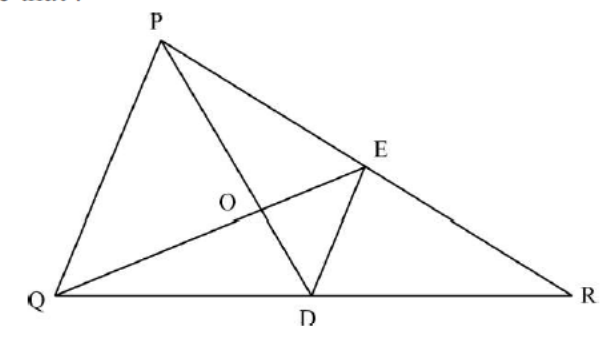
In the given figure, two medians PD and QE of $\triangle PQR$ meet each other at O. Prove that :
(i) $\triangle POQ \sim \triangle DOE$
(ii) $PO = 2OD$
(iii) $PO = \frac{2}{3} PD$
figure for this question
Show SolutionHide Solution
(i) As D and E are the mid-points of RQ and RP respectively.
By mid-point theorem, $ED \parallel PQ$ and $ED = \frac{1}{2} PQ$ ... (1)
$\Rightarrow \triangle POQ \sim \triangle DOE$
(ii) Using part (i), $\frac{PO}{OD} = \frac{PQ}{ED}$
Using (1), $PO = 2 OD$
(iii) Using part (ii), $PO = 2 OD = 2(PD – PO)$
$\Rightarrow 3PO = 2PD$
$\Rightarrow PO = \frac{2}{3} PD$
1065 Marks · March 2024 · Standardopen ↗
In the given figure PA, QB and RC are each perpendicular to AC. If AP = $x$, BQ = $y$ and CR = $z$, then prove that $\frac{1}{x} + \frac{1}{z} = \frac{1}{y}$.
figure for this question
Show SolutionHide Solution
Sol. $\triangle PAC \sim \triangle QBC$
$\therefore \frac{x}{y} = \frac{AC}{BC}$ or $\frac{y}{x} = \frac{BC}{AC}$ ----- (i)
$\triangle RCA \sim \triangle QBA$
$\therefore \frac{z}{y} = \frac{AC}{AB}$ or $\frac{y}{z} = \frac{AB}{AC}$ ----- (ii)
Adding (i) and (ii)
$\frac{y}{x} + \frac{y}{z} = \frac{BC+AB}{AC}$
$\Rightarrow y\left(\frac{1}{x} + \frac{1}{z}\right) = \frac{AC}{AC} = 1$
$\Rightarrow \frac{1}{x} + \frac{1}{z} = \frac{1}{y}$
1075 Marks · March 2024 · Standardopen ↗
Sides $AB$ and $AC$ and median $AD$ to $\triangle ABC$ are respectively proportional to sides $PQ$ and $PR$ and median $PM$ of another triangle $PQR$. Show that $\triangle ABC \sim \triangle PQR$.
Show SolutionHide Solution
Correct figure
Produce $AD$ to $E$ such that $AD = DE$ and join $EC$
Produce $PM$ to $N$ such that $PM = MN$ and join $NR$
$\triangle ADB \cong \triangle EDC$
$\therefore AB = EC$
Similarly, $PQ=NR$
Since, $\frac{AB}{PQ} = \frac{AC}{PR} = \frac{AD}{PM}$
$\Rightarrow \frac{EC}{NR} = \frac{AC}{PR} = \frac{AE}{PN}$
$\therefore \triangle AEC \sim \triangle PNR$
$\Rightarrow \angle 1 = \angle 2$
Similarly, $\angle 3 = \angle 4$
Hence $\angle 1 + \angle 3 = \angle 2 + \angle 4$ or $\angle A = \angle P$
Also, $\frac{AB}{PQ} = \frac{AC}{PR}$
$\therefore \triangle ABC \sim \triangle PQR$
figure for this question
1085 Marks · March 2024 · Standardopen ↗
In $\triangle$ABC, if AD $\perp$ BC and AD$^2$ = BD $\times$ DC, then prove that $\angle$BAC = $90^{\circ}$.
Show SolutionHide Solution
Sol.
Correct figure
AD$^2$ = BD $\times$ DC
$\frac{AD}{DC} = \frac{BD}{AD}$
$\triangle$ADB $\sim \triangle$CDA
$\angle$BAD = $\angle$ACD & $\angle$DAC = $\angle$DBA
In $\triangle$ABC
$\angle$ABC + $\angle$CAB + $\angle$BCA = $180^{\circ}$
$\angle$ABC + $\angle$BAD + $\angle$CAD + $\angle$BCA = $180^{\circ}$
$\angle$BAD + $\angle$CAD = $90^{\circ}$
$\angle$BAC = $90^{\circ}$
figure for this question
1095 Marks · March 2024 · Standardopen ↗
E is a point on the side AD produced of a parallelogram ABCD and BE intersects CD at F. Show that $\triangle ABE \sim \triangle CFB$.
Show SolutionHide Solution
Correct figure
In $\triangle ABE$ and $$\begin{aligned}& \triangle CFB \\ & \angle EAB = \angle BCF \\ & \angle AEB = \angle CBF \\ & \Rightarrow \triangle ABE \sim \triangle CFB\end{aligned}$$
figure for this question
1105 Marks · March 2024 · Standardopen ↗
Sides $AB$, $BC$ and the median $AD$ of $\triangle ABC$ are respectively proportional to sides $PQ$, $QR$ and the median $PM$ of another $\triangle PQR$. Prove that $\triangle ABC \sim \triangle PQR$.
Show SolutionHide Solution
Correct figure
$$\begin{aligned}& \therefore \frac{AB}{PQ} = \frac{BC}{QR} = \frac{AD}{PM} \\ & \therefore \frac{AB}{PQ} = \frac{2BD}{2QM} = \frac{AD}{PM} \\ & \Rightarrow \frac{AB}{PQ} = \frac{BD}{QM} = \frac{AD}{PM}-------(i) \\ & \Rightarrow \triangle ABD \sim \triangle PQM \\ & \Rightarrow \angle B = \angle Q_ -----(ii) \\ & \text{In } \triangle ABC \text{ and } \triangle PQR \\ & \frac{AB}{PQ} = \frac{BC}{QR} \\ & \angle B = \angle Q \\ & \therefore \triangle ABC \sim \triangle PQR\end{aligned}$$
figure for this question
1115 Marks · March 2024 · Standardopen ↗
E is a point on the side AD produced of a parallelogram ABCD and BE intersects CD at F. Show that $\triangle ABE \sim \triangle CFB$.
Show SolutionHide Solution
Correct figure
In $\triangle ABE$ and $\triangle CFB$
$\angle EAB = \angle BCF$
$\angle AEB = \angle CBF$
$\Rightarrow \triangle ABE \sim \triangle CFB$
figure for this question
1125 Marks · March 2024 · Standardopen ↗
Sides AB, BC and the median AD of $\triangle ABC$ are respectively proportional to sides PQ, QR and the median PM of another $\triangle PQR$. Prove that $\triangle ABC \sim \triangle PQR$.
Show SolutionHide Solution
Correct figure
$\therefore \frac{AB}{PQ} = \frac{BC}{QR} = \frac{AD}{PM}$
$\therefore \frac{AB}{PQ} = \frac{2BD}{2QM} = \frac{AD}{PM}$
$\Rightarrow \frac{AB}{PQ} = \frac{BD}{QM} = \frac{AD}{PM}$ ---------(i)
$\Rightarrow \triangle ABD \sim \triangle PQM$
$\Rightarrow \angle B = \angle Q$ ---------(ii)
In $\triangle ABC$ and $\triangle PQR$
$\frac{AB}{PQ} = \frac{BC}{QR}$
$\angle B = \angle Q$
$\therefore \triangle ABC \sim \triangle PQR$
figure for this question
1135 Marks · March 2024 · Standardopen ↗
In the given figure, $\triangle FEC = \triangle GDB$ and $\angle 1 = \angle 2$. Prove that $\triangle ADE \sim \triangle ABC$.
figure for this question
Show SolutionHide Solution
$\triangle FEC = \triangle GDB$
Therefore, $\angle 3 = \angle 4$
In $\triangle ABC$,
$\angle 3 = \angle 4$
$\therefore AB = AC ............(i)$
In $\triangle ADE$, $\angle 1 = \angle 2$
$AD = AE .............(ii)$
Dividing (ii) by (i)
$\frac{AD}{AB} = \frac{AE}{AC}$
$\Rightarrow DE \parallel BC$
$\angle 1 = \angle 3$ and $\angle 2 = \angle 4$
$\therefore \triangle ADE \sim \triangle ABC$
1145 Marks · March 2024 · Standardopen ↗
Sides AB and AC and median AD of a $\triangle ABC$ are respectively proportional to sides PQ and PR and median PM of another $\triangle PQR$. Show that $\triangle ABC \sim \triangle PQR$.
Show SolutionHide Solution
Correct figure
Produce AD to E such that $AD = DE$ and join EC.
Produce PM to L such that $PM = ML$ and join LR.
$\therefore \triangle ABD \cong \triangle ECD$
$\therefore AB = EC$
Similarly, $PQ = LR$
$\frac{AB}{PQ} = \frac{AC}{PR} = \frac{AD}{PM}$
$\frac{EC}{LR} = \frac{AC}{PR} = \frac{2AD}{2PM} = \frac{AE}{PL}$
$$\begin{aligned}& \therefore \triangle AEC \sim \triangle PLR \\ & \Rightarrow \angle 2 = \angle 4\end{aligned}$$
Similarly, $\angle 1 = \angle 3$
Adding both, $\angle BAC = \angle QPR$
$\therefore \triangle ABC \sim \triangle PQR$
figure for this question
1155 Marks · March 2025 · Standardopen ↗
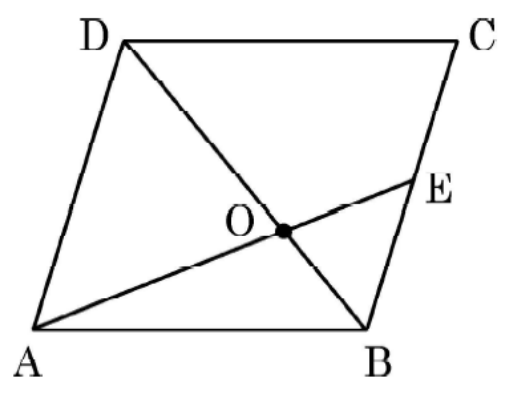
The diagonal $BD$ of a parallelogram $ABCD$ intersects the line segment $AE$ at the point $F$, where $E$ is any point on the side $BC$. Prove that $DF \times EF = FB \times FA$.
Show SolutionHide Solution
Correct figure. In $\Delta ADF$ and $\Delta EBF, \angle DFA = \angle EFB, \angle ADF = \angle FBE. \therefore \Delta ADF \sim \Delta EBF \implies \frac{DF}{FB} = \frac{FA}{EF} \implies DF \times EF = FB \times FA$.
figure for this question
1165 Marks · March 2025 · Standardopen ↗
In $\Delta ABC$, if $AD \perp BC$ and $AD^2 = BD \times DC$, then prove that $\angle BAC = 90^\circ$.
Show SolutionHide Solution
Correct figure. $AD^2 = BD \times DC \implies \frac{AD}{DC} = \frac{BD}{AD}$. Also, $\angle ADB = \angle ADC. \therefore \Delta DBA \sim \Delta DAC \implies \angle DBA = \angle DAC$ and $\angle BAD = \angle DCA$. Adding both, $\angle DBA + \angle DCA = \angle DAC + \angle BAD \implies \angle BAC = 90^\circ$.
figure for this question
1175 Marks · March 2025 · Standardopen ↗
Prove that a line drawn parallel to one side of a triangle to intersect the other two sides in distinct points divides the other two sides in the same ratio. Hence, in the figure given below, prove that $\frac{AM}{MB} = \frac{AN}{ND}$ where LM $||$ CB and LN $||$ CD.
figure for this question
Show SolutionHide Solution
Correct figure, given, to prove and construction
Correct proof
In $\triangle ABC$, LM $||$ CB
$\frac{AM}{MB} = \frac{AL}{LC}$ --- (1)
In $\triangle ADC$, LN $||$ CD
$\frac{AN}{ND} = \frac{AL}{LC}$ --- (2)
from (1) and (2), we have
$\frac{AM}{MB} = \frac{AN}{ND}$
1185 Marks · March 2025 · Standardopen ↗
In the given figure, PA, QB and RC are perpendicular to AC. If $PA = x$ units, $QB = y$ units and $RC = z$ units, prove that $\frac{1}{x} + \frac{1}{z} = \frac{1}{y}$.
figure for this question
Show SolutionHide Solution
Sol. $\triangle ABQ \sim \triangle ACR$
$\frac{AB}{AC} = \frac{QB}{RC} = \frac{y}{z}$ ... (i)
Similarly, $\triangle CBQ \sim \triangle CAP$
$\frac{BC}{AC} = \frac{QB}{PA} = \frac{y}{x}$ ... (ii)
On adding (i) & (ii), we get
$\frac{AB}{AC} + \frac{BC}{AC} = \frac{y}{z} + \frac{y}{x}$
$\frac{AB+BC}{AC} = y(\frac{1}{z} + \frac{1}{x})$
$\frac{AC}{AC} = y(\frac{1}{z} + \frac{1}{x})$
$1 = y(\frac{1}{z} + \frac{1}{x})$
$\therefore \frac{1}{y} = \frac{1}{x} + \frac{1}{z}$
1195 Marks · March 2025 · Standardopen ↗
Sides AB and BC and median AD of triangle ABC are respectively proportional to sides PQ and QR and median PM of $\triangle PQR$. Show that $\triangle ABC \sim \triangle PQR$.
Show SolutionHide Solution
Sol. Correct figure
In $\triangle ABD$ and $\triangle PQM$
$\frac{AB}{PQ} = \frac{BC}{QR} = \frac{AD}{PM}$ (given)
$\frac{AB}{PQ} = \frac{2BD}{2QM} = \frac{AD}{PM}$
$\frac{AB}{PQ} = \frac{BD}{QM} = \frac{AD}{PM}$
$\therefore \triangle ABD \sim \triangle PQM$
$\therefore \angle B = \angle Q$
In $\triangle ABC$ and $\triangle PQR$
$\frac{AB}{PQ} = \frac{BC}{QR}$ and $\angle B = \angle Q$
$\triangle ABC \sim \triangle PQR$
figure for this question
1205 Marks · March 2025 · Standardopen ↗
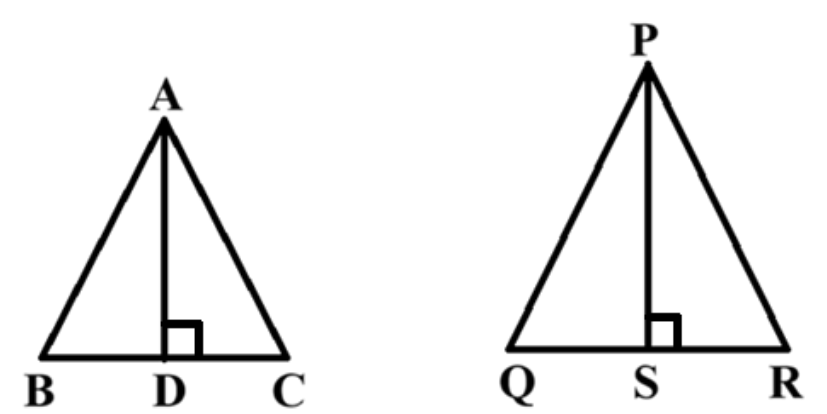
The corresponding sides of $\triangle ABC$ and $\triangle PQR$ are in the ratio $3 : 5$. AD$\perp$BC and PS$\perp$QR as shown in the following figures :
(i) Prove that $\triangle ADC \sim \triangle PSR$
(ii) If $AD = 4$ cm, find the length of PS.
(iii) Using (ii) find ar ($\triangle ABC$) : ar ($\triangle PQR$)
figure for this question
Show SolutionHide Solution
As, $\frac{AB}{PQ} = \frac{BC}{QR} = \frac{AC}{PR} = \frac{3}{5}$
$\Rightarrow \triangle ABC \sim \triangle PQR$
$\angle C = \angle R$
(i) In $\triangle ADC$ and $\triangle PSR$,
$\angle ADC = \angle PSR$
and $\angle C = \angle R$
$\therefore \triangle ADC \sim \triangle PSR$
(ii) $\frac{AD}{PS} = \frac{AC}{PR} = \frac{3}{5}$
$\Rightarrow \frac{4}{PS} = \frac{3}{5}$
$\Rightarrow PS = \frac{20}{3}$ cm
(iii) $\frac{\text{ar (}\triangle ABC)}{\text{ar (}\triangle PQR)} = \frac{\frac{1}{2}\times BC\times AD}{\frac{1}{2}\times QR\times PS}$
$= \frac{3}{5} \times \frac{3}{5} = \frac{9}{25}$
$\therefore$ ar ($\triangle ABC$): ar ($\triangle PQR$) = $9 : 25$
1215 Marks · March 2025 · Standardopen ↗
State basic proportionality theorem.
Use it to prove the following :
If three parallel lines $l, m, n$ are intersected by transversals $q$ and $s$ as shown in the adjoining figure, then $\frac{AB}{BC} = \frac{DE}{EF}$.
figure for this question
Show SolutionHide Solution
Correct statement
Join AF intersecting line $m$ at G
In $\triangle ACF$, BG $||$ CF
$\Rightarrow \frac{AB}{BC} = \frac{AG}{GF}$ ...(i)
In $\triangle FDA$, GE $||$ AD
$\Rightarrow \frac{EF}{DE} = \frac{GF}{AG}$ or $\frac{DE}{EF} = \frac{AG}{GF}$ ...(ii)
From, (i) and (ii), we get $\frac{AB}{BC} = \frac{DE}{EF}$
figure for this question
1225 Marks · March 2025 · Standardopen ↗
The corresponding sides of $\Delta ABC$ and $\Delta PQR$ are in the ratio $3 : 5$. $AD \perp BC$ and $PS \perp QR$ as shown in the following figures : (i) Prove that $\Delta ADC \sim \Delta PSR$ (ii) If $AD = 4$ cm, find the length of $PS$. (iii) Using (ii) find $ar (\Delta ABC) : ar (\Delta PQR)$
figure for this question
Show SolutionHide Solution
As, $\frac{AB}{PQ} = \frac{BC}{QR} = \frac{AC}{PR} = \frac{3}{5}$
$\implies \Delta ABC \sim \Delta PQR \implies \angle C = \angle R$
(i) In $\Delta ADC$ and $\Delta PSR, \angle ADC = \angle PSR = 90^{\circ}$ and $\angle C = \angle R \implies \Delta ADC \sim \Delta PSR$
(ii) $\frac{AD}{PS} = \frac{AC}{PR} = \frac{3}{5} \implies \frac{4}{PS} = \frac{3}{5} \implies PS = \frac{20}{3}$ cm
(iii) $\frac{ar (\Delta ABC)}{ar (\Delta PQR)} = \frac{\frac{1}{2} \times BC \times AD}{\frac{1}{2} \times QR \times PS} = \frac{3}{5} \times \frac{3}{5} = \frac{9}{25} \implies ar (\Delta ABC) : ar (\Delta PQR) = 9 : 25$
1235 Marks · March 2025 · Standardopen ↗
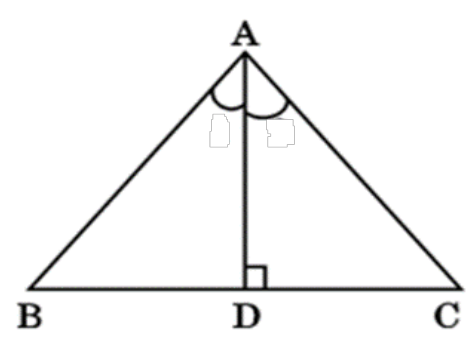
In the adjoining figure, $\Delta CAB$ is a right triangle, right angled at $A$ and $AD \perp BC$. Prove that $\Delta ADB \sim \Delta CDA$. Further, if $BC = 10$ cm and $CD = 2$ cm, find the length of $AD$.
figure for this question
Show SolutionHide Solution
$\Delta ABC \sim \Delta DAC$ (1 mark). Similarly, $\Delta ABC \sim \Delta DBA$ ($\frac{1}{2}$ mark). From equations ① and ②, $\Delta DAC \sim \Delta DBA$ or $\Delta ADB \sim \Delta CDA$ (1 mark). $\frac{AD}{CD} = \frac{BD}{AD}$ ($\frac{1}{2}$ mark). $AD^2 = BD \times CD = 8 \times 2$ ($\frac{1}{2} + 1$ marks). $\therefore AD = 4$ cm ($\frac{1}{2}$ mark).

Similarity with Quadrilaterals

1 Mark Questions
1241 Mark · March 2024 · Standardopen ↗
If the diagonals of a quadrilateral divide each other proportionally, then it is a :
  • (a)parallelogram
  • (b)rectangle
  • (c)square
  • (d)trapezium
Show SolutionHide Solution
(D) trapezium
1251 Mark · March 2024 · Standardopen ↗
Assertion (A): ABCD is a trapezium with $DC \parallel AB$. E and F are points on AD and BC respectively, such that $EF \parallel AB$. Then $\frac{AE}{ED} = \frac{BF}{FC}$.
Reason (R): Any line parallel to parallel sides of a trapezium divides the non-parallel sides proportionally.
  • (a)Both Assertion (A) and Reason (R) are true and Reason (R) is the correct explanation of Assertion (A).
  • (b)Both Assertion (A) and Reason (R) are true, but Reason (R) is not the correct explanation of Assertion (A).
  • (c)Assertion (A) is true, but Reason (R) is false.
  • (d)Assertion (A) is false, but Reason (R) is true.
Show SolutionHide Solution
(A) Both Assertion (A) and Reason (R) are true and Reason (R) is the correct explanation of Assertion (A).
1261 Mark · March 2024 · Standardopen ↗
Questions number $19$ and $20$ are Assertion and Reason based questions. Two statements are given, one labelled as Assertion (A) and the other is labelled as Reason (R). Select the correct answer to these questions from the codes (A), (B), (C) and (D) as given below.
(A) Both Assertion (A) and Reason (R) are true and Reason (R) is the correct explanation of Assertion (A).
(B) Both Assertion (A) and Reason (R) are true, but Reason (R) is not the correct explanation of Assertion (A).
(C) Assertion (A) is true, but Reason (R) is false.
(D) Assertion (A) is false, but Reason (R) is true.
Assertion (A): $ABCD$ is a trapezium with $DC \parallel AB$. $E$ and $F$ are points on $AD$ and $BC$ respectively, such that $EF \parallel AB$. Then $\frac{AE}{ED} = \frac{BF}{FC}$
Reason (R): Any line parallel to parallel sides of a trapezium divides the non-parallel sides proportionally.
Show SolutionHide Solution
(A) Both Assertion (A) and Reason (R) are true and Reason (R) is the correct explanation of Assertion (A).
1271 Mark · July 2025 · Standardopen ↗
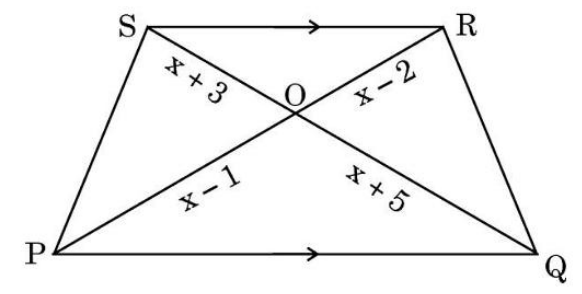
In the given figure, PQ $||$ SR. The value of $x$ is :
figure for this question
  • (a)$3$
  • (b)$5$
  • (c)$6$
  • (d)$7$
Show SolutionHide Solution
(D) $7$
2 Marks Questions
1282 Marks · March 2023 · Standardopen ↗
In the given figure, $ABCD$ is a parallelogram. $AE$ divides the line segment $BD$ in the ratio $1 : 2$. If $BE = 1.5$cm, then find the length of $BC$.
figure for this question
Show SolutionHide Solution
$$\begin{aligned}& \triangle OBE \sim \triangle ODA \\ & \frac{OB}{OD} = \frac{BE}{AD} \\ & \Rightarrow \frac{1}{2} = \frac{BE}{BC}\end{aligned}$$ (AD = BC)
$BE = 1.5$ cm $\Rightarrow BC = 3$ cm
1292 Marks · March 2023 · Standardopen ↗
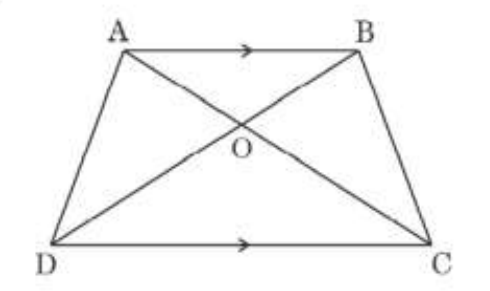
Diagonals $AC$ and $BD$ of trapezium $ABCD$ with $AB||DC$ intersect each other at point $O$. Show that $\frac{OA}{OC} = \frac{OB}{OD}$.
figure for this question
Show SolutionHide Solution
In $\triangle AOB$ and $\triangle COD$,
$\angle OAB = \angle OCD$
$\angle OBA = \angle ODC$
Therefore, $\triangle AOB \sim \triangle COD$
$\therefore \frac{OA}{OC} = \frac{OB}{OD}$
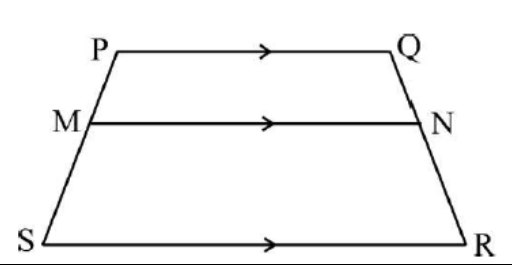
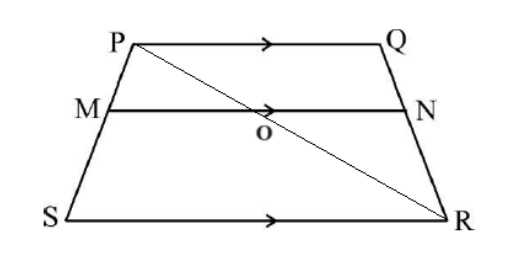
1302 Marks · March 2024 · Standardopen ↗
PQRS is a trapezium with PQ $||$ SR. If M and N are two points on the non-parallel sides PS and QR respectively, such that MN is parallel to PQ, then show that $\frac{PM}{MS} = \frac{QN}{NR}$.
figure for this question
Show SolutionHide Solution
Join PR
PQ $||$ SR and MN $||$ PQ $\Rightarrow$ MN $||$ SR
In $\triangle PSR$,
$\frac{PM}{MS} = \frac{PO}{OR}$ ... (i)
In $\triangle PQR$,
$\frac{PO}{OR} = \frac{QN}{NR}$ ... (ii)
From (i) and (ii), $\frac{PM}{MS} = \frac{QN}{NR}$
figure for this question
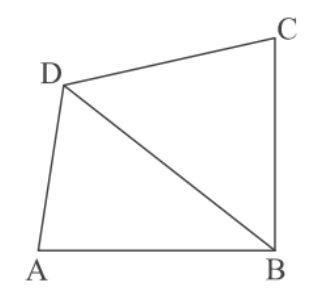
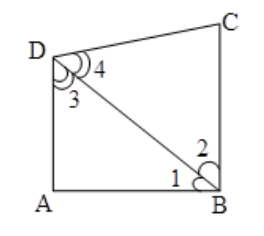
1312 Marks · March 2024 · Standardopen ↗
In the given figure, ABCD is a quadrilateral. Diagonal BD bisects $\angle B$ and $\angle D$ both. Prove that :
(i) $\triangle ABD \sim \triangle CBD$
(ii) $AB = BC$
figure for this question
Show SolutionHide Solution
Sol. (i) In $\triangle ABD \& \triangle CBD$
$\angle 3 = \angle 4$
$\angle 1 = \angle 2$
$\therefore \triangle ABD \sim \triangle CBD$
(ii) $\triangle ABD \cong \triangle CBD$
$\therefore AB = BC$
figure for this question
1322 Marks · March 2024 · Standardopen ↗
Diagonals AC and BD of a trapezium ABCD intersect at O, where AB$||$DC. If $\frac{DO}{OB} = \frac{1}{2}$, then show that AB = 2CD
figure for this question
Show SolutionHide Solution
$\triangle OAB \sim \triangle OCD \Rightarrow \frac{OD}{OB} = \frac{CD}{AB} \therefore \frac{OD}{OB} = \frac{1}{2} \text{ Therefore } \frac{CD}{AB} = \frac{1}{2} \Rightarrow AB = 2 CD$
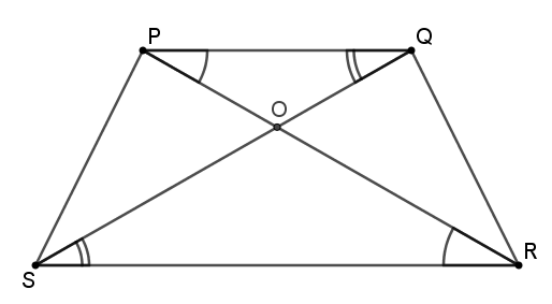
1332 Marks · March 2025 · Standardopen ↗
$PQRS$ is a trapezium in which $PQ \parallel SR$ and its diagonals intersect each other at the point $O$. Show that $\frac{PO}{QO} = \frac{RO}{SO}$.
Show SolutionHide Solution
In $\Delta POQ$ and $\Delta ROS$
$\angle P = \angle R$
and $\angle Q = \angle S$
$\implies \Delta POQ \sim \Delta ROS$
$\therefore \frac{PO}{RO} = \frac{QO}{SO} \implies \frac{PO}{QO} = \frac{RO}{SO}$
figure for this question
3 Marks Questions
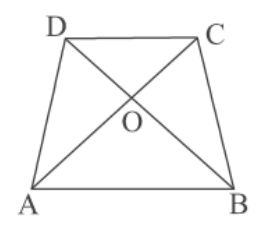
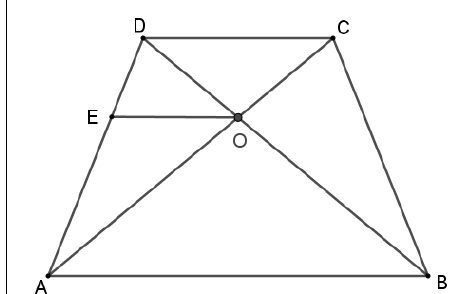
1343 Marks · July 2023 · Standardopen ↗
ABCD is a trapezium in which AB $||$DC and its diagonals AC and BD intersect at O. Show that $\frac{OA}{OB} = \frac{OC}{OD}$.
Show SolutionHide Solution
Draw OE $||$ CD
In $\triangle DAB$, OE $||$ AB (since OE $||$ CD and AB $||$ CD)
By Basic Proportionality Theorem (BPT): $\frac{DE}{AE} = \frac{DO}{OB}$
In $\triangle ADC$, OE $||$ DC
By BPT: $\frac{AE}{DE} = \frac{AO}{OC}$
From the two ratios: $\frac{DO}{OB} = \frac{AO}{OC}$
$\Rightarrow \frac{OA}{OB} = \frac{OC}{OD}$
figure for this question
1353 Marks · July 2023 · Standardopen ↗
Prove that each of the four triangles formed by joining the mid-points of the sides of a triangle are similar to the original triangle.
Show SolutionHide Solution
Let D, E, F be the mid-points of sides BC, CA, AB respectively of $\triangle ABC$.
By Mid-point Theorem, DE $||$ AB and DE $= \frac{1}{2}$ AB.
EF $||$ BC and EF $= \frac{1}{2}$ BC.
FD $||$ AC and FD $= \frac{1}{2}$ AC.
Consider $\triangle AFE$ and $\triangle ABC$.
$\frac{AF}{AB} = \frac{1}{2}$ and $\frac{AE}{AC} = \frac{1}{2}$ (F and E are mid-points)
$\angle A$ is common.
So, $\triangle AFE \sim \triangle ABC$ (SAS similarity criterion).
Similarly, $\triangle BDF \sim \triangle ABC$ and $\triangle CED \sim \triangle ABC$.
Also, DE $||$ AB, so ADEF is a parallelogram.
$\angle FDE = \angle A$ (Opposite angles of parallelogram)
$\frac{FD}{AC} = \frac{1}{2}$, $\frac{DE}{AB} = \frac{1}{2}$, $\frac{FE}{BC} = \frac{1}{2}$
So, $\triangle FDE \sim \triangle ABC$ (SSS similarity criterion).
Thus, all four triangles are similar to the original triangle.
figure for this question
1363 Marks · March 2023 · Standardopen ↗
In the given figure, $ABCD$ is a parallelogram. $BE$ bisects $CD$ at $M$ and intersects $AC$ at $L$. Prove that $EL = 2BL$.
figure for this question
Show SolutionHide Solution
$\triangle ALE \sim \triangle CLB$
$\Rightarrow \frac{AL}{CL} = \frac{EL}{BL}$
quad (i)
Also $\triangle CLM \sim \triangle ALB$
$\Rightarrow \frac{AL}{CL} = \frac{AB}{CM}$
$\Rightarrow \frac{AL}{CL} = \frac{CD}{CM}$
quad $\{AB = CD\}$
quad (ii)
Using (i) and (ii)
$\frac{EL}{BL} = \frac{2CM}{CM}$
$\Rightarrow EL = 2BL$
5 Marks Questions
1375 Marks · March 2023 · Standardopen ↗
$ABCD$ is a parallelogram, $P$ is a point on side $BC$ and $DP$ when produced meets $AB$ produced at $L$. Prove that
(i) $\frac{DP}{PL} = \frac{DC}{BL}$
(ii) $\frac{DL}{DP} = \frac{AL}{DC}$
(iii) If $LP : PD = 2 : 3$ then find $BP : BC$
figure for this question
Show SolutionHide Solution
(i) $$\begin{aligned}& \triangle DPC \sim \triangle LPB \\ & \Rightarrow \frac{DP}{PL} = \frac{PC}{PB} = \frac{DC}{BL} \quad \text{(i)} \\ & \text{(ii) As } BC \parallel AD \\ & \therefore \triangle LPB \sim \triangle LDA \\ & \text{In } \triangle DLA, AD \parallel BP \\ & \Rightarrow \frac{LP}{DP} = \frac{LB}{AB} \\ & \Rightarrow \frac{LP}{DP} + 1 = \frac{LB}{AB} + 1 \\ & \Rightarrow \frac{DL}{DP} = \frac{AL}{AB} \\ & \Rightarrow \frac{DL}{DP} = \frac{AL}{CD} \quad (AB = CD) \\ & \text{(iii) } \frac{LP}{LD} = \frac{PB}{AD} \quad (\triangle LPB \sim \triangle LDA) \\ & \Rightarrow \frac{2}{5} = \frac{PB}{BC} \quad (AD = BC)\end{aligned}$$
1385 Marks · March 2023 · Standardopen ↗
Through the mid-point M of the side CD of a parallelogram ABCD, the line BM is drawn intersecting AC in L and AD (produced) in E. Prove that EL = 2BL.
Show SolutionHide Solution
In $\triangle BMC$ and $\triangle EMD$
MC = MD
$\angle CMB = \angle EMD$
$\angle MBC = \angle MED$
$\therefore \triangle BMC \cong \triangle EMD$
$\Rightarrow$ BC = DE
But AD = BC
$\therefore$ AD = DE
$\Rightarrow$ AE = $2$ BC
In $\triangle AEL \sim \triangle CBL$
$\therefore \frac{EL}{BL} = \frac{AE}{BC}$
$\frac{EL}{BL} = \frac{2BC}{BC}$
$\frac{EL}{BL} = 2$
$\Rightarrow EL = 2 BL$
figure for this question
1395 Marks · March 2023 · Standardopen ↗
In the given figure, $\Delta ABC$ and ADBC are on the same base BC. If AD intersects BC at O, prove that $\frac{\text{ar}(\Delta ABC)}{\text{ar}(\Delta DBC)} = \frac{AO}{DO}$.
figure for this question
Show SolutionHide Solution
Draw $AL \perp BC$ and $DM \perp BC\\$In $\Delta AOL$ and $$\begin{aligned}& \Delta DOM, \\ & \angle AOL = \angle DOM\end{aligned}$$ (vertically opposite angles)
$\angle ALO = \angle DMO$ (each $90^\circ$)
$\Delta AOL \sim \Delta DOM$ (AA similarity)
$\Rightarrow \frac{AL}{DM} = \frac{AO}{DO}$
dots (i)
$$\begin{aligned}& \frac{\text{ar}(\Delta ABC)}{\text{ar}(\Delta DBC)} = \frac{\frac{1}{2} \times BC \times AL}{\frac{1}{2} \times BC \times DM} \\ & = \frac{AL}{DM} = \frac{AO}{DO}\end{aligned}$$ [using (i)]
figure for this question
1405 Marks · March 2024 · Standardopen ↗
In the given figure, MNOP is a parallelogram and AB $||$ MP. Prove that QC $||$ PO.
figure for this question
Show SolutionHide Solution
MP $||$ AB
$\Rightarrow \triangle QMP \sim \triangle QAB$
$\Rightarrow \frac{MP}{AB} = \frac{QP}{QB}$ ... (i)
Now, NO $||$ MP $||$ AB
$\Rightarrow \triangle CNO \sim \triangle CAB$
$\Rightarrow \frac{NO}{AB} = \frac{CO}{CB}$ ...(ii)
As MP = NO
From (i) and (ii),
$\frac{QP}{QB} = \frac{CO}{CB}$
$\frac{QB}{QP} = \frac{CB}{CO}$
$\frac{QB}{QP} - 1 = \frac{CB}{CO} - 1$
$\frac{QB-QP}{QP} = \frac{CB-CO}{CO}$
$\frac{BP}{QP} = \frac{BO}{CO}$
or $\frac{QP}{BP} = \frac{CO}{BO}$
$\therefore$ QC $||$ PO
1415 Marks · March 2024 · Standardopen ↗
Through the mid-point M of the side CD of a parallelogram ABCD, the line BM is drawn intersecting AC in L and AD produced in E. Prove that EL = 2BL.
Show SolutionHide Solution
Correct fig.
In $\triangle BLC$ and $\triangle ELA$
$\frac{BL}{EL} = \frac{BC}{EA} \dots(i)$
DM $||$ AB
$\therefore$ AD = DE
$\Rightarrow AE = 2AD$
$\Rightarrow AE = 2BC \dots(ii)$
From (i) and (ii)
$EL=2BL$
figure for this question
1425 Marks · March 2024 · Standardopen ↗
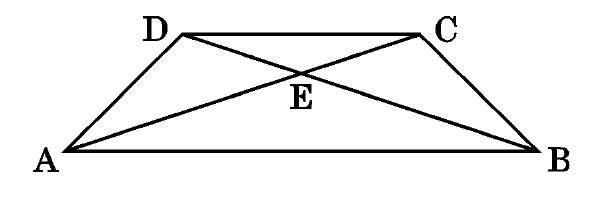
ABCD is a trapezium with AB $||$ DC. AC and BD intersect at E. If $\triangle AED \sim \triangle BEC$, then prove that AD = BC.
Show SolutionHide Solution
Given $$\begin{aligned}& \triangle AED \sim \triangle BEC \\ & \therefore \frac{AE}{BE} = \frac{DE}{CE} = \frac{AD}{BC} \dots (1) \\ & Also AB \parallel DC \Rightarrow \triangle AEB \sim \triangle CED \\ & \therefore \frac{AE}{CE} = \frac{BE}{DE}\end{aligned}$$ or $$\begin{aligned}& \frac{AE}{BE} = \frac{CE}{DE} \dots (2) \\ & From (1)\end{aligned}$$ and $(2)$, we get $$\begin{aligned}& \frac{DE}{CE} = \frac{CE}{DE} \\ & \Rightarrow DE^2 = CE^2 \Rightarrow DE = CE \\ & \therefore\end{aligned}$$ From $(1)$, $\frac{AD}{BC} = 1 \Rightarrow AD = BC$
figure for this question
1435 Marks · July 2025 · Standardopen ↗
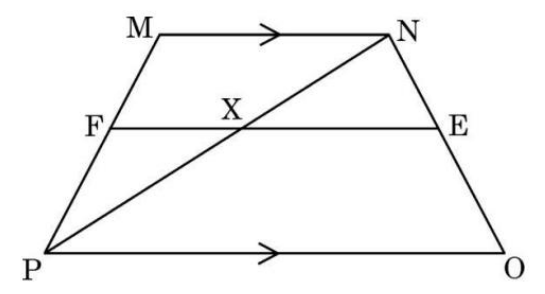
In the figure, MNOP is a trapezium with, MN $||$ PO and PO = $2$ MN.
A line segment FE drawn parallel to MN intersects MP at F and NO at E such that $\frac{NE}{EO} = \frac{3}{4}$. Diagonal PN intersects FE at X. Prove that $7$ FE = $10$ MN.
figure for this question
Show SolutionHide Solution
$\frac{NE}{EO} = \frac{3}{4} \Rightarrow \frac{NE}{NO} = \frac{3}{7}$
XE $||$ PO
Therefore, $\frac{NX}{NP} = \frac{NE}{NO} = \frac{XE}{PO} = \frac{3}{7}$
$\because$ PO = $2$ MN
$\frac{XE}{MN} = \frac{6}{7}$ --- (1)
Also, $\frac{NX}{NP} = \frac{XP}{NP} = \frac{3}{7}$
Now, FX $||$ MN
$\frac{XP}{NP} = \frac{FX}{MN} = \frac{4}{7}$ --- (2)
Using (1) and (2),
$\frac{XE}{MN} + \frac{XF}{MN} = \frac{6}{7} + \frac{4}{7}$
$\frac{EF}{MN} = \frac{10}{7}$
or $7$ FE = $10$ MN

Word Problems of Similarity

1 Mark Questions
1441 Mark · July 2023 · Standardopen ↗
A vertical pole $10$ m long casts a shadow of length $5$ m on the ground. At the same time, a tower casts a shadow of length $12.5$ m on the ground. The height of the tower is:
  • (a)$20$ m
  • (b)$25$ m
  • (c)$22$ m
  • (d)$24$ m
Show SolutionHide Solution
(c) $25$ m

General

1 Mark Questions
1451 Mark · March 2023 · Standardopen ↗
The area of the triangle formed by the line $\frac{x}{a} + \frac{y}{b} = 1$ with the coordinate axes is:
  • (a)ab
  • (b)$\frac{1}{2}ab$
  • (c)$\frac{1}{4}ab$
  • (d)$2ab$
Show SolutionHide Solution
(b) $\frac{1}{2}ab$
1461 Mark · March 2024 · Standardopen ↗
If two tangents inclined at an angle of $60^\circ$ are drawn to a circle of radius $5$ cm, then the length of each tangent is :
  • (a)$\frac{5\sqrt{3}}{2}$ cm
  • (b)$10$ cm
  • (c)$\frac{5}{\sqrt{3}}$ cm
  • (d)$5\sqrt{3}$ cm
Show SolutionHide Solution
(D) $5\sqrt{3}$ cm