203 previous-year board questions (2023–2025) with marking-scheme solutions, grouped by topic and marks.
Find T-ratio or value of Expression 1 Mark Questions
1 1 Mark · July 2023 · Standard open ↗ If $\tan A = \frac{3}{4}$, then the value of $\frac{4 \sin A-2 \cos A}{4 \sin A + 2 \cos A}$ is :
(a) $5$ (b) $\frac{1}{5}$ (c) $6$ (d) $\frac{1}{6}$ Show Solution Hide Solution ↓
2 1 Mark · March 2023 · Standard open ↗ If $2 \tan A = 3$, then the value of $\frac{4 \sin A +3 \cos A}{4 \sin A-3 \cos A}$ is
(a) $\frac{7}{\sqrt{13}}$ (b) $\frac{1}{\sqrt{13}}$ (c) 3 (d) does not exist Show Solution Hide Solution ↓
3 1 Mark · March 2023 · Standard open ↗ If $2 \tan A = 3$, then the value of $\frac{4 \sin A +3 \cos A}{4 \sin A-3 \cos A}$ is
(a) $\frac{7}{\sqrt{13}}$ (b) $\frac{1}{\sqrt{13}}$ (c) $3$ (d) does not exist Show Solution Hide Solution ↓
4 1 Mark · March 2023 · Standard open ↗ If $\tan \theta = \frac{5}{12}$, then the value of $\frac{\sin \theta + \cos \theta}{\sin \theta - \cos \theta}$ is:
(a) $\frac{17}{7}$ (b) $\frac{17}{7}$ (c) $\frac{17}{13}$ (d) $\frac{7}{13}$ Show Solution Hide Solution ↓
5 1 Mark · March 2023 · Standard open ↗ If $\tan \theta = \frac{x}{y}$, then $\cos \theta$ is equal to
(a) $\frac{x}{\sqrt{x^2 + y^2}}$ (b) $\frac{y}{\sqrt{x^2 + y^2}}$ (c) $\frac{x}{\sqrt{x^2-y^2}}$ (d) $\frac{y}{\sqrt{x^2-y^2}}$ Show Solution Hide Solution ↓ (B) $\frac{y}{\sqrt{x^2 + y^2}}$
6 1 Mark · July 2024 · Standard open ↗ If $\cos \theta = \frac{x}{y}$, $(x, y \neq 0)$, then $\tan \theta$ is equal to :
(a) $\frac{y}{\sqrt{y^2 - x^2}}$ (b) $\frac{\sqrt{y^2 - x^2}}{x}$ (c) $\frac{x}{\sqrt{x^2 + y^2}}$ (d) $\frac{x}{\sqrt{y^2 - x^2}}$ Show Solution Hide Solution ↓ (C) $\frac{\sqrt{y^2 - x^2}}{x}$
7 1 Mark · July 2024 · Standard open ↗ If $5 \tan \theta = 2$, then the value of $\frac{10 \sin \theta - 2 \cos \theta}{5 \sin \theta + 3\cos \theta}$ is :
(a) $\frac{2}{5}$ (b) $\frac{5}{2}$ (c) $1$ (d) $\frac{46}{31}$ Show Solution Hide Solution ↓
8 1 Mark · July 2024 · Standard open ↗ If $\text{cosec } \theta = \sqrt{10}$, then the value of $\text{sec } \theta$ is :
(a) $\frac{3}{\sqrt{10}}$ (b) $\frac{\sqrt{10}}{3}$ (c) $\frac{1}{\sqrt{10}}$ (d) $\frac{2}{\sqrt{10}}$ Show Solution Hide Solution ↓ Sol. (B) $\frac{\sqrt{10}}{3}$
9 1 Mark · March 2024 · Standard open ↗ If $\sin A = \frac{2}{3}$, then value of $\cot A$ is :
(a) $\frac{\sqrt{5}}{2}$ (b) $\frac{3}{2}$ (c) $\frac{5}{4}$ (d) $\frac{2}{3}$ Show Solution Hide Solution ↓
10 1 Mark · March 2024 · Standard open ↗ If $4 \sec \theta - 5 = 0$, then the value of $\cot \theta$ is:
(a) $\frac{3}{4}$ (b) $\frac{4}{5}$ (c) $\frac{5}{4}$ (d) $\frac{4}{3}$ Show Solution Hide Solution ↓
11 1 Mark · March 2024 · Standard open ↗ If $5 \tan \theta - 12 = 0$, then the value of $\sin \theta$ is :
(a) $\frac{5}{12}$ (b) $\frac{5}{13}$ (c) $\frac{12}{13}$ (d) $\frac{12}{5}$ Show Solution Hide Solution ↓
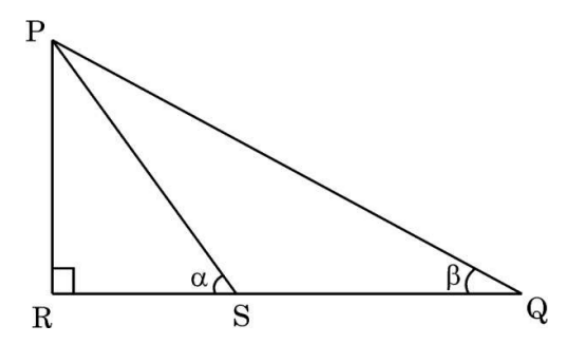
12 1 Mark · July 2025 · Standard open ↗ Find the value of $\frac{\tan \alpha}{\tan \beta}$ from the following diagram. It is given that RS: SQ = $1:2$.
Show Solution Hide Solution ↓
13 1 Mark · July 2025 · Standard open ↗ If $\cot \theta = \frac{p}{q}$ ($q \neq 0$), then $\sin \theta$ is equal to :
(a) $\frac{p}{\sqrt{p^2 + q^2}}$ (b) $\frac{\sqrt{p^2 + q^2}}{p}$ (c) $\frac{q}{\sqrt{p^2 + q^2}}$ (d) $\frac{q}{\sqrt{p^2 - q^2}}$ Show Solution Hide Solution ↓ (C) $\frac{q}{\sqrt{p^2 + q^2}}$
14 1 Mark · July 2025 · Standard open ↗ If $\triangle$ ABC is right-angled at C, then the value of $\cos (A + B)$ is :
(a) $1$ (b) $\frac{1}{2}$ (c) $\frac{\sqrt{3}}{2}$ (d) $0$ Show Solution Hide Solution ↓
15 1 Mark · March 2025 · Standard open ↗ In a right triangle $ABC$, right-angled at $A$, if $\sin B = \frac{1}{4}$, then the value of $\sec B$ is
(a) 4 (b) $\frac{\sqrt{15}}{4}$ (c) $\sqrt{15}$ (d) $\frac{4}{\sqrt{15}}$ Show Solution Hide Solution ↓ (D) $\frac{4}{\sqrt{15}}$
2 Marks Questions
16 2 Marks · March 2023 · Standard open ↗ If $\tan \theta = \frac{1}{\sqrt{7}}$, then show that $\frac{\text{cosec}^2 \theta - \sec^2 \theta}{\text{cosec}^2\theta+ \sec^2 \theta} = \frac{3}{4}$
Show Solution Hide Solution ↓ $$\begin{aligned}& \sec^2 \theta = 1 + \frac{1}{7} = \frac{8}{7} \\ & \cot \theta = \sqrt{7} \Rightarrow \text{cosec}^2 \theta = 1 + 7 = 8 \\ & \therefore \text{LHS} = \frac{8 - \frac{8}{7}}{8 + \frac{8}{7}} = \frac{\frac{48}{7}}{\frac{64}{7}} \\ & = \frac{3}{4} = \text{RHS}\end{aligned}$$
17 2 Marks · July 2024 · Standard open ↗ If $12 \text{cosec } A = 13$, then find the value of $\frac{2 \text{sin } A - 3 \text{cos } A}{4 \text{sin } A - 9 \text{cos } A}$.
Show Solution Hide Solution ↓ Sol. $\text{sin } A = \frac{12}{13}$, $\text{cos } A = \frac{5}{13}$
18 2 Marks · March 2024 · Standard open ↗ If $\sin A = \frac{3}{5}$ and $\cos B = \frac{12}{13}$, then find the value of $(\tan A + \tan B)$.
Show Solution Hide Solution ↓ $$\begin{aligned}& \sin A = \frac{3}{5} \Rightarrow \tan A = \frac{3}{4} \\ & \cos B = \frac{12}{13} \Rightarrow \tan B = \frac{5}{12} \\ & \tan A + \tan B = \frac{3}{4} + \frac{5}{12} = \frac{14}{12}\end{aligned}$$ or $\frac{7}{6}$
19 2 Marks · July 2025 · Standard open ↗ From the given figure, find the value of $\sin \alpha$.
Show Solution Hide Solution ↓ $\sin \alpha = \frac{\text{Perpendicular}}{\text{Hypotenuse}}$
20 2 Marks · March 2025 · Standard open ↗ If $\sin A = y$, then express $\cos A$ and $\tan A$ in terms of $y$.
Show Solution Hide Solution ↓ $\cos A = \sqrt{1-\sin^2 A} = \sqrt{1-y^2}$
3 Marks Questions
21 3 Marks · March 2024 · Standard open ↗ Prove that $\frac{\text{cosec}^2 \theta - \sec^2 \theta}{\text{cosec}^2 \theta + \sec^2 \theta} = \frac{3}{4}$, if $\tan \theta = \frac{1}{\sqrt{7}}$
Show Solution Hide Solution ↓ $\tan \theta = \frac{1}{\sqrt{7}}$
Specific Angles Expression 1 Mark Questions
28 1 Mark · March 2023 · Standard open ↗ $\frac{3}{4} \tan^2 30^\circ -\sec^2 45^\circ + \sin^2 60^\circ$ is equal to
(a) -1 (b) $\frac{5}{6}$ (c) $-\frac{3}{2}$ (d) $\frac{1}{6}$ Show Solution Hide Solution ↓
29 1 Mark · March 2023 · Standard open ↗ $\frac{5}{8} - \sec^2 60^{\circ} - \tan^2 60^{\circ} + \cos^2 45^{\circ}$ is equal to
(a) $-\frac{5}{3}$ (b) $-\frac{1}{2}$ (c) 0 (d) $-\frac{1}{4}$ Show Solution Hide Solution ↓
30 1 Mark · March 2023 · Standard open ↗ $\frac{3}{4} \tan^2 30^{\circ} -\sec^2 45^{\circ} + \sin^2 60^{\circ}$ is equal to
(a) $-1$ (b) $\frac{5}{6}$ (c) $-\frac{3}{2}$ (d) $\frac{1}{6}$ Show Solution Hide Solution ↓
31 1 Mark · March 2023 · Standard open ↗ $\frac{2 \tan 30^{\circ}}{1+ \tan^2 30^{\circ}}$ is equal to :
(a) $\sin 60^{\circ}$ (b) $\cos 60^{\circ}$ (c) $\tan 60^{\circ}$ (d) $\sin 30^{\circ}$ Show Solution Hide Solution ↓
32 1 Mark · March 2023 · Standard open ↗ $\frac{1-\tan^2 30^\circ}{1 + \tan^2 30^\circ}$ is equal to :
(a) $\sin 60^\circ$ (b) $\cos 60^\circ$ (c) $\tan 60^\circ$ (d) $\cos 30^\circ$ Show Solution Hide Solution ↓
33 1 Mark · March 2024 · Standard open ↗ For $\theta = 30^\circ$, the value of $(2 \sin \theta \cos \theta)$ is :
(a) $1$ (b) $\frac{\sqrt{3}}{2}$ (c) $\frac{\sqrt{3}}{4}$ (d) $\frac{3}{2}$ Show Solution Hide Solution ↓
34 1 Mark · March 2024 · Standard open ↗ Evaluate: $\frac{\sec^2 45^\circ - \tan^2 45^\circ}{\sin^2 45^\circ}$
Show Solution Hide Solution ↓ $\frac{\sec^2 45^\circ - \tan^2 45^\circ}{\sin^2 45^\circ} = \frac{(\sqrt{2})^2-(1)^2}{\left(\frac{1}{\sqrt{2}}\right)^2} = \frac{2-1}{\frac{1}{2}} = 2$
35 1 Mark · March 2025 · Standard open ↗ If $\sin 30^\circ \tan 45^\circ = \frac{\sec 60^\circ}{k}$, then the value of $k$ is:
Show Solution Hide Solution ↓
36 1 Mark · March 2025 · Standard open ↗ $\frac{1-\tan^2 30^\circ}{1+\tan^2 30^\circ}$ is equal to
(a) $\sin 60^\circ$ (b) $\cos 60^\circ$ (c) $\tan 60^\circ$ (d) $\sec 60^\circ$ Show Solution Hide Solution ↓
37 1 Mark · March 2025 · Standard open ↗ The value of $\frac{2 \tan 60^\circ}{1 - \tan^2 60^\circ}$ is same as the value of
(a) $-\tan 30^\circ$ (b) $-\tan 60^\circ$ (c) $2 \sin 60^\circ$ (d) $2 \cos 60^\circ$ Show Solution Hide Solution ↓
38 1 Mark · March 2025 · Standard open ↗ The value of $(1 - 2 \sin^2 60^{\circ})$ is same as that of
(a) $\sin 30^{\circ}$ (b) $-\sin 30^{\circ}$ (c) $\cos 60^{\circ}$ (d) $-\cos 30^{\circ}$ Show Solution Hide Solution ↓
39 1 Mark · March 2025 · Standard open ↗ If $x\left(\frac{2 \tan 30^\circ}{1 + \tan^2 30^\circ}\right) = y\left(\frac{2 \tan 30^\circ}{1 - \tan^2 30^\circ}\right)$, then $x:y=$
Show Solution Hide Solution ↓
40 1 Mark · March 2025 · Standard open ↗ If $x = \cos 30^{\circ} - \sin 30^{\circ}$ and $y = \tan 60^{\circ} - \cot 60^{\circ}$, then
(a) $x = y$ (b) $x > y$ (c) $x < y$ (d) $x > 1, y < 1$ Show Solution Hide Solution ↓
41 1 Mark · March 2025 · Standard open ↗ If $x = 2 \sin 60^{\circ} \cos 60^{\circ}$ and $y = \sin^2 30^{\circ} - \cos^2 30^{\circ}$ and $x^2 = ky^2$, the value of $k$ is
(a) $\sqrt{3}$ (b) $-\sqrt{3}$ (c) $3$ (d) $-3$ Show Solution Hide Solution ↓ 2 Marks Questions
42 2 Marks · March 2023 · Standard open ↗ If $4 \cot^2 45^\circ - \sec^2 60^\circ + \sin^2 60^\circ + p = \frac{3}{4}$, then find the value of p.
Show Solution Hide Solution ↓ $4 \cot^2 45^\circ - \sec^2 60^\circ + \sin^2 60^\circ + p = \frac{3}{4}$
43 2 Marks · March 2023 · Standard open ↗ Evaluate $\frac{5 \cos^2 60^\circ + 4 \sec^2 30^\circ – \tan^2 45^\circ}{\sin^2 30^\circ + \cos^2 30^\circ}$
Show Solution Hide Solution ↓ Sol. $\frac{5 \cos^2 60^\circ + 4 \sec^2 30^\circ - \tan^2 45^\circ}{\sin^2 30^\circ + \cos^2 30^\circ} = \frac{5(1/2)^2 + 4(2/\sqrt{3})^2 - (1)^2}{1}$
44 2 Marks · March 2023 · Standard open ↗ Evaluate : $\frac{5}{\cot^2 30^\circ} + \frac{1}{\sin^2 60^\circ} - \cot^2 45^\circ + 2 \sin^2 90^\circ$
Show Solution Hide Solution ↓ $$\begin{aligned}& \frac{5}{\cot^2 30^\circ} + \frac{1}{\sin^2 60^\circ} - \cot^2 45^\circ + 2 \sin^2 90^\circ \\ & = \frac{5}{(\sqrt{3})^2} + \frac{1}{(\sqrt{3}/2)^2} - (1)^2 + 2(1)^2 = \frac{5}{3} + \frac{4}{3} - 1 + 2 \\ & = \frac{9}{3} + 1 = 4 \\ & = 3 + 1 = 4 \\ & \text{OR}\end{aligned}$$
45 2 Marks · March 2023 · Standard open ↗ Evaluate $2\sec^2\theta + 3\text{cosec}^2\theta - 2\sin\theta\cos\theta$ if $\theta = 45^\circ$.
Show Solution Hide Solution ↓ $$\begin{aligned}& 2 \sec^2 45^\circ + 3 \text{cosec}^2 45^\circ - 2 \sin 45^\circ \cos 45^\circ \\ & = 2(\sqrt{2})^2 + 3(\sqrt{2})^2 - 2(\frac{1}{\sqrt{2}})(\frac{1}{\sqrt{2}}) \\ & = 4 + 6 - 1 = 9\end{aligned}$$
46 2 Marks · March 2024 · Standard open ↗ Find the value of $x$ such that,
Show Solution Hide Solution ↓ $3 \tan^2 60^\circ - x \sin^2 45^\circ + \frac{3}{4} \sec^2 30^\circ = 2 \cosec^2 30^\circ$
47 2 Marks · March 2024 · Standard open ↗ Evaluate: $2\sqrt{2} \cos 45^\circ \sin 30^\circ + 2\sqrt{3} \cos 30^\circ$
Show Solution Hide Solution ↓ Sol. $2\sqrt{2} \times \frac{1}{\sqrt{2}} \times \frac{1}{2} + 2\sqrt{3} \times \frac{\sqrt{3}}{2}$
48 2 Marks · March 2024 · Standard open ↗ If $A = 60^\circ$ and $B = 30^\circ$, verify that : $\sin (A + B) = \sin A \cos B + \cos A \sin B$
Show Solution Hide Solution ↓ Sol. LHS = $\sin (60^\circ + 30^\circ) = \sin 90^\circ = 1$
49 2 Marks · March 2024 · Standard open ↗ Evaluate: $2 \sin^2 30^\circ \sec 60^\circ + \tan^2 60^\circ$.
Show Solution Hide Solution ↓ $2\sin^2 30^\circ \sec 60^\circ + \tan^2 60^\circ$
50 2 Marks · March 2024 · Standard open ↗ Evaluate: $\frac{\cos 45^\circ + \sin 60^\circ}{\sec 30^\circ + \operatorname{cosec} 30^\circ}$
Show Solution Hide Solution ↓ $\frac{\cos 45^\circ + \sin 60^\circ}{\sec 30^\circ + \operatorname{cosec} 30^\circ}$
51 2 Marks · March 2024 · Standard open ↗ Evaluate : $\frac{5 \tan 60^{\circ}}{(\sin^2 60^{\circ} + \cos^2 60^{\circ}) \tan 30^{\circ}}$
Show Solution Hide Solution ↓ Sol.
52 2 Marks · March 2024 · Standard open ↗ Evaluate: $\frac{5 \cos^2 60^\circ + 4 \sec^2 30^\circ - \tan^2 45^\circ}{\sin^2 30^\circ + \sin^2 60^\circ}$
Show Solution Hide Solution ↓ $$\begin{aligned}& 5(\frac{1}{2})^2+4(\frac{2}{\sqrt{3}})^2-(1)^2 \\ & (\frac{1}{2})^2+(\frac{\sqrt{3}}{2})^2 \\ & = \frac{67}{12}\end{aligned}$$
53 2 Marks · March 2024 · Standard open ↗ Evaluate :
Show Solution Hide Solution ↓ $$\begin{aligned}& 2\times\frac{1}{\sqrt{3}}\times 2\times 1 \\ & \frac{1 - \frac{3}{4}}{} \\ & = \frac{16}{\sqrt{3}} \text{ or } \frac{16\sqrt{3}}{3}\end{aligned}$$
54 2 Marks · March 2025 · Standard open ↗ If $x \cos 60^\circ + y \cos 0^\circ + \sin 30^\circ - \cot 45^\circ = 5$, then find the value of $x + 2y$.
Show Solution Hide Solution ↓ $x(\frac{1}{2}) + y(1) + \frac{1}{2} - 1 = 5 \implies x + 2y = 11$
55 2 Marks · March 2025 · Standard open ↗ Evaluate: $\frac{\tan^2 60^\circ}{\sin^2 60^\circ + \cos^2 30^\circ}$
Show Solution Hide Solution ↓ $\frac{(\sqrt{3})^2}{(\frac{\sqrt{3}}{2})^2 + (\frac{\sqrt{3}}{2})^2} = 2$
56 2 Marks · March 2025 · Standard open ↗ If $4k = \tan^2 60^{\circ} - 2 \operatorname{cosec}^2 30^{\circ} -2 \tan^2 30^{\circ}$, then find the value of $k$.
Show Solution Hide Solution ↓ Sol. $4k = (\sqrt{3})^2 - 2(2)^2 - 2(\frac{1}{\sqrt{3}})^2$
57 2 Marks · March 2025 · Standard open ↗ If $4k = \tan^2 60^\circ - 2 \text{cosec}^2 30^\circ - 2 \tan^2 30^\circ$, then find the value of $k$.
Show Solution Hide Solution ↓ $$\begin{aligned}& 4k = (\sqrt{3})^2 - 2(2)^2 - 2\left(\frac{1}{\sqrt{3}}\right)^2 \\ & = -\frac{17}{3} \\ & k = -\frac{17}{12}\end{aligned}$$
58 2 Marks · March 2025 · Standard open ↗ Evaluate the following :
Show Solution Hide Solution ↓ $\frac{3 \sin 30^\circ-4 \sin^3 30^\circ}{2 \sin^2 50^\circ +2 \cos^2 50^\circ}$
59 2 Marks · March 2025 · Standard open ↗ It is given that $\sin(A-B) = \sin A \cos B - \cos A \sin B$. Use it to find the value of $\sin 15^\circ$.
Show Solution Hide Solution ↓ $\sin 15^\circ = \sin(45^\circ - 30^\circ)$
60 2 Marks · March 2025 · Standard open ↗ Evaluate : $\frac{5 \tan^2 30^\circ + 3 \cos^2 45^\circ - 4 \sin^2 30^\circ}{\sqrt{3} \sin 60^\circ \cos 60^\circ + \cot^2 45^\circ}$
Show Solution Hide Solution ↓ (b) $\frac{5(\frac{1}{\sqrt{3}})^2 + 3(\frac{1}{\sqrt{2}})^2 - 4(\frac{1}{2})^2}{\sqrt{3} .(\frac{\sqrt{3}}{2}). \frac{1}{2} + (1)^2} = \frac{26}{21}$
5 Marks Questions
61 5 Marks · July 2023 · Standard open ↗ Evaluate: $\frac{\tan^2 60^\circ + 4 \sin^2 45^\circ + 3 \sec^2 60^\circ + 5 \cos^2 90^\circ}{\text{cosec } 30^\circ + \sec 60^\circ - \cot^2 30^\circ}$
Show Solution Hide Solution ↓ Sol. $\frac{(\sqrt{3})^2+4(\frac{1}{\sqrt{2}})^2+3(2)^2+5(0)^2}{2+2-(\sqrt{3})^2}$ (3 Marks)
Find Angle of T-Ratio 1 Mark Questions
62 1 Mark · July 2023 · Standard open ↗ If $2 \sin 2A = \sqrt{3}$, then $\angle A$ is equal to :
(a) $60^\circ$ (b) $45^\circ$ (c) $90^\circ$ (d) $30^\circ$ Show Solution Hide Solution ↓
63 1 Mark · March 2024 · Standard open ↗ If $\tan^2\theta + \cot^2 \alpha = 2$, where $\theta = 45^\circ$ and $0^\circ\leq\alpha\leq90^\circ$, then the value of $\alpha$ is :
(a) $30^\circ$ (b) $60^\circ$ (c) $45^\circ$ (d) $90^\circ$ Show Solution Hide Solution ↓
64 1 Mark · March 2024 · Standard open ↗ If $\cos (\alpha + \beta) = 0$, then value of $\cos \left(\frac{\alpha + \beta}{2}\right)$ is equal to :
(a) $\frac{1}{\sqrt{2}}$ (b) $\frac{1}{2}$ (c) $0$ (d) $\sqrt{2}$ Show Solution Hide Solution ↓ Sol. (a) $\frac{1}{\sqrt{2}}$
65 1 Mark · March 2024 · Standard open ↗ If $\sin \theta = \cos \theta$, ($0^\circ < \theta < 90^\circ$), then value of $(\sec \theta \sin \theta)$ is :
(a) $\frac{1}{\sqrt{2}}$ (b) $1$ (c) $\sqrt{2}$ (d) $0$ Show Solution Hide Solution ↓
66 1 Mark · March 2024 · Standard open ↗ If $\sin \theta = \cos \theta$, ($0^\circ < \theta < 90^\circ$), then value of $(\sec \theta \cdot \sin \theta)$ is :
(a) $\frac{1}{\sqrt{2}}$ (b) $\sqrt{2}$ (c) 1 (d) 0 Show Solution Hide Solution ↓
67 1 Mark · March 2024 · Standard open ↗ If $\cos \theta = \frac{\sqrt{3}}{2}$ and $\sin \phi = \frac{1}{2}$, then $\tan (\theta + \phi)$ is :
(a) $\sqrt{3}$ (b) $\frac{1}{\sqrt{3}}$ (c) $1$ (d) not defined Show Solution Hide Solution ↓
68 1 Mark · March 2024 · Standard open ↗ If $\cos \theta = \frac{\sqrt{3}}{2}$ and $\sin \phi = \frac{1}{2}$, then $\tan (\theta + \phi)$ is :
(a) $\sqrt{3}$ (b) $1$ (c) $\frac{1}{\sqrt{3}}$ (d) not defined Show Solution Hide Solution ↓
69 1 Mark · March 2024 · Standard open ↗ If $\sin \alpha = \frac{\sqrt{3}}{2}$, $\cos \beta = \frac{\sqrt{3}}{2}$, then $\tan \alpha \cdot \tan \beta$ is:
(a) $\sqrt{3}$ (b) $1$ (c) $\frac{1}{\sqrt{3}}$ (d) $0$ Show Solution Hide Solution ↓
70 1 Mark · March 2024 · Standard open ↗ If $\sin \theta = 1$, then the value of $\frac{1}{2} \sin \frac{\theta}{2}$ is:
(a) $\frac{1}{2\sqrt{2}}$ (b) $\frac{1}{2}$ (c) $\frac{1}{\sqrt{2}}$ (d) $0$ Show Solution Hide Solution ↓ (A) $\frac{1}{2\sqrt{2}}$
71 1 Mark · March 2024 · Standard open ↗ If $\sin \theta = 1$, then the value of $\frac{1}{2} \sin \left(\frac{\theta}{2}\right)$ is :
(a) $\frac{1}{2\sqrt{2}}$ (b) $\frac{1}{\sqrt{2}}$ (c) $\frac{1}{2}$ (d) $0$ Show Solution Hide Solution ↓ (A) $\frac{1}{2\sqrt{2}}$
72 1 Mark · March 2024 · Standard open ↗ The value of $\theta$ for which $2 \sin^2 \theta = \frac{1}{2}$; $0^\circ \le \theta \le 90^\circ$ is:
(a) $30^\circ$ (b) $60^\circ$ (c) $45^\circ$ (d) $90^\circ$ Show Solution Hide Solution ↓
73 1 Mark · March 2024 · Standard open ↗ If $\tan A = 3 \cot A$, then the measure of the angle A is :
(a) $15^\circ$ (b) $30^\circ$ (c) $45^\circ$ (d) $60^\circ$ Show Solution Hide Solution ↓
74 1 Mark · March 2025 · Standard open ↗ If $\theta$ is an acute angle and $7 + 4 \sin \theta = 9$, then the value of $\theta$ is:
(a) $90^\circ$ (b) $30^\circ$ (c) $45^\circ$ (d) $60^\circ$ Show Solution Hide Solution ↓
75 1 Mark · March 2025 · Standard open ↗ If $\alpha + \beta = 90^\circ$ and $\alpha = 2\beta$, then $\cos^2 \alpha + \sin^2 \beta$ is equal to:
(a) $0$ (b) $\frac{1}{2}$ (c) $1$ (d) $2$ Show Solution Hide Solution ↓
76 1 Mark · March 2025 · Standard open ↗ If $\sin (\alpha + \beta) = 1$, then the value of $\sin \left(\frac{\alpha + \beta}{2}\right)$ is :
(a) $\frac{1}{\sqrt{2}}$ (b) $\frac{1}{2}$ (c) $0$ (d) $1$ Show Solution Hide Solution ↓
77 1 Mark · March 2025 · Standard open ↗ If $\sin \theta = \cos \theta$ ($0^\circ < \theta < 90^\circ$), then the value of $\sec \theta \cdot \sin \theta$ is:
(a) $\frac{1}{\sqrt{2}}$ (b) $\sqrt{2}$ (c) $0$ (d) $1$ Show Solution Hide Solution ↓
78 1 Mark · March 2025 · Standard open ↗ If $\tan \theta = \sqrt{3}$, then $\frac{\theta}{2}$ equals :
(a) $60^{\circ}$ (b) $30^{\circ}$ (c) $20^{\circ}$ (d) $10^{\circ}$ Show Solution Hide Solution ↓
79 1 Mark · March 2025 · Standard open ↗ If $\sin 4\theta = \frac{\sqrt{3}}{2}$, then $\theta$ equals :
(a) $60^\circ$ (b) $20^\circ$ (c) $15^\circ$ (d) $5^\circ$ Show Solution Hide Solution ↓
80 1 Mark · March 2025 · Standard open ↗ If $\tan 30 = \sqrt{3}$, then $\frac{\theta}{2}$ equals :
(a) $60^{\circ}$ (b) $30^{\circ}$ (c) $20^{\circ}$ (d) $10^{\circ}$ Show Solution Hide Solution ↓
81 1 Mark · March 2025 · Standard open ↗ $\tan 2A = 3 \tan A$ is true, when the measure of $\angle A$ is :
(a) $90^\circ$ (b) $60^\circ$ (c) $45^\circ$ (d) $30^\circ$ Show Solution Hide Solution ↓
82 1 Mark · March 2025 · Standard open ↗ $\sec A = 2 \cos A$ is true for $A = $
(a) $0^{\circ}$ (b) $30^{\circ}$ (c) $45^{\circ}$ (d) $60^{\circ}$ Show Solution Hide Solution ↓
83 1 Mark · March 2025 · Standard open ↗ If $\sin \theta - \cos \theta = 0$, then the value of $\sin^6 \theta + \cos^6 \theta$ is
(a) $1$ (b) $\frac{1}{8}$ (c) $\frac{3}{4}$ (d) $\frac{1}{4}$ Show Solution Hide Solution ↓ 2 Marks Questions
84 2 Marks · July 2023 · Standard open ↗ If $\tan A = 1$ and $\tan B = \sqrt{3}$, then evaluate ; $\cos A \cos B + \sin A \sin B$.
Show Solution Hide Solution ↓ $A = 45^\circ, B = 60^\circ$
85 2 Marks · March 2023 · Standard open ↗ If $\sin \alpha = \frac{1}{\sqrt{2}}$ and $\cot \beta= \sqrt{3}$, then find the value of $\text{cosec}\alpha+ \text{cosec}\beta$
Show Solution Hide Solution ↓ $\text{cosec} \alpha = \frac{1}{\sin \alpha} = \sqrt{2}$
86 2 Marks · March 2023 · Standard open ↗ If $A$ and $B$ are acute angles such that $\sin (A - B) = 0$ and $2 \cos (A + B) – 1 = 0$, then find angles $A$ and $B$.
Show Solution Hide Solution ↓ Sol. $\sin (A - B) = 0 \Rightarrow A-B=0^\circ$
87 2 Marks · March 2023 · Standard open ↗ If $\theta$ is an acute angle and $\sin \theta = \cos \theta$, find the value of $\tan^2\theta + \cot^2\theta – 2$.
Show Solution Hide Solution ↓ $$\begin{aligned}& \sin \theta = \cos \theta \Rightarrow \frac{\sin \theta}{\cos \theta} = 1 \Rightarrow \tan \theta = 1 \Rightarrow \cot \theta = 1 \\ & \tan^2 \theta + \cot^2 \theta – 2 = (1)^2 + (1)^2 – 2 = 0\end{aligned}$$
88 2 Marks · March 2024 · Standard open ↗ If $\cos (A + B) = \frac{1}{2}$ and $\tan (A - B) = \frac{1}{\sqrt{3}}$, where $0 \leq A + B \leq 90^\circ$, then find the value of $\sec (2A-3B)$.
Show Solution Hide Solution ↓ $\cos(A + B) = \frac{1}{2} \Rightarrow A + B = 60^\circ$ ... (i)
89 2 Marks · March 2024 · Standard open ↗ If $2 \sin (A + B) = \sqrt{3}$ and $\cos (A - B) = 1$, then find the measures of angles $A$ and $B$. $0 \le A, B, (A + B) \le 90^\circ$.
Show Solution Hide Solution ↓ $\sin(A + B) = \frac{\sqrt{3}}{2} \Rightarrow A + B = 60^\circ \dots (1)$
90 2 Marks · March 2024 · Standard open ↗ If $\sin (A-B) = \frac{1}{2}$, $\cos (A + B) = \frac{1}{2}$; $0 < A + B \le 90^\circ$, $A > B$; find $\angle A$ and $\angle B$.
Show Solution Hide Solution ↓ $$\begin{aligned}& \sin (A - B) = \sin 30^\circ \\ & A - B = 30^\circ --------(i) \\ & \cos (A+B) = \cos 60^\circ \\ & A + B = 60^\circ ---------(ii) \\ & \text{Solving (i) and (ii)} \\ & A = 45^\circ, B = 15^\circ\end{aligned}$$
91 2 Marks · July 2025 · Standard open ↗ If $\sin(2A + 3B) = 1$ and $\cos(2A - 3B) = \frac{\sqrt{3}}{2}$, $0^{\circ} < 2A + 3B \leq 90^{\circ}$, A $>$ B, then find A and B.
Show Solution Hide Solution ↓ $\sin (2A + 3B) = 1 \Rightarrow 2A + 3B = 90^{\circ}$ --- (1)
92 2 Marks · March 2025 · Standard open ↗ If $\tan A = \sqrt{3}$; where $A$ is an acute angle, then find the value of $\frac{\sin^2 A}{1 + \cos^2 A}$.
Show Solution Hide Solution ↓ $\tan A = \sqrt{3} = \tan 60^\circ$
3 Marks Questions
93 3 Marks · March 2025 · Standard open ↗ Let $2A + B$ and $A + 2B$ be acute angles such that $\sin(2A + B) = \frac{\sqrt{3}}{2}$ and $\tan(A + 2B) = 1$. Find the value of $\cot(4A - 7B)$.
Show Solution Hide Solution ↓ $\sin(2A + B) = \frac{\sqrt{3}}{2} \implies 2A + B = 60^\circ$ --- (1)
Find Value using Identities 1 Mark Questions
94 1 Mark · July 2023 · Standard open ↗ $\cot^2\theta - \frac{1}{\sin^2\theta}$ is equal to:
(a) $1$ (b) $-2$ (c) $2$ (d) $-1$ Show Solution Hide Solution ↓
95 1 Mark · July 2023 · Standard open ↗ $2 \cos^2 \theta (1 + \tan^2 \theta)$ is equal to:
Show Solution Hide Solution ↓
96 1 Mark · July 2023 · Standard open ↗ $(\sec^2\theta-1) (1-\text{cosec}^2\theta)$ is equal to:
(a) $1$ (b) $2$ (c) $-1$ (d) $-2$ Show Solution Hide Solution ↓
97 1 Mark · March 2023 · Standard open ↗ sec$\theta$ when expressed in terms of cot $\theta$, is equal to :
(a) $\frac{1+\cot^2\theta}{\cot \theta}$ (b) $\sqrt{1+\cot^2\theta}$ (c) $\frac{\sqrt{1+\cot^2\theta}}{\cot \theta}$ (d) $\frac{\sqrt{1-\cot^2\theta}}{\cot \theta}$ Show Solution Hide Solution ↓ Sol. (c) $\frac{\sqrt{1 + \cot^2 \theta}}{\cot \theta}$
98 1 Mark · March 2023 · Standard open ↗ Which of the following is true for all values of $\theta$ ($0^\circ \le \theta \le 90^\circ$) ?
(a) $\cos^2\theta - \sin^2 \theta = 1$ (b) $\text{cosec}^2\theta - \sec^2\theta = 1$ (c) $\sec^2\theta – \tan^2 \theta = 1$ (d) $\cot^2\theta - \tan^2\theta = 1$ Show Solution Hide Solution ↓ (c) $\sec^2\theta – \tan^2\theta = 1$
99 1 Mark · March 2023 · Standard open ↗ $(\sec^2\theta - 1) (\text{cosec}^2\theta - 1)$ is equal to :
(a) $-1$ (b) $1$ (c) $0$ (d) $2$ Show Solution Hide Solution ↓
100 1 Mark · March 2023 · Standard open ↗ If $\sec\theta - \tan\theta = \frac{1}{3}$, then the value of $(\sec\theta + \tan\theta)$ is :
(a) $\frac{4}{3}$ (b) $\frac{2}{3}$ (c) $\frac{1}{3}$ (d) $3$ Show Solution Hide Solution ↓
101 1 Mark · March 2023 · Standard open ↗ $\frac{\cos^2\theta}{\sin^2\theta} - \frac{1}{\sin^2\theta}$, in simplified form, is :
(a) $\tan^2\theta$ (b) 1 (c) $\sec^2\theta$ (d) -1 Show Solution Hide Solution ↓
102 1 Mark · March 2023 · Standard open ↗ Statement A (Assertion) : For $0 < \theta < 90^{\circ}$, $\text{cosec } \theta - \cot \theta$ and $\text{cosec } \theta + \cot \theta$ are reciprocal of each other.
Show Solution Hide Solution ↓
103 1 Mark · March 2023 · Standard open ↗ $(\cos^4 A - \sin^4 A)$ on simplification, gives
(a) $2 \sin^2 A - 1$ (b) $2 \sin^2 A + 1$ (c) $2 \cos^2 A + 1$ (d) $2 \cos^2 A - 1$ Show Solution Hide Solution ↓
104 1 Mark · March 2023 · Standard open ↗ Assertion - Reason Based Questions : In question numbers $19$ and $20$, a statement of Assertion (A) is followed by a statement of Reason (R). Choose the correct option out of the following :
Show Solution Hide Solution ↓
105 1 Mark · March 2024 · Standard open ↗ The value of $\sin^2 \theta + \frac{1}{1+ \tan^2 \theta}$ is :
(a) $0$ (b) $1$ (c) $2$ (d) $-1$ Show Solution Hide Solution ↓
106 1 Mark · March 2024 · Standard open ↗ If $\sec \theta - \tan \theta = m$, then the value of $\sec \theta + \tan \theta$ is :
(a) $1-\frac{1}{m}$ (b) $m^2-1$ (c) $\frac{1}{m}$ (d) $-m$ Show Solution Hide Solution ↓
107 1 Mark · March 2024 · Standard open ↗ Directions: In Question $19$ and $20$, Assertion (A) and Reason (R) are given. Select the correct option from the following :
Show Solution Hide Solution ↓ (A) Both Assertion (A) and (R) are true. Reason (R) is the correct explanation of Assertion (A)
108 1 Mark · March 2024 · Standard open ↗ Assertion (A) : If $\sin A = \frac{1}{3}$ ($0^\circ < A < 90^\circ$), then the value of $\cos A$ is $\frac{2\sqrt{2}}{3}$. Reason (R): For every angle $\theta$, $\sin^2\theta + \cos^2 \theta = 1$.
Show Solution Hide Solution ↓ (A) Both Assertion (A) and (R) are true. Reason (R) is the correct explanation of Assertion (A)
109 1 Mark · March 2024 · Standard open ↗ If $\frac{x}{3} = 2 \sin A$, $\frac{y}{3} = 2 \cos A$, then the value of $x^2 + y^2$ is:
(a) $36$ (b) $9$ (c) $6$ (d) $18$ Show Solution Hide Solution ↓
110 1 Mark · March 2024 · Standard open ↗ $(\sec \theta + \tan \theta) (1 - \sin \theta)$ is equal to :
(a) $\sec \theta$ (b) $\sin \theta$ (c) $\operatorname{cosec} \theta$ (d) $\cos \theta$ Show Solution Hide Solution ↓
111 1 Mark · July 2025 · Standard open ↗ If $x = p \cos^3 \alpha$ and $y = q \sin^3 \alpha$, then the value of $\left(\frac{x}{p}\right)^{2/3} + \left(\frac{y}{q}\right)^{2/3}$ is :
Show Solution Hide Solution ↓
112 1 Mark · July 2025 · Standard open ↗ If $\sin \theta + \sin^2 \theta = 1$, then the value of $\cos^2\theta + \cos^4\theta$ is :
(a) $1$ (b) $\frac{1}{2}$ (c) $2$ (d) $3$ Show Solution Hide Solution ↓
113 1 Mark · March 2025 · Standard open ↗ The value of $\tan^2 \theta - \left(\frac{1}{\cos \theta} \times \sec \theta\right)$ is:
(a) $1$ (b) $0$ (c) $-1$ (d) $2$ Show Solution Hide Solution ↓
114 1 Mark · March 2025 · Standard open ↗ The value of $(\tan A \operatorname{cosec} A)^2 - (\sin A \sec A)^2$ is:
(a) $0$ (b) $1$ (c) $-1$ (d) $2$ Show Solution Hide Solution ↓
115 1 Mark · March 2025 · Standard open ↗ $\frac{\cos \theta}{\sqrt{1-\cos^2 \theta}}$ is equal to :
(a) $\cot \theta$ (b) $\sqrt{\cos \theta}$ (c) $\frac{\cos \theta}{\sqrt{\sin \theta}}$ (d) $\tan \theta$ Show Solution Hide Solution ↓
116 1 Mark · March 2025 · Standard open ↗ Which of the following is a trigonometric identity ?
(a) $\sin^2 \theta = 1 + \cos^2 \theta$ (b) $\csc^2 \theta + \cot^2 \theta = 1$ (c) $\sec^2 \theta = 1 + \tan^2 \theta$ (d) $\sin 2\theta = 2 \sin \theta$ Show Solution Hide Solution ↓ (c) $\sec^2 \theta = 1 + \tan^2 \theta$
117 1 Mark · March 2025 · Standard open ↗ Directions: In Question Numbers 19 and 20, a statement of Assertion (A) is followed by a statement of Reason (R). Choose the correct option from following: (A) Both Assertion (A) and Reason (R) are true and Reason (R) is the correct explanation of Assertion (A). (B) Both Assertion (A) and Reason (R) are true, but Reason (R) is not the correct explanation of Assertion (A). (C) Assertion (A) is true, but Reason (R) is false. (D) Assertion (A) is false, but Reason (R) is true. Assertion (A): For an acute angle $\theta$, $\sin \theta = \frac{3}{5} \implies \cos \theta = -\frac{4}{5}$. Reason (R): For any value of $\theta$, $(0^\circ \le \theta \le 90^\circ)$ $\sin^2 \theta + \cos^2 \theta = 1$.
Show Solution Hide Solution ↓ (D) Assertion (A) is false, but Reason (R) is true.
118 1 Mark · March 2025 · Standard open ↗ Assertion (A) : For an acute angle $\theta$, $\sec \theta = 3 \implies \tan \theta = 2\sqrt{2}$.
Show Solution Hide Solution ↓ (C) Assertion (A) is true, but Reason (R) is false.
2 Marks Questions
119 2 Marks · March 2023 · Standard open ↗ If $\sin\theta + \cos\theta = \sqrt{3}$, then find the value of $\sin\theta \cdot \cos\theta$ .
Show Solution Hide Solution ↓ $\sin \theta + \cos \theta = \sqrt{3}$
120 2 Marks · March 2023 · Standard open ↗ If $\sin \theta + \sin^2 \theta = 1$, then prove that $\cos^2\theta + \cos^4 \theta = 1$.
Show Solution Hide Solution ↓ $$\begin{aligned}& \sin \theta + \sin^2 \theta = 1 \\ & \Rightarrow \sin \theta = 1 - \sin^2 \theta = \cos^2 \theta \\ & \therefore \cos^2 \theta + \cos^4 \theta = \cos^2 \theta (1 + \cos^2 \theta) \\ & = \sin \theta (1 + \sin \theta) \\ & = \sin \theta + \sin^2 \theta= 1\end{aligned}$$
121 2 Marks · March 2023 · Standard open ↗ If $\cos A + \cos^2 A = 1$, then find the value of $\sin^2 A + \sin^4 A$.
Show Solution Hide Solution ↓ $\cos A + \cos^2 A = 1 \Rightarrow \cos A = 1 - \cos^2 A = \sin^2 A$
122 2 Marks · March 2023 · Standard open ↗ If $\sin\theta - \cos\theta = 0$, then find the value of $\sin^4\theta + \cos^4\theta$.
Show Solution Hide Solution ↓ $$\begin{aligned}& \sin\theta - \cos\theta = 0 \Rightarrow \sin\theta = \cos\theta \Rightarrow \tan\theta = 1 \\ & Rightarrow \theta = 45^\circ \\ & sin^4 45^\circ + \cos^4 45^\circ = (\frac{1}{\sqrt{2}})^4 + (\frac{1}{\sqrt{2}})^4 \\ & = \frac{1}{4} + \frac{1}{4} = \frac{1}{2}\end{aligned}$$
123 2 Marks · March 2025 · Standard open ↗ Find the value of $x$ for which $(\sin A + \text{cosec } A)^2 + (\cos A + \sec A)^2 = x + \tan^2 A + \cot^2 A$
Show Solution Hide Solution ↓ $(\sin A + \text{cosec } A)^2 + (\cos A + \sec A)^2 = x + \tan^2 A + \cot^2 A$
124 2 Marks · March 2025 · Standard open ↗ Find the value of $x$ for which $(\sin A + \csc A)^2 + (\cos A + \sec A)^2 = x + \tan^2 A + \cot^2 A$
Show Solution Hide Solution ↓ $(\sin A + \csc A)^2 + (\cos A + \sec A)^2 = x + \tan^2 A + \cot^2 A$
125 2 Marks · March 2025 · Standard open ↗ Find the value of $x$ for which $(\sin A + \csc A)^2 + (\cos A + \sec A)^2 = x + \tan^2 A + \cot^2 A$
Show Solution Hide Solution ↓ $(\sin A + \csc A)^2 + (\cos A + \sec A)^2 = x + \tan^2 A + \cot^2 A \implies \sin^2 A + \csc^2 A + 2 + \cos^2 A + \sec^2 A + 2 = x + \tan^2 A + \cot^2 A \implies 1 + 2 + 2 + 1 + \cot^2 A + 1 + \tan^2 A = x + \tan^2 A + \cot^2 A \implies x = 7$.
126 2 Marks · March 2025 · Standard open ↗ Use the identity: $\sin^2 A + \cos^2 A = 1$ to prove that $\tan^2 A + 1 = \sec^2 A$. Hence, find the value of $\tan A$, when $\sec A = \frac{5}{3}$, where $A$ is an acute angle.
Show Solution Hide Solution ↓ $\sin^2 A + \cos^2 A = 1$. Dividing both sides by $\cos^2 A$, we get $\frac{\sin^2 A}{\cos^2 A} + \frac{\cos^2 A}{\cos^2 A} = \frac{1}{\cos^2 A}$ ($\frac{1}{2}$ mark). $\tan^2 A + 1 = \sec^2 A$ ($\frac{1}{2}$ mark). $\tan^2 A + 1 = (\frac{5}{3})^2$ ($\frac{1}{2}$ mark). $\tan A = \frac{4}{3}$ ($\frac{1}{2}$ mark).
Prove Given Result 1 Mark Questions
127 1 Mark · July 2024 · Standard open ↗ $\frac{\text{sin}^3 A + \text{cos}^3 A}{\text{sin } A + \text{cos } A} + \text{sin } A \text{cos } A$ on simplification gives :
(a) $1$ (b) $2$ (c) $1 + 2 \text{sin } A \text{cos } A$ (d) $0$ Show Solution Hide Solution ↓
128 1 Mark · March 2024 · Standard open ↗ If $x = a \cos \theta$ and $y = b \sin \theta$, then the value of $b^2x^2 + a^2y^2$ is:
(a) $a^2b^2$ (b) $a^4b^4$ (c) $ab$ (d) $a^2 + b^2$ Show Solution Hide Solution ↓ 2 Marks Questions
129 2 Marks · July 2023 · Standard open ↗ Prove that $\frac{1-\cos \theta}{1 + \cos \theta} = (\cot \theta - \operatorname{cosec} \theta)^2$
Show Solution Hide Solution ↓ LHS $= \frac{1-\cos \theta}{1 + \cos \theta} \times \frac{1-\cos \theta}{1-\cos \theta}$
130 2 Marks · July 2023 · Standard open ↗ Prove that $\frac{\tan A}{1- \cot A} + \frac{\cot A}{1-\tan A} = 1 + \sec A \operatorname{cosec} A$
Show Solution Hide Solution ↓ Getting $\frac{\sin^2 A}{\cos A(\sin A-\cos A)} + \frac{\cos^2 A}{\sin A(\cos A-\sin A)}$
131 2 Marks · March 2023 · Standard open ↗ If $a \cos \theta + b \sin \theta = m$ and $a \sin \theta - b \cos \theta = n$, then prove that $a^2 + b^2 = m^2 + n^2$.
Show Solution Hide Solution ↓ $m^2 + n^2 = (a \cos \theta + b \sin \theta)^2 + (a \sin \theta - b \cos \theta)^2$
132 2 Marks · March 2023 · Standard open ↗ Prove that : $\sqrt{\frac{\sec A-1}{\sec A+ 1}} + \sqrt{\frac{\sec A+ 1}{\sec A-1}} = 2 \cosec A$
Show Solution Hide Solution ↓ $LHS = \sqrt{\frac{\sec A-1}{\sec A+ 1}} + \sqrt{\frac{\sec A+ 1}{\sec A-1}}$
133 2 Marks · March 2023 · Standard open ↗ Prove that: $\sqrt{\frac{\sec A-1}{\sec A+1}} + \sqrt{\frac{\sec A+1}{\sec A-1}} = 2 \operatorname{cosec} A$
Show Solution Hide Solution ↓ LHS $= \frac{\sqrt{\sec A-1}}{\sqrt{\sec A+1}} + \frac{\sqrt{\sec A+1}}{\sqrt{\sec A-1}}$
134 2 Marks · March 2023 · Standard open ↗ Prove that : $\sqrt{\frac{\sec A-1}{\sec A+1}} + \sqrt{\frac{\sec A+1}{\sec A-1}} = 2 \operatorname{cosec} A$
Show Solution Hide Solution ↓ LHS $$\begin{aligned}& = \sqrt{\frac{\sec A-1}{\sec A+1}} + \sqrt{\frac{\sec A+1}{\sec A-1}} \\ & = \frac{(\sec A-1) + (\sec A+1)}{\sqrt{\sec^2 A-1}} \\ & = \frac{2\sec A}{\tan A} \\ & = 2 \times \frac{\cos A}{\sin A} \times \frac{1}{\cos A} \\ & = 2 \operatorname{cosec} A = \text{RHS}\end{aligned}$$
135 2 Marks · March 2024 · Standard open ↗ If $\tan \theta + \sec \theta = m$, then prove that $\sec \theta = \frac{m^2+1}{2m}$
Show Solution Hide Solution ↓ $$\begin{aligned}& \tan \theta + \sec \theta = m \dots (i) \\ & Therefore, \sec \theta - \tan \theta = \frac{1}{m} \dots (ii) \\ & Adding (i)\end{aligned}$$ and $(ii)$ to get
136 2 Marks · March 2025 · Standard open ↗ If $\tan A + \cot A = 6$, then find the value of $\tan^2 A + \cot^2 A-4$.
Show Solution Hide Solution ↓ Sol. $$\begin{aligned}& (\tan A + \cot A)^2 = 36 \\ & \tan^2 A + \cot^2 A + 2\tan A \cot A = 36 \\ & \tan^2 A + \cot^2 A = 34 \\ & \therefore \tan^2 A + \cot^2 A - 4 = 30\end{aligned}$$
137 2 Marks · March 2025 · Standard open ↗ If $a \sec \theta + b \tan \theta = m$ and $b \sec \theta + a \tan \theta = n$, prove that $a^2 + n^2 = b^2 + m^2$
Show Solution Hide Solution ↓ $m^2 = a^2 \sec^2 \theta + b^2 \tan^2 \theta + 2ab \sec \theta \tan \theta$ ($\frac{1}{2}$ mark). $n^2 = b^2 \sec^2 \theta + a^2 \tan^2 \theta + 2ab \sec \theta \tan \theta$ ($\frac{1}{2}$ mark). $m^2 - n^2 = a^2(\sec^2 \theta - \tan^2 \theta) + b^2(\tan^2 \theta - \sec^2 \theta)$ ($\frac{1}{2}$ mark). $\Rightarrow m^2 - n^2 = a^2 - b^2$ or $a^2 + n^2 = m^2 + b^2$ ($\frac{1}{2}$ mark).
138 2 Marks · March 2025 · Standard open ↗ Prove that $(\text{cosec} \theta + \sin \theta) (\text{cosec} \theta - \sin \theta) = \cot^2 \theta + \cos^2 \theta$.
Show Solution Hide Solution ↓ (a) LHS = $(\text{cosec} \theta + \sin \theta) (\text{cosec} \theta - \sin \theta) = \frac{(1+\sin^2 \theta)(1-\sin^2 \theta)}{\sin^2 \theta} = (1 + \sin^2 \theta) (\frac{\cos^2 \theta}{\sin^2 \theta}) = (\cot^2 \theta + \cos^2 \theta)$
3 Marks Questions
139 3 Marks · March 2023 · Standard open ↗ Prove that: $\frac{\tan \theta + \sec \theta-1}{\tan \theta - \sec \theta+1} = \frac{1+\sin \theta}{\cos \theta}$
Show Solution Hide Solution ↓ LHS= $\frac{(\tan \theta + \sec \theta) – (\sec^2 \theta – \tan^2 \theta)}{\tan \theta - \sec \theta + 1}$
140 3 Marks · March 2023 · Standard open ↗ Prove that $(\text{cosec } A - \sin A)(\sec A - \cos A) = \frac{1}{\cot A-\tan A}$
Show Solution Hide Solution ↓ LHS $= (\frac{1}{\sin A} - \sin A) (\frac{1}{\cos A} - \cos A)$
141 3 Marks · March 2023 · Standard open ↗ Prove that: $2(\sin^6 \theta + \cos^6 \theta) -3(\sin^4 \theta + \cos^4 \theta)+1=0$.
Show Solution Hide Solution ↓ LHS = $$\begin{aligned}& 2(\sin^6\theta + \cos^6\theta) - 3(\sin^4\theta + \cos^4\theta) + 1 \\ & = 2[(\sin^2\theta)^3 + (\cos^2\theta)^3] - 3(\sin^4\theta + \cos^4\theta) + 1 \\ & = 2[(\sin^2\theta + \cos^2\theta)(\sin^4\theta - \sin^2\theta \cos^2\theta + \cos^4\theta)] - 3(\sin^4\theta + \cos^4\theta) + 1 \\ & = 2[\sin^4\theta + \cos^4\theta - \sin^2\theta \cos^2\theta] - 3(\sin^4\theta + \cos^4\theta) + 1 \\ & = -[\sin^4\theta + \cos^4\theta + 2 \sin^2\theta \cos^2\theta] + 1 \\ & = -(\sin^2\theta + \cos^2\theta)^2 + 1 \\ & = -1 + 1 = 0\end{aligned}$$
142 3 Marks · March 2023 · Standard open ↗ Prove that: $\left( \frac{1}{\cos \theta} - \cos \theta \right) \left( \frac{1}{\sin \theta} - \sin \theta \right) = \frac{1}{\tan \theta + \cot \theta}$
Show Solution Hide Solution ↓ LHS = $\left( \frac{1}{\cos \theta} - \cos \theta \right) \left( \frac{1}{\sin \theta} - \sin \theta \right)$
143 3 Marks · March 2023 · Standard open ↗ Prove that : $\frac{\sin \theta}{1 + \cos \theta} + \frac{1 + \cos \theta}{\sin \theta} = 2 \cosec \theta$
Show Solution Hide Solution ↓ $LHS = \frac{\sin^2 \theta + (1 + \cos \theta)^2}{(1 + \cos \theta) \sin \theta}$
144 3 Marks · March 2023 · Standard open ↗ Prove that :
Show Solution Hide Solution ↓ $LHS = \frac{\cos^2 \theta}{1-\tan \theta} + \frac{\sin^3 \theta}{\sin \theta - \cos \theta}$
145 3 Marks · March 2023 · Standard open ↗ Prove that $\frac{\sin A - 2 \sin^3 A}{2 \cos^3 A - \cos A} = \tan A$
Show Solution Hide Solution ↓ Sol. LHS = $\frac{\sin A - 2 \sin^3 A}{2 \cos^3 A - \cos A} = \frac{\sin A (1 – 2 \sin^2 A)}{\cos A (2 \cos^2 A – 1)}$
146 3 Marks · March 2023 · Standard open ↗ Prove that $\sec A (1 – \sin A) (\sec A + \tan A) = 1$.
Show Solution Hide Solution ↓ Sol. LHS = $\sec A (1 – \sin A) (\sec A + \tan A)$
147 3 Marks · March 2023 · Standard open ↗ Prove that : $\frac{\tan \theta}{1-\cot \theta} + \frac{\cot \theta}{1-\tan \theta} = 1 + \sec \theta \cosec \theta$
Show Solution Hide Solution ↓ $LHS = \frac{\sin \theta / \cos \theta}{1-\cos \theta / \sin \theta} + \frac{\cos \theta / \sin \theta}{1-\sin \theta / \cos \theta}$
148 3 Marks · March 2023 · Standard open ↗ Prove that: $\frac{\tan \theta}{1-\cot \theta} + \frac{\cot \theta}{1-\tan \theta} = 1 + \sec \theta \operatorname{cosec} \theta$
Show Solution Hide Solution ↓ LHS $= \frac{\frac{\sin \theta}{\cos \theta}}{1-\frac{\cos \theta}{\sin \theta}} + \frac{\frac{\cos \theta}{\sin \theta}}{1-\frac{\sin \theta}{\cos \theta}}$
149 3 Marks · March 2023 · Standard open ↗ Prove that $\frac{1 + \sec A}{\sec A} = \frac{\sin^2 A}{1-\cos A}$.
Show Solution Hide Solution ↓ $LHS = \frac{1 + \sec A}{\sec A} = \frac{1+\frac{1}{\cos A}}{\frac{1}{\cos A}}$
150 3 Marks · March 2023 · Standard open ↗ If $\sin \theta + \cos \theta = p$ and $\sec \theta + \text{cosec } \theta = q$, then prove that $q(p^2 - 1) = 2p$.
Show Solution Hide Solution ↓ $\sin \theta + \cos \theta = p$, $\sec \theta + \text{cosec } \theta = q$
151 3 Marks · March 2023 · Standard open ↗ Prove that $(\sin \theta + \cos \theta) (\tan \theta + \cot \theta) = \sec \theta + \text{cosec } \theta$.
Show Solution Hide Solution ↓ LHS $= (\sin \theta + \cos \theta) (\frac{\sin \theta}{\cos \theta} + \frac{\cos \theta}{\sin \theta})$
152 3 Marks · March 2024 · Standard open ↗ Prove that :
Show Solution Hide Solution ↓ LHS $= \frac{1+\tan^2 A}{1+\frac{1}{\tan^2 A}} = \frac{\tan^2 A (1+\tan^2 A)}{1+\tan^2 A} = \tan^2 A$
153 3 Marks · July 2024 · Standard open ↗ Prove that :
Show Solution Hide Solution ↓ LHS $= \sin^2A + \cosec^2A + 2 \sin A \cosec A + \cos^2A + \sec^2A + 2 \cos A \sec A$
154 3 Marks · July 2024 · Standard open ↗ Prove that :
Show Solution Hide Solution ↓ $LHS = (\frac{\sin \alpha}{\cos \alpha} + \frac{1}{\cos \alpha})^2 + (\frac{\sin \alpha}{\cos \alpha} - \frac{1}{\cos \alpha})^2$
155 3 Marks · July 2024 · Standard open ↗ Prove that $\sqrt{\text{sec}^2 A + \text{cosec}^2 A} = \text{tan } A + \text{cot } A$.
Show Solution Hide Solution ↓ Sol. L.H.S. = $\sqrt{(1 + \text{tan}^2A) + (1 + \text{cot}^2A)}$
156 3 Marks · March 2024 · Standard open ↗ Prove that: $\frac{\tan \theta}{1-\cot \theta} + \frac{\cot \theta}{1-\tan \theta} = 1 + \sec \theta \cosec \theta$
Show Solution Hide Solution ↓ Sol. LHS = $\frac{\frac{\sin\theta}{\cos\theta}}{1-\frac{\cos\theta}{\sin\theta}} + \frac{\frac{\cos\theta}{\sin\theta}}{1-\frac{\sin\theta}{\cos\theta}}$
157 3 Marks · March 2024 · Standard open ↗ Prove that $\frac{1 + \sec \theta - \tan \theta}{1 + \sec \theta + \tan \theta} = \frac{1 - \sin \theta}{\cos \theta}$
Show Solution Hide Solution ↓ $LHS = \frac{(\sec^2 \theta - \tan^2 \theta) + (\sec \theta - \tan \theta)}{1 + \sec \theta + \tan \theta}$
158 3 Marks · March 2024 · Standard open ↗ Prove that $\frac{\sin \theta - 2 \sin^3 \theta}{2 \cos^3 \theta - \cos \theta} = \tan \theta$.
Show Solution Hide Solution ↓ $L.H.S = \frac{\sin\theta-2\sin^3\theta}{2\cos^3\theta-\cos\theta}$
159 3 Marks · March 2024 · Standard open ↗ Prove that $\frac{\sin A + \cos A}{\sin A - \cos A} + \frac{\sin A - \cos A}{\sin A + \cos A} = \frac{2}{2 \sin^2 A-1}$
Show Solution Hide Solution ↓ L.H.S$= \frac{(\sin A+\cos A)^2+(\sin A-\cos A)^2}{(\sin A-\cos A)(\sin A+\cos A)}$
160 3 Marks · March 2024 · Standard open ↗ Prove that :
Show Solution Hide Solution ↓ Sol.
161 3 Marks · March 2024 · Standard open ↗ Prove that $\frac{\sin \theta - \cos \theta+1}{\sin \theta + \cos \theta-1} = \frac{1}{\sec \theta - \tan \theta}$
Show Solution Hide Solution ↓ $$\begin{aligned}& L.H.S = \frac{\sin \theta - \cos \theta+1}{\sin \theta + \cos \theta-1} \\ & \text{Divide Numerator and Denominator by } \cos \theta. \\ & = \frac{\tan \theta-1+\sec \theta}{\tan \theta+1-\sec \theta} \\ & = \frac{\tan \theta-1+\sec \theta}{(\tan \theta-\sec\theta)+(\sec^2\theta-\tan^2\theta)} \\ & = \frac{\tan \theta-1+\sec \theta}{(\sec \theta-\tan \theta) (\tan \theta+\sec\theta-1)} \\ & = \frac{1}{\sec \theta-\tan \theta} \\ & = R.H.S\end{aligned}$$
162 3 Marks · March 2024 · Standard open ↗ If $\sin \theta + \cos \theta = p$ and $\sec \theta + \cosec \theta = q$, then prove that $q (p^2 - 1) = 2p$.
Show Solution Hide Solution ↓ L.H.S = $q (p^2 - 1)$
163 3 Marks · March 2024 · Standard open ↗ Prove that $\sqrt{\sec^2\theta + \cosec^2 \theta} = \tan \theta + \cot \theta$.
Show Solution Hide Solution ↓ $$\begin{aligned}& L.H.S = \sqrt{\sec^2\theta + \cosec^2\theta} \\ & = \sqrt{1 + \tan^2\theta + 1 + \cot^2\theta} \\ & = \sqrt{(\tan\theta + \cot\theta)^2} \\ & = \tan \theta + \cot \theta \\ & = R.H.S\end{aligned}$$
164 3 Marks · March 2024 · Standard open ↗ Prove that :
Show Solution Hide Solution ↓ $$\begin{aligned}& LHS = \frac{\frac{\sin A}{\cos A}}{1 - \frac{\cos A}{\sin A}} + \frac{\frac{\cos A}{\sin A}}{1 - \frac{\sin A}{\cos A}} \\ & = \frac{\frac{\sin A}{\cos A}}{\frac{\sin A - \cos A}{\sin A}} + \frac{\frac{\cos A}{\sin A}}{\frac{\cos A - \sin A}{\cos A}} \\ & = \frac{\sin^2 A}{\cos A (\sin A - \cos A)} - \frac{\cos^2 A}{\sin A (\sin A - \cos A)} \\ & = \frac{1}{(\sin A - \cos A)} \left[ \frac{\sin^3 A - \cos^3 A}{\sin A \cos A} \right] \\ & = \frac{1}{(\sin A - \cos A)} \frac{(\sin A - \cos A)(\sin^2 A + \cos^2 A + \sin A \cos A)}{\sin A \cos A} \\ & = \frac{1 + \sin A \cos A}{\sin A \cos A} \\ & = \frac{1}{\sin A \cos A} + 1 \\ & = 1 + \sec A \cosec A = RHS\end{aligned}$$
165 3 Marks · March 2024 · Standard open ↗ Prove that : $\frac{\sin \theta}{1 + \cos \theta} + \frac{1 + \cos \theta}{\sin \theta} = 2 \operatorname{cosec} \theta$
Show Solution Hide Solution ↓ LHS = $\frac{\sin^2 \theta + (1 + \cos \theta)^2}{\sin \theta (1 + \cos \theta)}$ (1 Mark)
166 3 Marks · March 2024 · Standard open ↗ This section comprises Short Answer (SA) type questions of $3$ marks each.
Show Solution Hide Solution ↓ $LHS = \frac{\frac{\sin \theta}{\cos \theta} - \frac{\cos \theta}{\sin \theta}}{\sin \theta \cos \theta}$
167 3 Marks · March 2024 · Standard open ↗ Prove that : $\frac{\tan \theta}{1- \cot \theta} + \frac{\cot \theta}{1-\tan \theta} = 1 + \tan \theta + \cot \theta$
Show Solution Hide Solution ↓ $$\begin{aligned}& LHS = \frac{\tan \theta}{1 - \frac{1}{\tan \theta}} + \frac{\frac{1}{\tan \theta}}{1-\tan \theta} \\ & = \frac{\tan^2\theta}{\tan \theta - 1} - \frac{1}{\tan \theta(1 - \tan \theta)} \\ & = \frac{\tan^3\theta - 1}{\tan \theta(\tan \theta - 1)} \\ & = \frac{(\tan \theta - 1) (\tan^2\theta + \tan \theta+ 1)}{\tan \theta(\tan \theta - 1)} \\ & = \tan\theta + 1 + \cot\theta = RHS\end{aligned}$$
168 3 Marks · July 2025 · Standard open ↗ Prove that: $\frac{1}{\cot^2 A} + \frac{1}{1 + \tan^2 A} = \frac{1}{1-\sin^2 A} - \frac{1}{\text{cosec}^2 A}$
Show Solution Hide Solution ↓ LHS = $\tan^2 A + \frac{1}{\sec^2 A}$
169 3 Marks · July 2025 · Standard open ↗ Prove that:
Show Solution Hide Solution ↓ LHS = $\frac{(\cot \theta + \cosec \theta) - (\cosec^2 \theta - \cot^2 \theta)}{\cot \theta - \cosec \theta + 1}$
170 3 Marks · July 2025 · Standard open ↗ Prove that : $\frac{\tan^3 \theta}{1+\tan^2 \theta} + \frac{\cot^3 \theta}{1 + \cot^2 \theta} = \sec \theta \cosec \theta - 2 \sin \theta \cos \theta$
Show Solution Hide Solution ↓ LHS $= \frac{\tan^3 \theta}{\sec^2 \theta} + \frac{\cot^3 \theta}{\cosec^2 \theta}$
171 3 Marks · July 2025 · Standard open ↗ If $1 + \sin^2 \theta = 3 \sin \theta \cos \theta$, then prove that $\tan \theta = 1$ or $\frac{1}{2}$.
Show Solution Hide Solution ↓ $1 + \sin^2 \theta = 3 \sin \theta \cos \theta$
172 3 Marks · July 2025 · Standard open ↗ Prove that : $\frac{\sin \theta - \cos \theta + 1}{\cos \theta + \sin \theta - 1} = \frac{1}{\sec \theta - \tan \theta}$
Show Solution Hide Solution ↓ LHS = $\frac{\sin \theta - \cos \theta + 1}{\cos \theta + \sin \theta - 1}$
173 3 Marks · July 2025 · Standard open ↗ If $\sin A + \cos A = \sqrt{3}$, then prove that $\tan A + \cot A = 1$.
Show Solution Hide Solution ↓ Given $\sin A + \cos A = \sqrt{3}$
174 3 Marks · March 2025 · Standard open ↗ Prove that: $\frac{\tan \theta}{1 - \cot \theta} + \frac{\cot \theta}{1 - \tan \theta} = 1 + \sec \theta \csc \theta$
Show Solution Hide Solution ↓ LHS $= \frac{\sin \theta / \cos \theta}{1 - \cos \theta / \sin \theta} + \frac{\cos \theta / \sin \theta}{1 - \sin \theta / \cos \theta} = \frac{\sin^2 \theta}{\cos \theta(\sin \theta - \cos \theta)} - \frac{\cos^2 \theta}{\sin \theta(\sin \theta - \cos \theta)} = \frac{1}{(\sin \theta - \cos \theta)} [\frac{\sin^3 \theta - \cos^3 \theta}{\sin \theta \cos \theta}] = \frac{(\sin \theta - \cos \theta)(\sin^2 \theta + \sin \theta \cos \theta + \cos^2 \theta)}{(\sin \theta - \cos \theta) \sin \theta \cos \theta} = \frac{1 + \sin \theta \cos \theta}{\sin \theta \cos \theta} = 1 + \sec \theta \csc \theta = \text{RHS}$.
175 3 Marks · March 2025 · Standard open ↗ Prove that: $\frac{\sin A + \cos A}{\sin A - \cos A} + \frac{\sin A - \cos A}{\sin A + \cos A} = \frac{2}{2 \sin^2 A - 1}$
Show Solution Hide Solution ↓ LHS $= \frac{(\sin A + \cos A)^2 + (\sin A - \cos A)^2}{(\sin A - \cos A)(\sin A + \cos A)} = \frac{\sin^2 A + \cos^2 A + 2 \sin A \cos A + \sin^2 A + \cos^2 A - 2 \sin A \cos A}{\sin^2 A - \cos^2 A} = \frac{1 + 1}{\sin^2 A - (1 - \sin^2 A)} = \frac{2}{2 \sin^2 A - 1} = \text{RHS}$.
176 3 Marks · March 2025 · Standard open ↗ Prove that : $\frac{\tan \theta}{1-\cot \theta} + \frac{\cot \theta}{1-\tan \theta} = 1 + \sec \theta \operatorname{cosec} \theta$
Show Solution Hide Solution ↓ LHS = $\frac{\tan \theta}{1-\cot \theta} + \frac{\cot \theta}{1-\tan \theta}$
177 3 Marks · March 2025 · Standard open ↗ Prove that: $\frac{\tan \theta}{1-\cot \theta} + \frac{\cot \theta}{1-\tan \theta} = 1 + \sec \theta \operatorname{cosec} \theta$
Show Solution Hide Solution ↓ LHS $= \frac{\tan \theta}{1-\cot \theta} + \frac{\cot \theta}{1-\tan \theta}$
178 3 Marks · March 2025 · Standard open ↗ Prove that: $1+\frac{1}{\tan^2 \theta} \left(1+\frac{1}{\cot^2 \theta}\right) = \frac{1}{\sin^2 \theta - \sin^4 \theta}$
Show Solution Hide Solution ↓ LHS = $(1 + \cot^2\theta)(1 + \tan^2\theta)$
179 3 Marks · March 2025 · Standard open ↗ Prove that: $\sqrt{\frac{\csc \theta-1}{\csc \theta +1}} + \sqrt{\frac{\csc \theta +1}{\csc \theta-1}} = 2 \sec \theta$
Show Solution Hide Solution ↓ LHS = $\frac{\sqrt{\csc \theta-1} \sqrt{\csc \theta-1} + \sqrt{\csc \theta+1} \sqrt{\csc \theta+1}}{\sqrt{(\csc \theta+1)(\csc \theta-1)}}$
180 3 Marks · March 2025 · Standard open ↗ If $\tan \theta + \sin \theta = m$ and $\tan \theta - \sin \theta = n$, then prove that $m^2 - n^2 = 4\sqrt{mn}$.
Show Solution Hide Solution ↓ $LHS = m^2 - n^2$
181 3 Marks · March 2025 · Standard open ↗ Prove that : $\frac{\cot A - 1}{2 - \sec^2 A} = \frac{\cot A}{1 + \tan A}$
Show Solution Hide Solution ↓ $LHS = \frac{\frac{1}{\tan A} - 1}{2 - (1+\tan^2 A)}$ ($1$ mark)
182 3 Marks · March 2025 · Standard open ↗ Prove that : $\sqrt{\sec^2 \theta + \text{cosec}^2 \theta} = \tan \theta + \cot \theta$
Show Solution Hide Solution ↓ LHS $= \sqrt{\frac{1}{\cos^2 \theta} + \frac{1}{\sin^2 \theta}}$ ($1/2$)
183 3 Marks · March 2025 · Standard open ↗ If $\text{cosec } \theta = x + \frac{1}{4x}$, prove that $\text{cosec } \theta + \cot \theta = 2x$ or $\frac{1}{2x}$.
Show Solution Hide Solution ↓ $\cot^2 \theta = \text{cosec}^2 \theta - 1 = (x + \frac{1}{4x})^2 - 1$ ($1$)
184 3 Marks · March 2025 · Standard open ↗ Prove that : $\sqrt{\frac{\sec A-1}{\sec A + 1}} + \sqrt{\frac{\sec A + 1}{\sec A - 1}} = 2 \operatorname{cosec} A$
Show Solution Hide Solution ↓ Sol. LHS $= \frac{\sec A - 1 + \sec A + 1}{\sqrt{\sec^2 A - 1}}$
185 3 Marks · March 2025 · Standard open ↗ Prove that : $( \frac{1}{\cos A} - \cos A ) ( \frac{1}{\sin A} - \sin A ) = \frac{1}{\tan A + \cot A}$
Show Solution Hide Solution ↓ Sol. LHS $= (\frac{1 - \cos^2 A}{\cos A}) (\frac{1 - \sin^2 A}{\sin A})$
186 3 Marks · March 2025 · Standard open ↗ Prove that : $\sqrt{\frac{\sec \text{ A}-1}{\sec \text{ A}+1}} + \sqrt{\frac{\sec \text{ A}+1}{\sec \text{ A}-1}} = 2 \text{ cosec A}$
Show Solution Hide Solution ↓ LHS $$\begin{aligned}& = \frac{\sec \text{A}-1 + \sec \text{A}+1}{\sqrt{\sec^2 \text{A}-1}} \\ & = \frac{2\sec \text{A}}{\tan \text{A}} \\ & = 2\text{cosec A} = \text{RHS}\end{aligned}$$
187 3 Marks · March 2025 · Standard open ↗ Prove that : $\left(\frac{1}{\cos \text{A}}-\cos \text{A}\right) \left(\frac{1}{\sin \text{A}}-\sin \text{A}\right) = \frac{1}{\tan \text{A} + \cot \text{A}}$
Show Solution Hide Solution ↓ LHS $$\begin{aligned}& = \left(\frac{1-\cos^2 \text{A}}{\cos \text{A}}\right) \left(\frac{1-\sin^2 \text{A}}{\sin \text{A}}\right) \\ & = \frac{\sin^2 \text{A} \cos^2 \text{A}}{\cos \text{A} \sin \text{A}} \\ & = \sin \text{A} \cdot \cos \text{A} \\ & \text{RHS} = \frac{1}{\frac{\sin \text{A}}{\cos \text{A}} + \frac{\cos \text{A}}{\sin \text{A}}} \\ & = \frac{1}{\frac{\sin^2 \text{A} + \cos^2 \text{A}}{\sin \text{A} \cos \text{A}}} \\ & = \sin \text{A} \cdot \cos \text{A} \\ & \therefore \text{LHS} = \text{RHS}\end{aligned}$$
188 3 Marks · March 2025 · Standard open ↗ Prove that: $\sqrt{\frac{\sec A-1}{\sec A + 1}} + \sqrt{\frac{\sec A + 1}{\sec A - 1}} = 2\text{ cosec } A$
Show Solution Hide Solution ↓ Sol. LHS $$\begin{aligned}& = \frac{\sec A - 1 + \sec A + 1}{\sqrt{\sec^2 A - 1}} \\ & = \frac{2\sec A}{\tan A} \\ & = 2\text{cosec } A = \text{RHS}\end{aligned}$$
189 3 Marks · March 2025 · Standard open ↗ Prove that $\frac{\cos A + \sin A-1}{\cos A-\sin A +1} = \text{cosec } A - \cot A$
Show Solution Hide Solution ↓ LHS = $\frac{\cos A+\sin A-1}{\cos A-\sin A+1}$
190 3 Marks · March 2025 · Standard open ↗ If $\cot \theta + \cos \theta = p$ and $\cot \theta-\cos \theta = q$, prove that $p^2 – q^2 = 4\sqrt{pq}$
Show Solution Hide Solution ↓ LHS = $p^2 – q^2$
191 3 Marks · March 2025 · Standard open ↗ Prove that $\frac{\cos A + \sin A - 1}{\cos A - \sin A + 1} = \csc A - \cot A$
Show Solution Hide Solution ↓ $LHS = \frac{\cos A + \sin A - 1}{\cos A - \sin A + 1} = \frac{\cot A + 1 - \csc A}{\cot A - 1 + \csc A}$
192 3 Marks · March 2025 · Standard open ↗ Prove that $\frac{\cos A + \sin A - 1}{\cos A - \sin A + 1} = \csc A - \cot A$
Show Solution Hide Solution ↓ $LHS = \frac{\cos A + \sin A - 1}{\cos A - \sin A + 1} = \frac{\cot A + 1 - \csc A}{\cot A - 1 + \csc A} = \frac{\cot A - \csc A + \csc^2 A - \cot^2 A}{\cot A - 1 + \csc A} = \frac{(\csc A - \cot A)(-1 + \csc A + \cot A)}{\cot A - 1 + \csc A} = \csc A - \cot A = RHS$.
193 3 Marks · March 2025 · Standard open ↗ Prove the following trigonometric identity: $\frac{1 + \text{cosec } A}{\text{cosec } A} = \frac{\cos^2 A}{1 - \sin A}$
Show Solution Hide Solution ↓ $LHS = \frac{1 + \frac{1}{\sin A}}{\frac{1}{\sin A}} = \sin A + 1$
194 3 Marks · March 2025 · Standard open ↗ Prove the following trigonometric identity : $\frac{1 + \csc A}{\csc A} = \frac{\cos^2 A}{1 - \sin A}$
Show Solution Hide Solution ↓ $LHS = \frac{1 + \frac{1}{\sin A}}{\frac{1}{\sin A}} = \sin A + 1$
195 3 Marks · March 2025 · Standard open ↗ Prove that $\frac{\cos \theta - 2\cos^3 \theta}{\sin \theta - 2\sin^3 \theta} + \cot \theta = 0$.
Show Solution Hide Solution ↓ $LHS = \frac{\cos \theta - 2\cos^3 \theta}{\sin \theta - 2\sin^3 \theta} + \cot \theta = \frac{\cos \theta(1 - 2\cos^2 \theta)}{\sin \theta(1 - 2\sin^2 \theta)} + \cot \theta$ ($\frac{1}{2}$ mark). $= \frac{\cos \theta}{\sin \theta} [\frac{\sin^2 \theta + \cos^2 \theta - 2\cos^2 \theta}{\sin^2 \theta + \cos^2 \theta - 2\sin^2 \theta}] + \cot \theta$ (1 mark). $= \frac{\cot \theta(\sin^2 \theta - \cos^2 \theta)}{(\cos^2 \theta - \sin^2 \theta)} + \cot \theta$ (1 mark). $= -\cot \theta + \cot \theta = 0 = RHS$ ($\frac{1}{2}$ mark).
196 3 Marks · March 2025 · Standard open ↗ Given that $\sin \theta + \cos \theta = x$, prove that $\sin^4 \theta + \cos^4 \theta = \frac{2 - (x^2 - 1)^2}{2}$.
Show Solution Hide Solution ↓ Given: $\sin \theta + \cos \theta = x$. Squaring both sides $\sin^2 \theta + \cos^2 \theta + 2\cos \theta \sin \theta = x^2$. $2\sin \theta \cos \theta = x^2 - 1$ (1 mark). $RHS = \frac{2 - (2\sin \theta \cos \theta)^2}{2} = \frac{2 - 4\sin^2 \theta \cos^2 \theta}{2} = 1 - 2\sin^2 \theta \cos^2 \theta$ ($\frac{1}{2} + \frac{1}{2}$ marks). $= (\sin^2 \theta + \cos^2 \theta)^2 - 2\sin^2 \theta \cos^2 \theta = (\sin^4 \theta + \cos^4 \theta) = LHS$ ($\frac{1}{2} + \frac{1}{2}$ marks).
197 3 Marks · March 2025 · Standard open ↗ Prove that $2(\sin^6 \theta + \cos^6 \theta) - 3(\sin^4 \theta + \cos^4 \theta) + 1 = 0$
Show Solution Hide Solution ↓ LHS = $2[(\sin^2 \theta + \cos^2 \theta)^3 - 3 \sin^2 \theta \cos^2 \theta(\sin^2 \theta + \cos^2 \theta)] - 3[(\sin^2 \theta + \cos^2 \theta)^2 - 2 \sin^2 \theta \cos^2 \theta] + 1$
4 Marks Questions
198 4 Marks · July 2023 · Standard open ↗ (i) Prove that : $\sqrt{\sec^2\theta + \operatorname{cosec}^2\theta} = \tan\theta + \cot\theta$
Show Solution Hide Solution ↓ (i) LHS $= \sqrt{1 + \tan^2\theta + 1 + \cot^2\theta}$
199 4 Marks · July 2023 · Standard open ↗ If $x \sin^3 \theta + y \cos^3 \theta = \sin \theta \cos \theta$ and $x \sin \theta = y \cos \theta$, prove that $x^2 + y^2 = 1$.
Show Solution Hide Solution ↓ Given, $x \sin^3 \theta + y \cos^3 \theta = \sin \theta \cos \theta$
200 4 Marks · March 2023 · Standard open ↗ Prove that : $\frac{\tan A}{1 + \sec A} - \frac{\tan A}{1 - \sec A} = 2 \operatorname{cosec} A$
Show Solution Hide Solution ↓ LHS $$\begin{aligned}& = \frac{\tan A(1 - \sec A) - \tan A(1 + \sec A)}{1 - \sec^2 A} \\ & = \frac{-2 \tan A \sec A}{-\tan^2 A} \\ & = 2 \times \frac{\cos A}{\sin A} \times \frac{1}{\cos A} \\ & = 2 \operatorname{cosec} A = \text{RHS}\end{aligned}$$
201 4 Marks · March 2024 · Standard open ↗ Prove that $\sin^6 \theta + \cos^6 \theta = 1 - 3 \sin^2 \theta \cos^2 \theta$.
Show Solution Hide Solution ↓ LHS $= \sin^6\theta+ \cos^6 \theta$
5 Marks Questions
202 5 Marks · July 2023 · Standard open ↗ Prove that : $\frac{1+\sin \theta}{1-\sin \theta} - \frac{1-\sin \theta}{1+\sin \theta} = 4 \tan \theta \sec \theta$
Show Solution Hide Solution ↓ Sol. LHS $= \frac{(1+\sin\theta)^2-(1-\sin \theta)^2}{(1+\sin \theta) (1-\sin \theta)}$ (2 Marks)
_q_1.png)