Assertion (A): Common difference of the AP: $5, 1, - 3, - 7, \dots$ is $4$. Reason (R): Common difference of the AP : $a_1, a_2, a_3, \dots, a_n$ is obtained by $d = a_n - a_{n-1}$
(a)Both Assertion (A) and Reason (R) are true and Reason (R) is the correct explanation of the Assertion (A).
(b)Both Assertion (A) and Reason (R) are true, but Reason (R) is not the correct explanation of the Assertion (A).
(c)Assertion (A) is true, but Reason (R) is false.
(d)Assertion (A) is false, but Reason (R) is true.
Show SolutionHide Solution↓
(D) Assertion (A) is false, but Reason (R) is true.
Questions number $19$ and $20$ are Assertion and Reason based questions. Two statements are given, one labelled as Assertion (A) and the other is labelled as Reason (R). Select the correct answer to these questions from the codes (A), (B), (C) and (D) as given below. (A) Both Assertion (A) and Reason (R) are true and Reason (R) is the correct explanation of the Assertion (A). (B) Both Assertion (A) and Reason (R) are true, but Reason (R) is textbf{not} the correct explanation of the Assertion (A). (C) Assertion (A) is true, but Reason (R) is false. (D) Assertion (A) is false, but Reason (R) is true. Assertion (A): Common difference of the AP : $5, 1, -3, -7, ...$ is $4$. Reason (R): Common difference of the AP : $a_1, a_2, a_3, ..., a_n$ is obtained by $d = a_n - a_{n-1}$
Show SolutionHide Solution↓
(D) Assertion (A) is false, but Reason (R) is true.
Assertion (A) : The eighth term of the A.P. $\frac{1}{m}$, $\frac{1+2m}{m}$, $\frac{1+4m}{m}$, dots is $\frac{1+14m}{m}$. Reason (R) : The $n^{th}$ term of A.P. ($a_n$) = $a + (n - 1) d$.
Show SolutionHide Solution↓
Sol. (A) Both Assertion (A) and Reason (R) are true and Reason (R) is the correct explanation of Assertion (A).
Assertion (A): For an A.P., 3, 6, 9, ..., 198, $10^{th}$ term from the end is 168. Reason (R): If 'a' and 'l' are the first term and last term of an A.P. with common difference 'd', then $n^{th}$ term from the end of the given A.P. is $l - (n-1)d$.
Show SolutionHide Solution↓
(D) Assertion (A) is false, but Reason (R) is true.
Directions : In Question Numbers 19 and 20, a statement of Assertion (A) is followed by a statement of Reason (R). Choose the correct option from following : (A) Both Assertion (A) and Reason (R) are true and Reason (R) is the correct explanation of Assertion (A). (B) Both Assertion (A) and Reason (R) are true, but Reason (R) is not the correct explanation of (A). (C) Assertion (A) is true, but Reason (R) is false. (D) Assertion (A) is false, but Reason (R) is true. Assertion (A) : For an A.P., 3, 6, 9, ..., 198, $10^{th}$ term from the end is 168. Reason (R) : If 'a' and 'l' are the first term and last term of an A.P. with common difference 'd', then $n^{th}$ term from the end of the given A.P. is $l - (n - 1)d$.
Show SolutionHide Solution↓
(D) Assertion (A) is false, but Reason (R) is true.
Which term of the A.P. : $65, 61, 57, 53, \dots$ is the first negative term ?
Show SolutionHide Solution↓
Sol. $65, 61, 57, 53, \dots$ $a = 65, d = -4$ Let $a_n$ be the first negative term $a_n < 0 \Rightarrow a+(n-1)d < 0$ $65 + (n - 1) (-4) <0 \Rightarrow 69 – 4n < 0$ $n > \frac{69}{4}$ $\therefore$ Least positive integral value of $n$ which satisfies $n > \frac{69}{4}$ is $18$ $\therefore 1^{st}$ negative term of the AP = $18$
The sum of the third and seventh terms of an AP is $40$ and the sum of its sixth and fourteenth terms is $70$. Find the sum of the first ten terms of the AP.
Show SolutionHide Solution↓
$a_3 + a_7 = 40$ $(a + 2d) + (a + 6d) = 40$ $\Rightarrow 2a + 8d = 40$ or $a + 4d = 20$ --- (1) $a_6 + a_{14} = 70$ $(a + 5d) + (a + 13d) = 70$ $\Rightarrow 2a +18d = 70$ or $a + 9d = 35$ --- (2) Solving (1) and (2), we get $a = 8$ and $d = 3$ $S_{10} = \frac{10}{2} \times [2 (8) + 9 (3)]$ $= 215$
DIRECTIONS : In the question number $19$ and $20$, a statement of Assertion (A) is followed by a statement of Reason (R). Choose the correct option out of the following : Assertion (A) : $a, b, c$ are in A.P. if and only if $2b = a + c$. Reason (R) : The sum of first $n$ odd natural numbers is $n^2$.
(a)Both Assertion (A) and Reason (R) are true and Reason (R) is the correct explanation of Assertion (A).
(b)Both Assertion (A) and Reason (R) are true and Reason (R) is not the correct explanation of Assertion (A).
(c)Assertion (A) is true but Reason (R) is false.
(d)Assertion (A) is false but Reason (R) is true.
Show SolutionHide Solution↓
(b) Both Assertion (A) and Reason (R) are true and Reason (R) is not the correct explanation of Assertion (A).
Assertion (A): The sum of the first fifteen terms of the AP $21, 18, 15, 12, \dots$ is zero. Reason (R) : The sum of the first $n$ terms of an AP with first term '$a$' and common difference '$d$' is given by $S_n = \frac{n}{2} [a + (n - 1) d]$.
Show SolutionHide Solution↓
(C) Assertion (A) is true, but Reason (R) is false.
If the sum of first $7$ terms of an A.P. is $49$ and that of first $17$ terms is $289$, find the sum of its first $20$ terms.
Show SolutionHide Solution↓
Let $a$ be the first term and $d$ be the common difference. $\frac{7}{2}(2a + 6d) = 49$ $a+3d=7 \dots (i)$ $\frac{17}{2}(2a + 16d) = 289$ $a + 8d = 17 \dots (ii)$ solving (i) and (ii) $d=2 \& a=1$ $S_{20} = \frac{20}{2} [2(1)+19(2)]$ $= 400$
How many terms of the arithmetic progression $45, 39, 33, ........$ must be taken so that their sum is $180$? Explain the double answer.
Show SolutionHide Solution↓
$45, 39, 33, .......$ a = $45$, d = $- 6$ Sn = $180$ $180 = \frac{n}{2} [2 \times 45 + (n - 1) (-6)]$ $180 = \frac{n}{2} [90-6n + 6]$ $\Rightarrow 360 = 96n - 6n^2$ $\Rightarrow 6n^2 - 96n + 360 = 0$ $\Rightarrow n^2 - 16n + 60 = 0 \Rightarrow (n - 10) (n - 6) = 0$ n - 10 = $0$, n - 6 = $0 \Rightarrow n = 10, 6$ We get two values of 'n' as sum of $7^{th}$ term to $10^{th}$ term is zero as some terms are negative and some are positive.
If the sum of first $m$ terms of an A.P. is same as sum of its first $n$ terms ($m \ne n$), then show that the sum of its first $(m + n)$ terms is zero.
The ratio of the $10^{th}$ term to its $30^{th}$ term of an A.P. is $1: 3$ and the sum of its first six terms is $42$. Find the first term and the common difference of A.P.
Show SolutionHide Solution↓
Let $a$ be the first term and $d$ be the common difference. $\frac{a + 9d}{a + 29d} = \frac{1}{3}$ $\Rightarrow a=d \dots (i)$ $\frac{6}{2}(2a + 5d) = 42$ $\Rightarrow 2a + 5d = 14 \dots (ii)$ Solving (i) and (ii) $a=2$ and $d=2$
The first term of an A.P. is $5$, the last term is $45$ and the sum of all the terms is $400$. Find the number of terms and the common difference of the A.P.
Show SolutionHide Solution↓
$a = 5, a_n = 45, S_n = 400$ $\frac{n}{2}(5 + 45) = 400$ $\Rightarrow n = 16$ $5+15d=45$ $\Rightarrow d = \frac{40}{15} \text{ or } \frac{8}{3}$
The ratio of the $11^{\text{th}}$ term to $17^{\text{th}}$ term of an A.P. is $3:4$. Find the ratio of $5^{\text{th}}$ term to $21^{\text{st}}$ term of the same A.P. Also, find the ratio of the sum of first 5 terms to that of first 21 terms.
The ratio of the $11^{th}$ term to the $18^{th}$ term of an A.P. is $2: 3$. Find the ratio of the $5^{th}$ term to the $21^{st}$ term. Also, find the ratio of the sum of first $5$ terms to the sum of first $21$ terms.
OR The sum of first $q$ terms of an A.P. is $63q - 3q^2$. If its $p^{\text{th}}$ term is $-60$, find the value of $p$. Also, find the $11^{\text{th}}$ term of this A.P.
The sum of first and eighth terms of an A.P. is $32$ and their product is $60$. Find the first term and common difference of the A.P. Hence, also find the sum of its first $20$ terms.
Show SolutionHide Solution↓
Sol. $a + a_8 = 32 \Rightarrow 2a + 7d = 32$ ----- (i) $a \times a_8 = 60 \Rightarrow a(a + 7d) = 60$ ----- (ii) Solving (i) & (ii), we get $a=2$ or $a = 30$ and $d = 4$ or $d = -4$ First term and common difference of A.P. are $2$ and $4$ or $30$ and $-4$ respectively.
In an A.P. of $40$ terms, the sum of first $9$ terms is $153$ and the sum of last $6$ terms is $687$. Determine the first term and common difference of A.P. Also, find the sum of all the terms of the A.P.
Show SolutionHide Solution↓
Sol. Here $n = 40$, $S_9 = \frac{9}{2} [2a +8d] = 153 \Rightarrow a + 4d = 17$ ----- (i) and $S_{40} - S_{34} = 687$ or $a_{35} + a_{36} + a_{37} + a_{38} + a_{39} + a_{40} = 687$ $\Rightarrow 6a+219d = 687$ or $2a + 73d = 229$ ----- (ii) solving (i) and (ii) to get $a = 5, d = 3$ Also, $S_{40} = \frac{40}{2} (10 + 39 \times 3) = 2540$
An AP consists of '$n$' terms whose $n^{\text{th}}$ term is $4$ and the common difference is $2$. If the sum of '$n$' terms of AP is $-14$, then find '$n$'. Also, find the sum of the first $20$ terms.
Show SolutionHide Solution↓
Let first term = $a$, common difference = $$\begin{aligned}& d = 2 \\ & a_n = a + (n - 1)2 = 4 \\ & text{ATQ, } a + 2n = 6 \\ & a = 6-2n \\ & text{ATQ, } S_n = \frac{n}{2}[2a + (n - 1)2] = -14 \\ & n[a + n - 1] = -14 \\ & n[6 - 2n + n - 1] = -14 \\ & n^2 - 5n - 14 = 0 \\ & Rightarrow n = 7 \\ & text{and } a = -8 \\ & S_{20} = \frac{20}{2}[2\times (-8) + 19 \times 2] \\ & = 220\end{aligned}$$
The sum of the first six terms of an arithmetic progression is $42$. The ratio of the $10^{\text{th}}$ term to the $30^{\text{th}}$ term is $1 : 3$. Calculate the first and the thirteenth terms of the AP.
Show SolutionHide Solution↓
Let first term = $a$ and common difference = $$\begin{aligned}& d \\ & text{ATQ, } \frac{a_{10}}{a_{30}} = \frac{a + 9d}{a + 29d} = \frac{1}{3} \\ & 3a + 27d = a + 29d \\ & 2a = 2d \Rightarrow a = d \\ & S_6 = \frac{6}{2}[2a + (6-1)d] = 42 \\ & 3[2a + 5a] = 42 \quad (\text{since } a=d) \\ & 3[7a] = 42 \\ & 21a = 42 \\ & a = 2 \\ & d = 2 \\ & a_{13} = a + 12d = 2 + 12 \times 2 = 2 + 24 = 26\end{aligned}$$
Rohan repays his total loan of ₹1,18,000 by paying every month starting with the first instalment of ₹1,000. If he increases the instalment by ₹100 every month, what amount will be paid by him in the $30^{th}$ instalment ? What amount of loan has he paid after $30^{th}$ instalment ?
Show SolutionHide Solution↓
A.P formed is $1000, 1100, 1200, ...$ $a = 1000, d = 100$ $a_{30} = a + 29d = 3900$ Amount paid in $30^{th}$ instalment $= \text{\text{Rs} }3,900$ $S_{30} = \frac{30}{2}[2 \times 1000 + 29 \times 100] = 15 \times 4900 = 73,500$ $\therefore$ Total amount paid after $30^{th}$ instalment $= \text{\text{Rs} }73,500$
In an A.P., the sum of three consecutive terms is $24$ and the sum of their squares is $194$. Find the numbers.
Show SolutionHide Solution↓
Let the numbers be $a - d, a, a + d$ $\therefore a - d + a + a + d = 24$ $\Rightarrow a = 8$ Also, $(a - d)^2 + a^2 + (a + d)^2 = 194$ $\Rightarrow (8 - d)^2 + 8^2 + (8 + d)^2 = 194$ $\Rightarrow d^2 = 1 \Rightarrow d = \pm 1$ $\therefore$ Numbers are $7, 8, 9$ or $9,8,7$
A sum of ₹2,000 is invested at $7\%$ per annum simple interest. Calculate the interests at the end of $1^{st}$, $2^{nd}$ and $3^{rd}$ year. Do these interests form an AP ? If so, find the interest at the end of the $27^{th}$ year.
Show SolutionHide Solution↓
Interest at the end of $1^{st}$ year $= \frac{2000 \times 7 \times 1}{100} = \text{Rs}140$ Interest at the end of $2^{nd}$ year $= \frac{2000 \times 7 \times 2}{100} = \text{Rs}280$ Interest at the end of $3^{rd}$ year $= \frac{2000 \times 7 \times 3}{100} = \text{Rs}420$ $140, 280, 420, \dots$ Yes, Interests form an AP with first term = $140$ and common difference = $140$ Interest at the end of $27^{th}$ year $= 140 + 26 \times 140$ $= \text{Rs}3780$
A school has decided to plant some endangered trees on $51^{st}$ World Environment Day in the nearest park. They have decided to plant those trees in few concentric circular rows such that each succeeding row has $20$ more trees than the previous one. The first circular row has $50$ trees. Based on the above given information, answer the following questions : (i) How many trees will be planted in the $10^{th}$ row? (ii) How many more trees will be planted in the $8^{th}$ row than in the $5^{th}$ row? (iii) (a) If $3200$ trees are to be planted in the park, then how many rows are required ? OR (b) If $3200$ trees are to be planted in the park, then how many trees are still left to be planted after the $11^{th}$ row?
Show SolutionHide Solution↓
Here $a = 50$ and $d = 20$ (i) Number of trees planted in $10^{th}$ row $= a_{10} = 50 + 9 \times 20 = 230$ (ii) $a_8 - a_5 = 3 \times 20 = 60$ (iii) (a) Let $S_n = 3200$ $\Rightarrow \frac{n}{2}[2 \times 50 + (n-1) \times 20] = 3200$ $\Rightarrow n^2 + 4n - 320 = 0$ $\Rightarrow (n + 20)(n - 16) = 0$ $n \neq -20$ $\therefore n = 16$ Hence, required number of rows are $16$ OR (iii) (b) Required number of trees $= S_n - S_{11}$ $= 3200 - \frac{11}{2}[2 \times 50 + 10 \times 20]$ $= 3200 - 1550$ $= 1650$ Hence, number of trees left are $1650$
Case Study – 1 Hari wants to participate in a $200$ m race. He can currently run that distance in $51$ seconds, and with each day of practice, he hopes to take $2$ seconds less than the previous day. He wants to do it in $31$ seconds. Based on the above information, answer the following questions: (i) Write the A.P. which represents the above situation. (ii) Find the minimum number of days he needs to practice to achieve the goal. (iii) (a) Find the expression for the $n^{th}$ term of the A.P. OR (b) If he wants to do it in $21$ seconds, how many minimum days will he take ?
Show SolutionHide Solution↓
Sol. (i) $51, 49, 47, 45, \dots, 31$ (ii) Here $a = 51 \& d = -2$ $31 = 51 + (n - 1) (-2)$ $\Rightarrow n = 11$ So, minimum $11$ days he need to practice to achieve the goal. (iii) (a) $a_n = 51 + (n - 1) (-2)$ $a_n = 53 - 2n$ OR (b) $21 = 51 + (n - 1) (-2)$ $n = 16$ So, minimum $16$ days he need to practice to achieve the goal.
Case Study - 2 Treasure Hunt is an exciting and adventurous game where participants follow a series of clues/numbers/maps to discover hidden treasures. Players engage in a thrilling quest, solving puzzles and riddles to unveil the location of the coveted prize. While playing a treasure hunt game, some clues (numbers) are hidden in various spots collectively forming an A.P. If the number on the $n^{th}$ spot is $20+4n$, then answer the following questions to help the players in spotting the clues : (i) Which number is on first spot? (ii) (a) Which spot is numbered as $112$? OR (b) What is the sum of all the numbers on the first $10$ spots? (iii) Which number is on the $(n - 2)^{th}$ spot ?
Show SolutionHide Solution↓
(i) Number on the first spot $$\begin{aligned}& = 20 + 4 \times 1 = 24 \\ & \text{(ii) (a) } 20 + 4n = 112 \\ & \Rightarrow n = 23 \\ & \text{OR} \\ & \text{(ii) (b) } d = 4 \\ & S_{10} = \frac{10}{2} [2 \times 24 + 9 \times 4] \\ & = 420 \\ & \text{(iii) Number on the } (n - 2)^{th} \text{ spot } = 20 + 4(n - 2) \\ & = 12 + 4n\end{aligned}$$
Case Study – 3 A road roller is a compactor-type engineering vehicle, used to compact soil, gravel, concrete, etc, in the construction of roads and foundations. They are also used at landfills or in agriculture. A company started making road rollers $10$ years ago and increased its production uniformly by a fixed number every year. The company produces $800$ rollers in the $6^{th}$ year and $1130$ rollers in the $9^{th}$ year. Based on the above information, answer the following questions : (i) What is the company's production in the first year ? (ii) What was the increase in the company's production every year? (iii) (a) What was the company's production in the $8^{th}$ year? OR (b) What was the company's total production in the first $6$ years?
Show SolutionHide Solution↓
(i) $$\begin{aligned}& (a + 8d) - (a + 5d) = 330 \Rightarrow d = 110 \\ & a+5\times110 = 800 \Rightarrow a = 250 \\ & (ii) d=110 \\ & (iii) (a)\end{aligned}$$a_8 = 250 + 7 times 110 = 1020 OR (iii) (b) $$\begin{aligned}& S_6 = \frac{6}{2} [2 \times 250 + 5 \times 110] \\ & = 3150\end{aligned}$$
Case Study - 2 In the month of September, villagers of Ankurhut were falling ill with high temperature. Paracetamol was one of the highest sold medicines during that phase. A survey was conducted to estimate the overall sale of Paracetamol of each pharmacy during the last $7$ days. It was observed that the number of Paracetamol sold in different shops were all 3-digit numbers, divisible by $13$, taken in order. Based on the information given above, answer the following questions : (i) How many Paracetamols were sold by the $7^{th}$ pharmacy? (ii) What was the difference between the number of Paracetamols sold by the $14^{th}$ and the $9^{th}$ pharmacy? (iii) (a) How many Paracetamols were sold by the $9^{th}$ pharmacy from the last? OR (iii) (b) What was the total number of Paracetamols sold in that week?
Show SolutionHide Solution↓
(i) A.P. formed is $104, 117, 130, \dots$ with $a = 104$ and $d = 13$ $a_7 = 104 + 6 \times 13 = 182$ (ii) $a_{14} - a_9 = 5 \times 13 = 65$ (iii) (a) Last term of A.P. is $988$ and $d = -13$ $a_9 = 988 + 8 \times (-13) = 884$ OR (b) Last term of A.P. is $988$ and $d = -13$ $988 = 104 + (n - 1) \times 13$ $\Rightarrow n = 69$ $S_{69} = \frac{69}{2} \times (104+988)$ $= 37674$
Case Study - 1: A school is organizing a charity run to raise funds for a local hospital. The run is planned as a series of rounds around a track, with each round being $300$ metres. The organizers decide to increase the distance of each subsequent round by $50$ metres. The total number of rounds planned is $10$. (i) Write the fourth, fifth and sixth term of the Arithmetic Progression so formed. (ii) Determine the distance of the $8^{th}$ round. (iii) (a) Find the total distance run after completing all $10$ rounds. OR (iii) (b) If a runner completes only the first $6$ rounds, what is the total distance run by the runner?
The minimum age of children eligible to participate in a painting competition is $8$ years. It is observed that the age of the youngest boy was $8$ years and the ages of the participants, when seated in order of age, have a common difference of $4$ months. If the sum of the ages of all the participants is $168$ years, find the age of the eldest participant in the painting competition.
Show SolutionHide Solution↓
Sol. The ages of the participants form the following AP $8, 8\frac{1}{3}, 8\frac{2}{3}, 9, ...$ where first term $= 8$ and common difference $= \frac{1}{3}$ Let the number of participants be $n$ $S_n = \frac{n}{2}[2 \times 8 + (n-1)\frac{1}{3}] = 168$ $n^2 + 47n - 1008 = 0$ $\Rightarrow n = 16$ $\therefore$ the age of the eldest participant $= 8 + 15 \times \frac{1}{3} = 13$ years
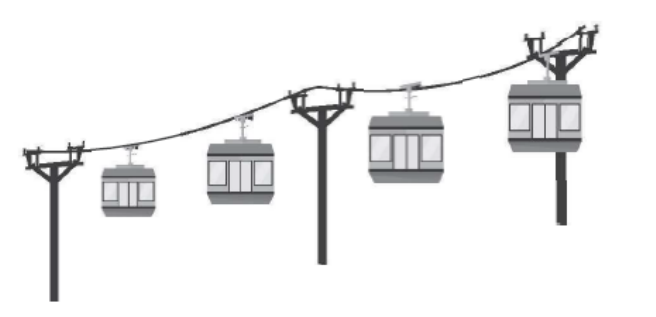
Cable cars at hill stations are one of the major tourist attractions. On a hill station, the length of cable car ride from base point to top most point on the hill is $5000$ m. Poles are installed at equal intervals on the way to provide support to the cables on which car moves. The distance of first pole from base point is $200$ m and subsequent poles are installed at equal interval of $150$ m. Further, the distance of last pole from the top is $300$ m. Based on above information, answer the following questions using Arithmetic Progression : (i) Find the distance of $10^{th}$ pole from the base. (ii) Find the distance between $15^{th}$ pole and $25^{th}$ pole. (iii) (a) Find the time taken by cable car to reach $15^{th}$ pole from the top if it is moving at the speed of $5$m/sec and coming from top. OR (iii) (b) Find the total number of poles installed along the entire journey.
Show SolutionHide Solution↓
AP formed is $200, 350, 500, ...$ (i) Distance of $10^{th}$ pole from base = $A_{10}$ $= 200+9\times 150$ $= 1550$ m (ii) Distance between $15^{th}$ pole and $25^{th}$ pole = $a_{25} - A_{15}$ $= 10 \times 150 = 1500$ m (iii) (a) Distance of $15^{th}$ pole from the top = $300 + 14 \times 150$ $= 2400$ m Time taken by cable car = $\frac{2400}{5} = 480$ seconds or $8$ minutes OR (iii) (b) Distance of last pole from the base = $(5000 – 300)$ m = $4700$ m $\therefore a_n = 4700$ $\Rightarrow 200+ (n – 1)150 = 4700$ Solving, we get $n = 31$
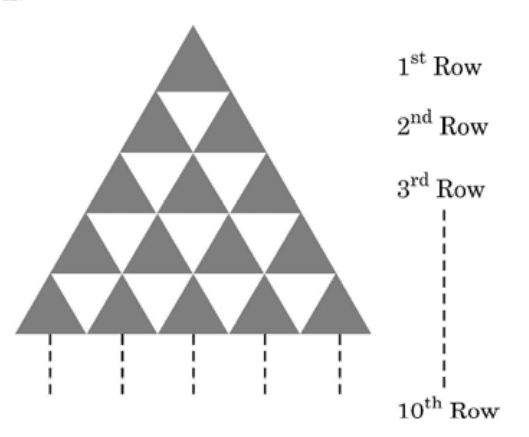
In an equilateral triangle of side 10 cm, equilateral triangles of side 1 cm are formed as shown in the figure below, such that there is one triangle in the first row, three triangles in the second row, five triangles in the third row and so on. Based on given information, answer the following questions using Arithmetic Progression. (i) How many triangles will be there in bottom most row? (ii) How many triangles will be there in fourth row from the bottom? (iii) (a) Find the total number of triangles of side 1 cm each till $8^{th}$ row. OR (iii) (b) How many more number of triangles are there from $5^{th}$ row to $10^{th}$ row than in first 4 rows? Show working.
Show SolutionHide Solution↓
Given A.P. is 1, 3, 5, ... (i) $a_{10} = 1 + 9 \times 2 = 19$ (ii) $a_4$ (from bottom) $= 19 + 3 \times (-2) = 13$ (iii) (a) $S_8 = \frac{8}{2} \times [2 \times 1 + 7 \times 2] = 64$ (iii) (b) Number of triangles from $5^{th}$ row to $10^{th}$ row $= S_{10} - S_4 = \frac{10}{2} \times [2 \times 1 + 9 \times 2] - \frac{4}{2} \times [2 \times 1 + 3 \times 2] = 84$. Number of triangles in first 4 rows, $S_4 = \frac{4}{2} \times [2 \times 1 + 3 \times 2] = 16$. Required number of triangles $= 84 - 16 = 68$
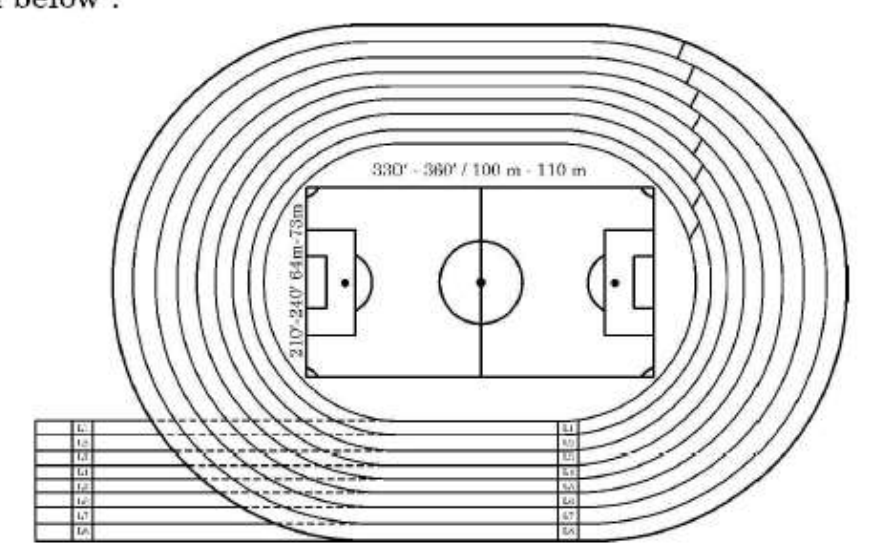
In order to organise, Annual Sports Day, a school prepared an eight lane running track with an integrated football field inside the track area as shown below: The length of innermost lane of the track is 400 m and each subsequent lane is 7.6 m longer than the preceding lane. Based on given information, answer the following questions, using concept of Arithmetic Progression. (i) What is the length of the 6th lane? (ii) How long is the 8th lane than that of 4th lane? (iii) (a) While practicing for a race, a student took one round each in first six lanes. Find the total distance covered by the student. OR (iii) (b) A student took one round each in lane 4 to lane 8. Find the total distance covered by the student.
Show SolutionHide Solution↓
Here AP is 400, 407.6, 415.2, ... (i) $a_6 = 400 + 5(7.6) = 438$ m (1 mark). (ii) $a_8 - a_4 = 30.4$ m (1 mark). (iii) $S_6 = \frac{6}{2}(2 \times 400 + 5 \times 7.6) = 2514$ m (1 + 1 marks). OR (iii) Total distance covered = $S_8 - S_3 = \frac{8}{2}(2 \times 400 + 7 \times 7.6) - \frac{3}{2}(2 \times 400 + 2 \times 7.6) = 2190$ m (1 + 1 marks).
To inculcate the good habit of savings in her children, Reema brought a piggy bank and after putting a ₹ $10$ coin in it, she handed it over to her daughter Amisha and asked as to put money in it from her pocket money at the beginning of every week. Amisha put two ten rupee coins at the beginning of next (second) week and in this way increases her savings by one ₹ $10$ coin every week. Based on the above, answer the following questions : (a) How many coins were added in the piggy bank at the beginning of $5^{th}$ week ? (b) How many ₹ $10$ coins will be there in the piggy bank after the end of $7$ weeks ? (c) (i) If the piggy bank can hold a maximum of $300$ ₹ $10$ coins, after how many weeks it would be full ? OR (c) (ii) Find the total amount of money in the piggy bank at the end of $20$ weeks.
250 logs are stacked in the following manner: 22 logs in the bottom row, 21 in the next row, 20 in the row next to it and so on (as shown by an example). In how many rows, are the 250 logs placed and how many logs are there in the top row?
Prerna saves ₹32 during the first month, ₹36 in the second month and ₹40 in the third month. If she continues to save in this manner, in how many months will she save ₹2,000?
Show SolutionHide Solution↓
ATQ, $32+36 +40 + ..... = 2,000$ $a = 32, d =4$ ($\frac{1}{2} + \frac{1}{2}$) Let 'n' be the number of months. $S_n = 2000$ $\frac{n}{2}[2(32) + (n - 1) 4] = 2000$ (1) $n^2 + 15n - 1000 = 0$ (1) $n^2 + 40n - 25n - 1000 = 0$ $(n + 40) (n - 25) = 0$ (1) $\Rightarrow n = -40, n = 25$ (rejecting) $\therefore n = 25$ (1) So, Prerna will save ₹2,000, in $25$ months.
A man starts his job with a certain monthly salary and earns a fixed increment every year. If his salary was ₹15,000 after $4$ years of service and ₹18,000 after $10$ years of service, what was his starting salary and what was the annual increment?
Show SolutionHide Solution↓
Let his starting salary is $a$ and annual increment be $d$. A.T.Q $a+3d=15000$ ---------(i) $a+9d=18000$ ----------(ii) On solving equations (i) & (ii) $a = 13500$ & $d = 500$ Starting salary = ₹13,500 Annual increment = ₹500
Two A.P.s have the same first term. The common difference of the first A.P. is $- 3$ and of the second A.P. is $- 5$. The difference of the $6^{th}$ term of the second A.P. from that of the first A.P. is :


._q_1.png)