Assertion (A): Point $P (0, 2)$ is the point of intersection of $y$-axis with the line $3x + 2y = 4$. Reason (R): The distance of point $P (0, 2)$ from $x$-axis is 2 units.
Show SolutionHide Solution↓
(B) Both Assertion (A) and Reason (R) are correct but Reason (R) is not the correct explanation of Assertion (A)
A$(-4, 5)$ and C$(8, 2)$ are the two opposite vertices of a parallelogram ABCD. Its diagonals intersect each other at P$(a, b)$. The relation between 'a' and 'b' is:
Find a relation between $x$ and $y$ such that $P(x, y)$ is equidistant from the points $A(3, 5)$ and $B(7, 1)$. Hence, write the coordinates of the points on $x$-axis and $y$-axis which are equidistant from points $A$ and $B$.
Show SolutionHide Solution↓
$PA = PB \implies PA^2 = PB^2$ $(x-3)^2 + (y-5)^2 = (x-7)^2 + (y-1)^2$ $\implies x - y = 2$ $\therefore$ Required point on $x$-axis is $(2, 0)$ $\&$ required point on $y$-axis is $(0, -2)$
Assertion (A): The point $(-2, 4)$ divides the line segment joining the points $(-4, 8)$ and $(5, -10)$ in the ratio $2 : 7$ internally. Reason (R): If three points $P$, $Q$ and $R$ are collinear, then $PQ + QR = PR$.
(a)Both Assertion (A) and Reason (R) are true and Reason (R) is the correct explanation of Assertion (A).
(b)Both Assertion (A) and Reason (R) are true, but Reason (R) is not the correct explanation of Assertion (A).
(c)Assertion (A) is true, but Reason (R) is false.
(d)Assertion (A) is false, but Reason (R) is true.
Show SolutionHide Solution↓
(B) Both Assertion(A) and Reason(R) are true, but Reason(R) is not the correct explanation of Assertion(A).
Show that the points $(-3, -3)$, $(3, 3)$ and $(-3\sqrt{3}, 3\sqrt{3})$ are the vertices of an equilateral triangle.
Show SolutionHide Solution↓
Let $A (-3, -3)$, $B (3, 3)$ and $C (-3\sqrt{3}, 3\sqrt{3})$ be the given points. Using distance formula $AB = \sqrt{(3 + 3)^2 + (3 + 3)^2} = 6\sqrt{2}$ units $BC = \sqrt{(-3\sqrt{3}- 3)^2 + (3\sqrt{3} - 3)^2} = 6\sqrt{2}$ units $CA = \sqrt{(-3 + 3\sqrt{3})^2 + (-3 - 3\sqrt{3})^2} = 6\sqrt{2}$ units As $AB = BC = CA$, so the given points are the vertices of an equilateral triangle.
Show that the points $(-2, 3)$, $(8, 3)$ and $(6, 7)$ are the vertices of a right-angled triangle.
Show SolutionHide Solution↓
Let the given points be A $(-2, 3)$, B $(8, 3)$ and C $(6, 7)$ Then, AB = $10$, BC = $\sqrt{4 + 16} = \sqrt{20}$, AC = $\sqrt{64 + 16} = \sqrt{80}$ $\therefore AB^2 = BC^2 + AC^2$ $\therefore$ the given points are the vertices of a right angled triangle.
Show that the points $(a, a)$, $(-a, -a)$ and $(-\sqrt{3}a, \sqrt{3}a)$ are the vertices of an equilateral triangle.
Show SolutionHide Solution↓
Let A $(a, a)$, B $(–a, –a)$ and C $(-\sqrt{3}a, \sqrt{3}a)$ be the given points. AB = $\sqrt{(-a - a)^2 + (-a - a)^2} = \sqrt{8a^2}$ or $2\sqrt{2} a$ BC = $\sqrt{(-\sqrt{3}a + a)^2 + (\sqrt{3}a + a)^2} = \sqrt{8a^2}$ or $2\sqrt{2} a$ CA = $\sqrt{(-\sqrt{3}a – a)^2 + (\sqrt{3}a – a)^2} = \sqrt{8a^2}$ or $2\sqrt{2} a$ Since AB = BC = CA Therefore, $\triangle$ ABC is an equilateral triangle.
A line segment joining the points $P(-5, 11)$ and $Q$ is divided internally by the point $M(2, - 3)$ such that $PM: MQ = 7 : 2$. The coordinates of $Q$ are :
Assertion (A): The point which divides the line segment joining the points $A (1, 2)$ and $B(-1, 1)$ internally in the ratio $1: 2$ is $(-\frac{1}{3}, \frac{5}{3})$. Reason (R): The coordinates of the point which divides the line segment joining the points $A (x_1, y_1)$ and $B(x_2, y_2)$ in the ratio $m_1: m_2$ are $(\frac{m_1x_2 + m_2x_1}{m_1 + m_2}, \frac{m_1y_2 + m_2y_1}{m_1 + m_2})$
Show SolutionHide Solution↓
(D) Assertion (A) is false, but Reason(R) is true.
Assertion (A): The point which divides the line segment joining the points A $(1, 2)$ and B$(-1, 1)$ internally in the ratio $1: 2$ is $\left(-\frac{1}{3}, \frac{5}{3}\right)$. Reason (R): The coordinates of the point which divides the line segment joining the points A $(x_1, y_1)$ and B$(x_2, y_2)$ in the ratio $m_1: m_2$ are $\left(\frac{m_1x_2 + m_2x_1}{m_1 + m_2}, \frac{m_1y_2 + m_2y_1}{m_1 + m_2}\right)$
Show SolutionHide Solution↓
(D) Assertion (A) is false, but Reason(R) is true.
Directions: Questions number $19$ and $20$ are Assertion and Reason based questions carrying $1$ mark each. Two statements are given, one labelled as Assertion (A) and the other is labelled as Reason (R). Select the correct answer to these questions from the codes (A), (B), (C) and (D) as given below: (A) Both Assertion (A) and Reason (R) are true and Reason (R) is the correct explanation of the Assertion (A). (B) Both Assertion (A) and Reason (R) are true, but Reason (R) is not the correct explanation of the Assertion (A). (C) Assertion (A) is true, but Reason (R) is false. (D) Assertion (A) is false, but Reason (R) is true. Assertion (A): The point which divides the line segment joining the points A $(1, 2)$ and B$(-1, 1)$ internally in the ratio $1: 2$ is $(\frac{-1}{3}, \frac{5}{3})$ Reason (R): The coordinates of the point which divides the line segment joining the points A $(x_1, y_1)$ and B$(x_2, y_2)$ in the ratio $m_1: m_2$ are $(\frac{m_1x_2 + m_2x_1}{m_1 + m_2}, \frac{m_1y_2 + m_2y_1}{m_1 + m_2})$
Show SolutionHide Solution↓
Sol. (D) Assertion (A) is false, but Reason(R) is true.
Questions number $19$ and $20$ are Assertion and Reason based questions. Two statements are given, one labelled as Assertion (A) and the other is labelled as Reason (R). Select the correct answer to these questions from the codes (A), (B), (C) and (D) as given below. (A) Both Assertion (A) and Reason (R) are true and Reason (R) is the correct explanation of the Assertion (A). (B) Both Assertion (A) and Reason (R) are true, but Reason (R) is not the correct explanation of the Assertion (A). (C) Assertion (A) is true, but Reason (R) is false. (D) Assertion (A) is false, but Reason (R) is true. Assertion (A): Mid-point of a line segment divides the line segment in the ratio $1:1$. Reason (R): The ratio in which the point $(-3, k)$ divides the line segment joining the points $(-5, 4)$ and $(-2, 3)$ is $1: 2$.
Assertion (A): Mid-point of a line segment divides the line segment in the ratio $1:1$. Reason (R): The ratio in which the point $(-3, k)$ divides the line segment joining the points $(-5, 4)$ and $(-2, 3)$ is $1: 2$.
Assertion (A): Mid-point of a line segment divides the line segment in the ratio $1:1$. Reason (R): The ratio in which the point $(-3, k)$ divides the line segment joining the points $(-5, 4)$ and $(-2, 3)$ is $1: 2$.
Find the ratio in which the point $(-1, k)$ divides the line segment joining the points $(-3, 10)$ and $(6,-8)$. Hence, find the value of $k$.
Show SolutionHide Solution↓
Let $C (-1, k)$ be divides the line segment joining the points $A (-3, 10)$ and $B (6, -8)$ in the ratio $m : 1$. Using section formula $-1 = \frac{-3+6m}{m+1}$ $\Rightarrow m = \frac{2}{7}$ Hence, required ratio is $2 : 7$ $k = \frac{10\times7-8\times2}{2+7} = 6$
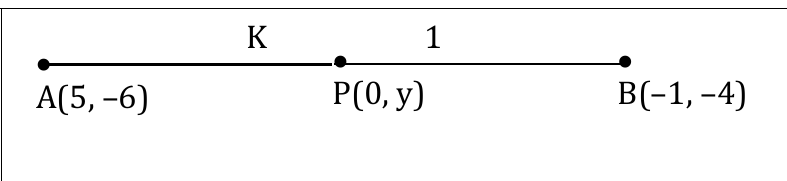
Find the ratio in which the y-axis divides the line segment joining the points $(5, - 6)$ and $(- 1, - 4)$. Also, find the point of intersection.
Show SolutionHide Solution↓
Let the ratio be $k:1$ Point of intersection is $(0,y)$ $0 = \frac{k(-1) + 1(5)}{k+1} \Rightarrow -k+5 = 0 \Rightarrow k=5$ Required ratio is $5:1$ $y = \frac{k(-4) + 1(-6)}{k+1} = \frac{5(-4)+1(-6)}{5+1} = \frac{-20-6}{6} = \frac{-26}{6} = -\frac{13}{3}$ Point of intersection is $(0, -\frac{13}{3})$
In what ratio is the line segment joining the points $(3, -5)$ and $(-1, 6)$ divided by the line $y = x$ ?
Show SolutionHide Solution↓
Let the required ratio be $K:1$ Coordinates of point $P$ are $(\frac{-K + 3}{K+1}, \frac{6K-5}{K+1})$ Point $P$ lies on line $y = x \Rightarrow \frac{-K + 3}{K+1} = \frac{6K - 5}{K+1}$ Solving, we get $K = \frac{8}{7}$ $\therefore$ Required ratio is $8:7$
In what ratio is the line segment joining the points $(3, -5)$ and $(-1, 6)$ divided by the line $y = x$ ?
Show SolutionHide Solution↓
Let the required ratio be $K:1$ Coordinates of point P are $(\frac{-K + 3}{K+1}, \frac{6K - 5}{K+1})$ Point P lies on line $y = x \Rightarrow \frac{-K + 3}{K + 1} = \frac{6K - 5}{K+1}$ Solving, we get $K = \frac{8}{7}$ $\therefore$ Required ratio is $8: 7$
Find the coordinates of the point C which lies on the line AB produced such that $AC = 2BC$, where coordinates of points A and B are $(-1, 7)$ and $(4,-3)$ respectively.
Show SolutionHide Solution↓
A $(-1, 7)$ B $(4, -3)$ C $(x, y)$ Let coordinates of point C be $(x, y)$ $AC = 2 BC$ $\Rightarrow$ B is mid-point of AC $\Rightarrow \frac{-1+x}{2} = 4 \Rightarrow x = 9$ $\frac{7+y}{2} = -3 \Rightarrow y = -13$ $\therefore$ Coordinates of C are $(9, -13)$
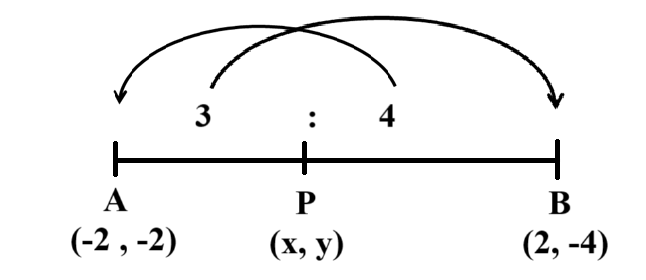
The coordinates of the end points of the line segment $AB$ are $A(-2, -2)$ and $B(2, -4)$. $P$ is the point on $AB$ such that $BP = \frac{4}{7}AB$. Find the coordinates of point $P$.
Show SolutionHide Solution↓
$P(x, y)$ divides $AB$ in the ratio $3:4$ $x = \frac{3 \times 2 + 4 \times (-2)}{4+3} \implies x = -\frac{2}{7}$ $y = \frac{3 \times (-4) + 4 \times (-2)}{4+3} \implies y = -\frac{20}{7}$ $\therefore$ Coordinates of $P$ are $(-\frac{2}{7}, -\frac{20}{7})$
Find the ratio in which the point $\left(\frac{8}{5}, y\right)$ divides the line segment joining the points $(1, 2)$ and $(2, 3)$. Also, find the value of $y$.
Show SolutionHide Solution↓
Sol. Let AP: PB = $k : 1$ $\frac{2k+1}{k+1} = \frac{8}{5}$ $\Rightarrow k = \frac{3}{2}$ $\therefore$ required ratio is $3: 2$. $y = \frac{3\times 3+2\times 2}{3+2} = \frac{13}{5}$
Find the ratio in which the line segment joining the points $(5, 3)$ and $(-1, 6)$ is divided by Y-axis.
Show SolutionHide Solution↓
Let the line segment divides y-axis at $(0, y)$. Let the required ratio be $k:1$ $\therefore 0 = \frac{(-1)k+5(1)}{k+1}$ $\Rightarrow k = 5$ Hence ratio is $5 : 1$
P$(-2, 5)$ and Q$(3, 2)$ are two points. Find the coordinates of the point R on line segment PQ such that $PR = 2QR$.
Show SolutionHide Solution↓
Let coordinates of R be $(x, y)$. $PR : RQ = 2 : 1$ $x = \frac{2(3)+1(-2)}{2+1} = \frac{4}{3}$ $y = \frac{2(2)+1(5)}{2+1} = 3$ $\therefore$ Coordinates of the point R $(\frac{4}{3}, 3)$
In what ratio does the X-axis divides the line segment joining the points$(2, -3)$ and $(5, 6)$? Also, find the coordinates of the point of intersection.
Show SolutionHide Solution↓
Let the co ordinate of the point of intersection be $(x, 0)$. Let ratio be $k:1$ $\frac{6k-3}{k+1} = 0$ $\Rightarrow k = \frac{1}{2}$ $\therefore$ required ratio is $1: 2$ $x = \frac{5\times1+2\times2}{1+2} = \frac{9}{3} = 3$ $\therefore$ the co ordinate of the point of intersection is $(3,0)$
Find the ratio in which the y-axis divides the line segment joining the points $(5, -6)$ and $(-1, -4)$. Also find the point of intersection.
Show SolutionHide Solution↓
Let the ratio be $k:1$ and point on y-axis be $P(0, y)$. $0 = \frac{-k + 5}{k + 1} \implies k = 5$. Hence, ratio is $5:1$. $y = \frac{-4(5) - 6}{5 + 1} = \frac{-26}{6} = \frac{-13}{3}$. Coordinates of point of intersection are $P(0, -\frac{13}{3})$.
Find the ratio in which the y-axis divides the line segment joining the points $(5, -6)$ and $(-1, -4)$. Also find the point of intersection.
Show SolutionHide Solution↓
Let the ratio be $k:1$ and point on y- axis be $P(0, y)$ $0 = \frac{-k+5}{k+1}$ $k = 5$ Hence, ratio is $5:1$ $y = \frac{-4(5)-6}{5+1} = \frac{-26}{6} = -\frac{13}{3}$ Coordinates of point of intersection are $P(0, -\frac{13}{3})$
Find the coordinates of the points which divide the line segment joining $A(-2, 2)$ and $B(2, 8)$ into four equal parts.
Show SolutionHide Solution↓
Sol. $A(-2, 2) \quad P \quad Q \quad R \quad B(2, 8)$ Coordinates of mid – point Q of AB $= (0,5)$ Coordinates of mid – point P of AQ $= (-1, \frac{7}{2})$ Coordinates of mid – point R of BQ $= (1, \frac{13}{2})$
Find the coordinates of the points which divide the line segment joining A $(-2, 2)$ and B $(2, 8)$ into four equal parts.
Show SolutionHide Solution↓
Sol. Let points P, Q and R divide the line segment joining A $(-2, 2)$ and B $(2, 8)$ into four equal parts. $\therefore$ P divides AB in the ratio $1:3$ or AP : PB = $1:3$ So, coordinates of P = $(\frac{1\times2+3\times(-2)}{1+3}, \frac{1\times8+3\times2}{1+3}) = (-1, \frac{7}{2})$ $\therefore$ Q divides AB in the ratio $1:1$ or AQ : QB = $1:1$ So, coordinates of P = $(\frac{1\times2+1\times(-2)}{1+1}, \frac{1\times8+1\times2}{1+1}) = (0,5)$ $\therefore$ R divides AB in the ratio $3:1$ or AR : RB = $3:1$ So, coordinates of P = $(\frac{3\times2+1\times(-2)}{3+1}, \frac{3\times8+1\times2}{3+1}) = (1, \frac{13}{2})$
If A(-2,-1), B(a, 0), C(4, b) and D(1, 2) are the vertices of a parallelogram ABCD, then find the values of a and b.
Show SolutionHide Solution↓
Sol. Coordinates of the mid-point of AC = Coordinates of the mid-point of BD $(\frac{-2+4}{2}, \frac{-1+b}{2}) = (\frac{a+1}{2}, \frac{0+2}{2})$ $\therefore \frac{-2+4}{2} = \frac{a+1}{2} \Rightarrow a=1$ (1/2 Mark) and $\frac{-1+b}{2} = \frac{0+2}{2} \Rightarrow b=3$ (1/2 Mark)
The three vertices of a parallelogram ABCD, taken in order, are A(-1, 0), B(3, 1) and C(2, 2). Find the coordinates of the fourth vertex D.
Show SolutionHide Solution↓
Sol. Let the coordinates of fourth vertex D be $(x, y)$ Coordinates of the mid-point of AC = Coordinates of the mid-point of BD $(\frac{-1+2}{2}, \frac{0+2}{2}) = (\frac{3+x}{2}, \frac{1+y}{2})$ $\therefore \frac{-1+2}{2} = \frac{3+x}{2} \Rightarrow x=-2$ (1/2 Mark) and $\frac{0+2}{2} = \frac{1+y}{2} \Rightarrow y=1$ (1/2 Mark)
If $\text{P}$ is the mid-point of the line segment forming the points $\text{A}(-2, 8)$ and $\text{B}(-6, -4)$, then the coordinates of $\text{P}$ are:
Assertion (A): If the points $A(4, 3)$ and $B(x, 5)$ lie on a circle with centre $O(2, 3)$, then the value of $x$ is $2$. Reason (R): Centre of a circle is the mid-point of each chord of the circle.
Show SolutionHide Solution↓
(c) Assertion (A) is true, but Reason (R) is false
ABC is a triangle. B lies on x-axis at a distance of 4 units from y-axis at its right. C is on y-axis and it is 3 units away from the origin. If the coordinates of A are (0, 0), the perimeter of $\triangle ABC$ is :
The line represented by $\frac{x}{4} + \frac{y}{6} = 1$, intersects $x$-axis and $y$-axis respectively at P and Q. The coordinates of the mid-point of line segment PQ are:
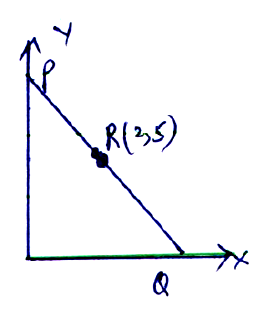
A line intersects $y$-axis and $x$-axis at point $P$ and $Q$, respectively. If $R(2, 5)$ is the mid-point of line segment $PQ$, then find the coordinates of $P$ and $Q$.
Show SolutionHide Solution↓
Let the coordinates of $P$ and $Q$ be $(0, y)$ and $(x, 0)$ respectively. $\therefore R(2, 5)$ is the midpoint of $PQ$ $\frac{0+x}{2} = 2$ and $\frac{y+0}{2} = 5$ $\therefore x = 4, y = 10$ $P(0, 10)$ and $Q(4, 0)$
The vertices of a $\Delta ABC$ are A$(-2, 4)$, B$(4, 3)$ and C$(1, -6)$. Find length of the median BD.
Show SolutionHide Solution↓
Mid-point of AC is D $(\frac{-1}{2}, -1)$ (1) Length of median BD $= \sqrt{(4+\frac{1}{2})^2+(3+1)^2} = \sqrt{\frac{145}{4}}$ or $\frac{\sqrt{145}}{2}$ (1)
Points $A(-1, y)$ and $B(5, 7)$ lie on a circle with centre $O(2, -3y)$ such that $AB$ is a diameter of the circle. Find the value of $y$. Also, find the radius of the circle.
Show SolutionHide Solution↓
Centre $O (2, -3y)$ is the mid point of $AB$ $\frac{-1+5}{2} = 2$, $\frac{y+7}{2} = -3y$ $\Rightarrow y = -1$ Radius = $OB = \sqrt{(5 - 2)^2 + (7 - (-1))^2} = 5$
The coordinates of the centre of a circle are $(2a, a - 7)$. Find the value(s) of '$a$' if the circle passes through the point $(11, -9)$ and has diameter $10\sqrt{2}$ units.
Find the length of the median through the vertex B of $\triangle ABC$ with vertices A($9$, $-2$), B($-3$, $7$) and C($-1$, $10$).
Show SolutionHide Solution↓
Mid point of AC = $(4,4)$ Length of median from B to AC = $\sqrt{(4+3)^2 + (4-7)^2}$ $= \sqrt{7^2 + (-3)^2} = \sqrt{49+9} = \sqrt{58}$ Hence the length of median is $\sqrt{58}$ units
Find the coordinates of the point C which lies on the line AB produced such that $AC = 2BC$, where coordinates of points A and B are $(-1, 7)$ and $(4, -3)$ respectively.
Show SolutionHide Solution↓
Let coordinates of point C be $(x, y)$. $AC = 2BC \implies B$ is mid-point of $AC$. $\frac{-1+x}{2} = 4 \implies x = 9$. $\frac{7+y}{2} = -3 \implies y = -13$. $\therefore$ Coordinates of C are $(9, -13)$.
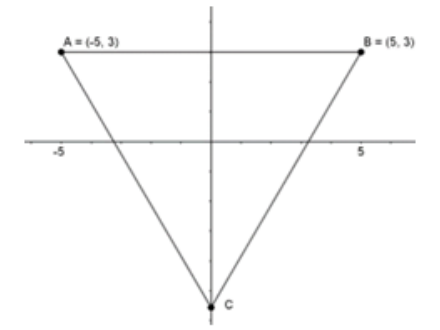
If $(-5,3)$ and $(5,3)$ are two vertices of an equilateral triangle, then find coordinates of the third vertex, given that origin lies inside the triangle. (Take $\sqrt{3}= 1.7$)
Show SolutionHide Solution↓
Let the third vertex be $(x,y)$ $A (-5,3)$ $B(5,3)$ $C(x,y)$ $AB=10=AC$ $AC^2=100$ $(-5-x)^2+(3-y)^2 = (5-x)^2+(3-y)^2$ $20x =0$ $x=0$ $(3-y)^2=75$ $3-y = \pm 5\sqrt{3}$ $y=3-5\sqrt{3}$ $y= -5.5$ The coordinates of the third vertex are $(0,-5.5)$
The centre of a circle is $(2a, a-7)$. Find the values of '$a$' if the circle passes through the point $(11,-9)$. Radius of the circle is $5\sqrt{2}$ cm.
If $(-5,3)$ and $(5,3)$ are two vertices of an equilateral triangle, then find coordinates of the third vertex, given that origin lies inside the triangle. (Take $\sqrt{3}= 1.7$)
Show SolutionHide Solution↓
Let the third vertex be $$\begin{aligned}& (x,y) \\ & A (-5,3) B(5,3) C(x,y) \\ & AB=10=AC \\ & AC^2=100 \\ & (-5-x)^2+(3-y)^2 = (5-x)^2+(3-y)^2 \\ & 20x =0 \\ & x=0 \\ & (3-y)^2=75 \\ & 3-y = \pm5\sqrt{3} \\ & y=3-5\sqrt{3} \\ & y= -5.5 \\ & \text{The coordinates of the third vertex are } (0,-5.5)\end{aligned}$$
ABCD is a rectangle formed by the points $A (-1, -1)$, $B (-1, 6)$, $C (3, 6)$ and $D (3, -1)$. P, Q, R and S are mid-points of sides AB, BC, CD and DA respectively. Show that diagonals of the quadrilateral PQRS bisect each other.
Show SolutionHide Solution↓
Sol. Co-ordinates of point P are $\left(\frac{-1-1}{2}, \frac{-1+6}{2}\right)$ i.e. $\left(-1,\frac{5}{2}\right)$ Co-ordinates of point Q are $\left(\frac{-1+3}{2}, \frac{6+6}{2}\right)$ i.e. $(1, 6)$ Co-ordinates of point R are $\left(\frac{3+3}{2}, \frac{6-1}{2}\right)$ i.e. $\left(3,\frac{5}{2}\right)$ Co-ordinates of point S are $\left(\frac{-1+3}{2}, \frac{-1-1}{2}\right)$ i.e. $(1,-1)$ Co-ordinates of mid point of diagonal QS are $\left(\frac{1+1}{2}, \frac{6-1}{2}\right)$ i.e. $\left(1,\frac{5}{2}\right)$ Co-ordinates of mid point of diagonal PR are $\left(\frac{-1+3}{2}, \frac{5+5}{2}\right)$ i.e. $\left(1,\frac{5}{2}\right)$ Since coordinates of mid point of QS = coordinates of mid point of PR Therefore, diagonals PR and QS bisect each other.
ABCD is a rectangle formed by the points A $(-1, -1)$, B $(-1, 6)$, C $(3, 6)$ and D $(3, -1)$. P, Q, R and S are mid-points of sides AB, BC, CD and DA respectively. Show that diagonals of the quadrilateral PQRS bisect each other.
Show SolutionHide Solution↓
Co-ordinates of point P are $(\frac{-1-1}{2}, \frac{-1+6}{2})$ i.e. $(-1, \frac{5}{2})$ Co-ordinates of point Q are $(\frac{-1+3}{2}, \frac{6+6}{2})$ i.e. $(1, 6)$ Co-ordinates of point R are $(\frac{3+3}{2}, \frac{6-1}{2})$ i.e. $(3, \frac{5}{2})$ Co-ordinates of point S are $(\frac{-1+3}{2}, \frac{-1-1}{2})$ i.e. $(1, -1)$ Co-ordinates of mid point of diagonal QS are $(\frac{1+1}{2}, \frac{6-1}{2})$ i.e. $(1, \frac{5}{2})$ Co-ordinates of mid point of diagonal PR are $(\frac{-1+3}{2}, \frac{5/2+5/2}{2})$ i.e. $(1, \frac{5}{2})$ Since coordinates of mid point of QS = coordinates of mid point of PR Therefore, diagonals PR and QS bisect each other.
ABCD is a rectangle formed by the points $A (-1, -1)$, $B (-1, 6)$, $C (3, 6)$ and $D (3, -1)$. P, Q, R and S are mid-points of sides AB, BC, CD and DA respectively. Show that diagonals of the quadrilateral PQRS bisect each other.
Show SolutionHide Solution↓
Co-ordinates of point P are $(\frac{-1-1}{2}, \frac{-1+6}{2})$ i.e. $(-1, \frac{5}{2})$ Co-ordinates of point Q are $(\frac{-1+3}{2}, \frac{6+6}{2})$ i.e. $(1, 6)$ Co-ordinates of point R are $(\frac{3+3}{2}, \frac{6-1}{2})$ i.e. $(3, \frac{5}{2})$ Co-ordinates of point S are $(\frac{-1+3}{2}, \frac{-1-1}{2})$ i.e. $(1, -1)$ Co-ordinates of mid point of diagonal QS are $(\frac{1+1}{2}, \frac{6-1}{2})$ i.e. $(1, \frac{5}{2})$ Co-ordinates of mid point of diagonal PR are $(\frac{-1+3}{2}, \frac{5}{2})$ i.e. $(1, \frac{5}{2})$ Since coordinates of mid point of QS = coordinates of mid point of PR Therefore, diagonals PR and QS bisect each other.
$P (x, y)$, $Q (-2, – 3)$ and $R (2, 3)$ are the vertices of a right triangle PQR right angled at P. Find the relationship between $x$ and $y$. Hence, find all possible values of $x$ for which $y = 2$.
If the points $A(6, 1)$, $B(p, 2)$, $C(9, 4)$ and $D(7, q)$ are the vertices of a parallelogram $ABCD$, then find the values of $p$ and $q$. Hence, check whether $ABCD$ is a rectangle or not.
Show SolutionHide Solution↓
Diagonals of a parallelogram bisect each other. $\therefore$ Co-ordinates of mid point of diagonal $AC$ = Co-ordinates of mid-point of diagonal $BD$. $(\frac{6+9}{2}, \frac{1+4}{2}) = (\frac{p+7}{2}, \frac{2+q}{2})$ (1 mark). $\Rightarrow \frac{p+7}{2} = \frac{15}{2}$ and $\frac{2+q}{2} = \frac{5}{2}$. $\therefore p=8$ and $q=3$ ($\frac{1}{2}$ mark). Diagonal $AC = \sqrt{3^2 + 3^2} = 3\sqrt{2}$ ($\frac{1}{2}$ mark). Diagonal $BD = \sqrt{(-1)^2 + 1^2} = \sqrt{2}$ ($\frac{1}{2}$ mark). $AC \neq BD \therefore ABCD$ is not a rectangle ($\frac{1}{2}$ mark).
Case Study – 2 Morning assembly is an integral part of every school's schedule. In the assembly, students always stand in rows and columns and this makes a coordinate system. In a school, there are $200$ students and they all assemble for prayer in $10$ rows. $4$ students are at A, B, C and D with the following positions of the coordinate system : A $(3, 4)$, B $(6, 7)$, C $(9, 4)$ and D $(6, 1)$. Based on the above, answer the following questions : (a) Find the distance between A and B. (b) Find the distance between C and D. (c) Show that ABCD forms a parallelogram. OR (c) Find the mid-point of the line segments AC and BD.
Show SolutionHide Solution↓
(a) Distance between A $(3,4)$ and B $(6,7)$: $AB = \sqrt{(6-3)^2 + (7-4)^2} = \sqrt{3^2 + 3^2} = \sqrt{9+9} = \sqrt{18} = 3\sqrt{2}$ units. (b) Distance between C $(9,4)$ and D $(6,1)$: $CD = \sqrt{(6-9)^2 + (1-4)^2} = \sqrt{(-3)^2 + (-3)^2} = \sqrt{9+9} = \sqrt{18} = 3\sqrt{2}$ units. (c) (i) To show ABCD forms a parallelogram, we can show opposite sides are equal or diagonals bisect each other. Using distance formula for all sides: $AB = 3\sqrt{2}$ (from part a) $CD = 3\sqrt{2}$ (from part b) Distance between B $(6,7)$ and C $(9,4)$: $BC = \sqrt{(9-6)^2 + (4-7)^2} = \sqrt{3^2 + (-3)^2} = \sqrt{9+9} = \sqrt{18} = 3\sqrt{2}$ units. Distance between A $(3,4)$ and D $(6,1)$: $AD = \sqrt{(6-3)^2 + (1-4)^2} = \sqrt{3^2 + (-3)^2} = \sqrt{9+9} = \sqrt{18} = 3\sqrt{2}$ units. Since all sides are equal ($AB=BC=CD=DA=3\sqrt{2}$), ABCD is a rhombus, which is a type of parallelogram. OR (c) (ii) Mid-point of AC: A $(3,4)$, C $(9,4)$ Mid-point $= (\frac{3+9}{2}, \frac{4+4}{2}) = (\frac{12}{2}, \frac{8}{2}) = (6,4)$. Mid-point of BD: B $(6,7)$, D $(6,1)$ Mid-point $= (\frac{6+6}{2}, \frac{7+1}{2}) = (\frac{12}{2}, \frac{8}{2}) = (6,4)$. Since the mid-points of AC and BD are the same, the diagonals bisect each other. Therefore, ABCD is a parallelogram.
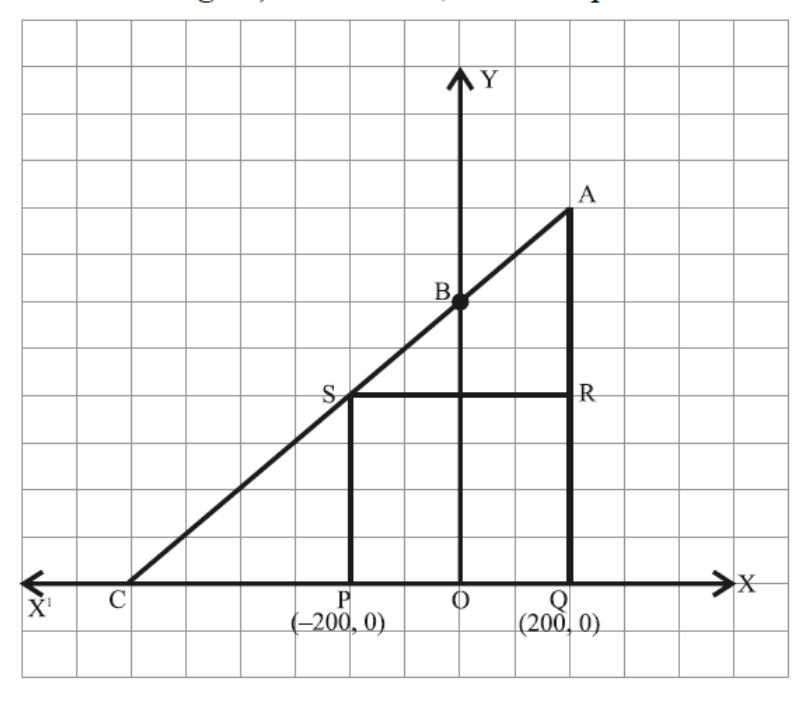
Jagdish has a field which is in the shape of a right angled triangle AQC. He wants to leave a space in the form of a square PQRS inside the field for growing wheat and the remaining for growing vegetables (as shown in the figure). In the field, there is a pole marked as O. Based on the above information, answer the following questions : (i) Taking O as origin, coordinates of P are $(-200, 0)$ and of Q are $(200, 0)$. PQRS being a square, what are the coordinates of R and S? (ii) (a) What is the area of square PQRS ? OR (b) What is the length of diagonal PR in square PQRS ? (iii) If S divides CA in the ratio K:1, what is the value of K, where point A is $(200, 800)$ ?
Show SolutionHide Solution↓
Sol. (i) R$(200, 400)$, S$(-200, 400)$(ii) (a) side PQ = $(200+200)$ m = $400$ m Area of square PQRS = $400 \times 400$ $= 160000$ sq. units OR (ii) (b) Diagonal PR = $\sqrt{(400)^2 + (400)^2}$ $= \sqrt{3200}$ or $400\sqrt{2}$ (iii) C$(-600,0)$; A$(200,800)$; S$(-200,400)$ S divides CA in the ratio k: $1$ $-200 = \frac{k(200)+1(-600)}{k+1}$ $\Rightarrow k = 1$
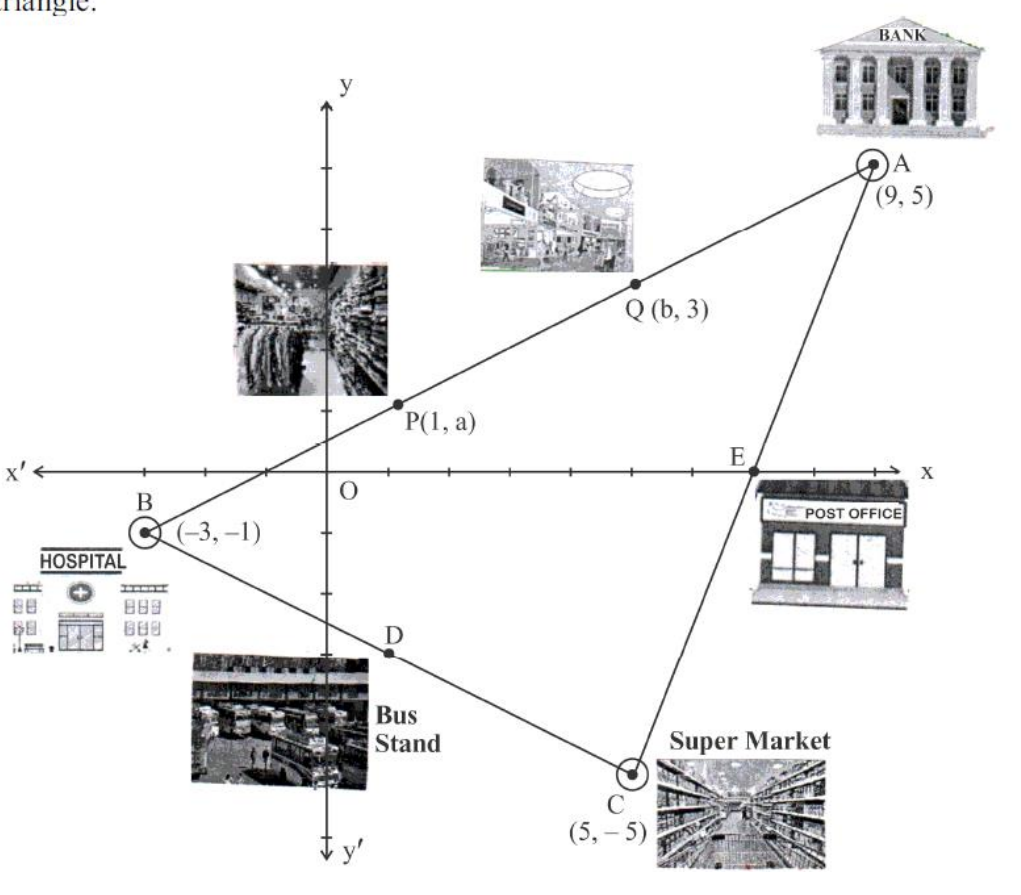
Partha, a software engineer, lives in Jerusalem for his work. He lives in the most convenient area of the city from where bank, hospital, post office and supermarket can be easily accessed. In the graph, the bank is plotted as A$(9, 5)$, hospital as B$(-3,-1)$ and supermarket as C$(5,-5)$ such that A, B, C form a triangle. Based on the above given information, answer the following questions : (i) Find the distance between the bank and the hospital. (ii) In between the bank and the supermarket, there is a post office plotted at E which is their mid-point. Find the coordinates of E. (iii) (a) In between the hospital and the supermarket, there is a bus stop plotted as D, which is their mid-point. If Partha wants to reach the bus stand from the bank, then how much distance does he need to cover ? OR (b) P and Q are two different garment shops lying between the bank and the hospital, such that BP = PQ = QA. If the coordinates of P and Q are $(1, a)$ and $(b, 3)$ respectively, then find the values of 'a' and 'b'.
Show SolutionHide Solution↓
(i) Distance between bank and hospital $= \sqrt{(-3-9)^2 + (-1 - 5)^2}$ $= \sqrt{180}$ units or $6\sqrt{5}$ units (ii) Coordinates of E are $(\frac{9+5}{2}, \frac{5+(-5)}{2}) = (7,0)$ (iii) (a) Coordinates of D are $(\frac{-3+5}{2}, \frac{-1+(-5)}{2}) = (1, -3)$ Distance Partha need to cover $= \sqrt{(9-1)^2 + (5 - (-3))^2}$ $= \sqrt{128}$ units or $8\sqrt{2}$ units OR (iii) (b) P is mid-point of BQ $\therefore a = \frac{-1+3}{2} = 1$ Q is mid-point of PA $\therefore b = \frac{1+9}{2} = 5$
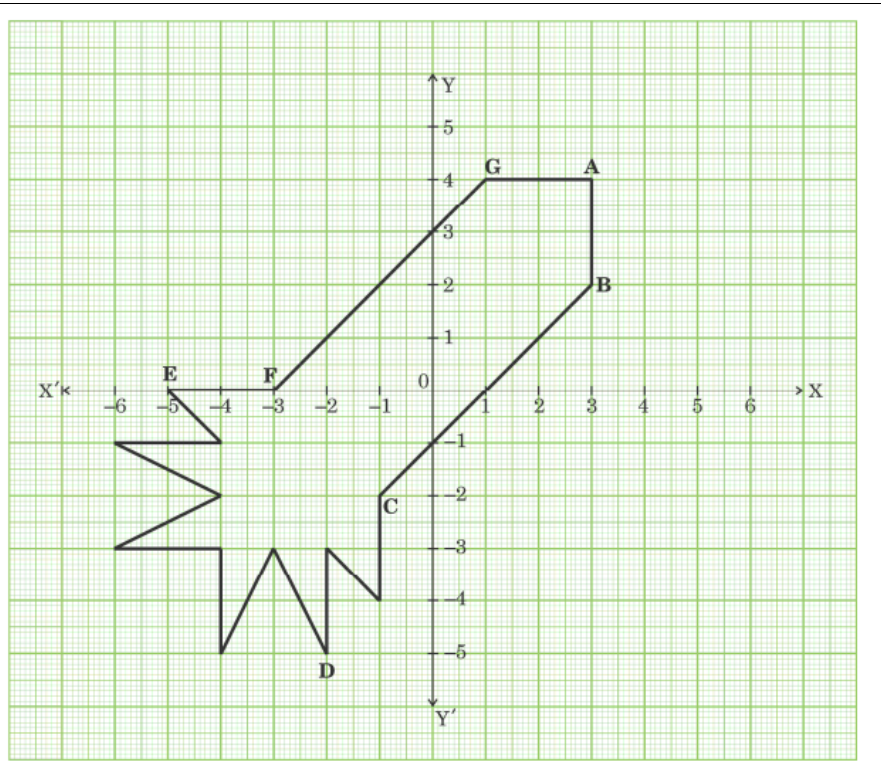
Case Study - 1 Ryan, from a very young age, was fascinated by the twinkling of stars and the vastness of space. He always dreamt of becoming an astronaut one day. So he started to sketch his own rocket designs on the graph sheet. One such design is given below : Based on the above, answer the following questions : (i) Find the mid-point of the segment joining F and G. (ii) (a) What is the distance between the points A and C? OR (b) Find the coordinates of the point which divides the line segment joining the points A and B in the ratio $1:3$ internally. (iii) What are the coordinates of the point D?
Show SolutionHide Solution↓
(i) Mid point of FG is $(\frac{-3+1}{2}, \frac{0+4}{2}) = (-1,2)$ (ii) (a) $$\begin{aligned}& AC = \sqrt{(1-3)^2 + (-2 - 4)^2} \\ & = \sqrt{52}\end{aligned}$$ or $2\sqrt{13}$ OR (ii) (b) The coordinates of required point are $$\begin{aligned}& (\frac{1\times3+3\times3}{1+3}, \frac{1\times2+3\times4}{1+3}) \\ & \text{i.e. } (3,\frac{7}{2}) \\ & (iii)\end{aligned}$$D(-2, -5)$
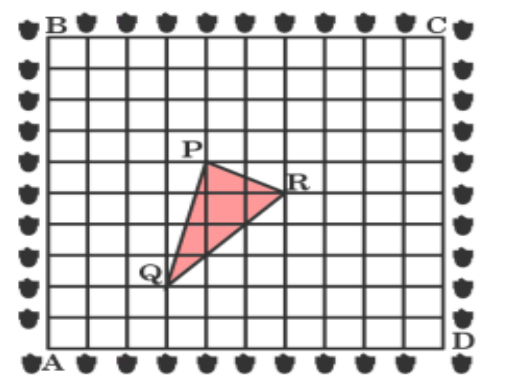
A garden is in the shape of a square. The gardener grew saplings of Ashoka tree on the boundary of the garden at the distance of $1 \text{ m}$ from each other. He wants to decorate the garden with rose plants. He chose a triangular region inside the garden to grow rose plants. In the above situation, the gardener took help from the students of class $10$. They made a chart for it which looks like the given figure. Based on the above, answer the following questions : (i) If A is taken as origin, what are the coordinates of the vertices of $\triangle PQR$? (ii) (a) Find distances PQ and QR. OR (b) Find the coordinates of the point which divides the line segment joining points P and R in the ratio $2: 1$ internally. (iii) Find out if $\triangle PQR$ is an isosceles triangle.
Show SolutionHide Solution↓
(i) $$\begin{aligned}& P (4,6), Q (3, 2), R (6, 5) \\ & (ii) (a) PQ = \sqrt{(4-3)^2 + (6 - 2)^2} = \sqrt{17} \\ & QR = \sqrt{(3 - 6)^2 + (2 - 5)^2} = \sqrt{18} \\ & \text{OR} \\ & (b) \text{ The coordinate of required point are } \left( \frac{6\times 2+1\times 4}{3}, \frac{5\times 2+1\times 6}{3} \right) \\ & \text{i.e. } \left( \frac{16}{3}, \frac{16}{3} \right) \\ & (iii) PQ = \sqrt{(4-3)^2 + (6-2)^2} = \sqrt{17} \\ & QR = \sqrt{(3 - 6)^2 + (2 - 5)^2} = \sqrt{18} \\ & PR = \sqrt{(4 - 6)^2 + (6-5)^2} = \sqrt{5} \\ & PQ \neq QR \neq PR \\ & \triangle PQR \text{ is not isosceles}\end{aligned}$$
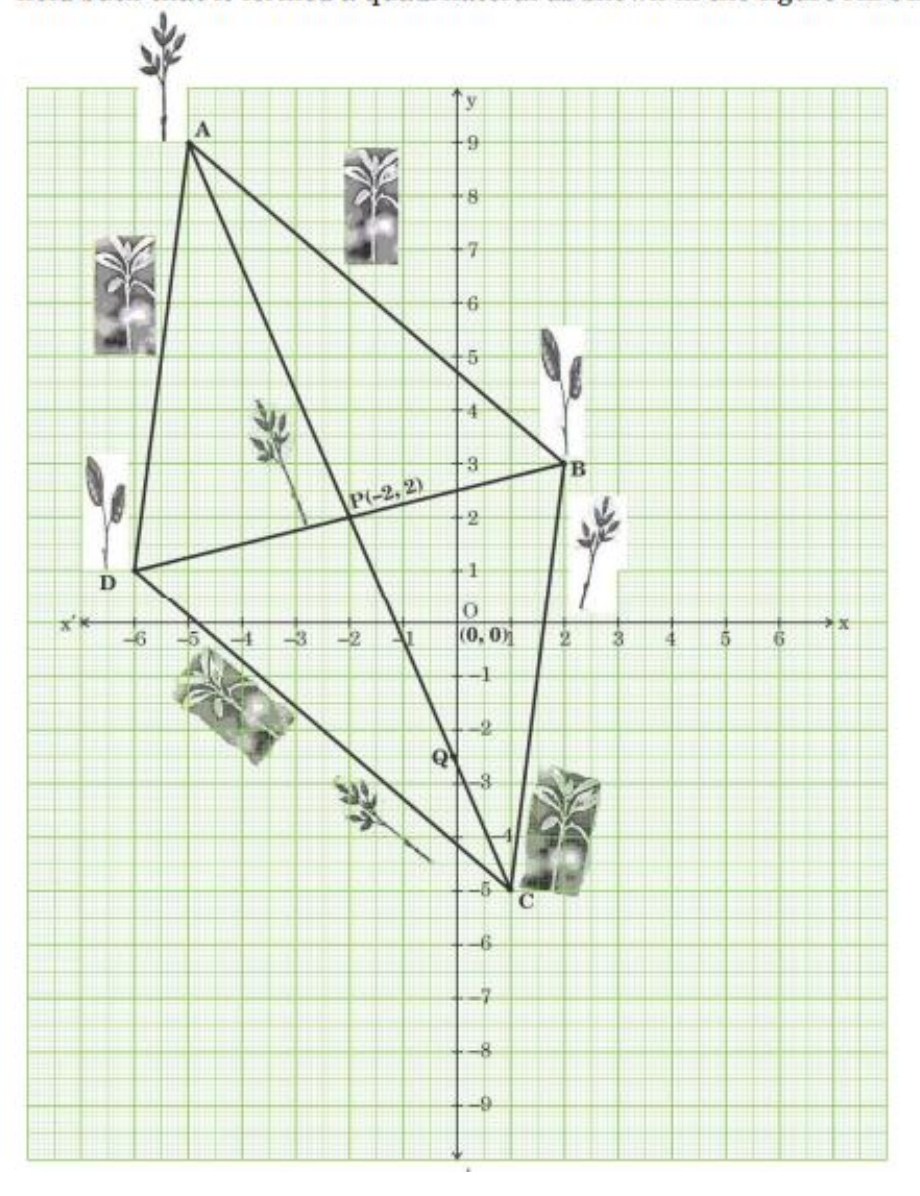
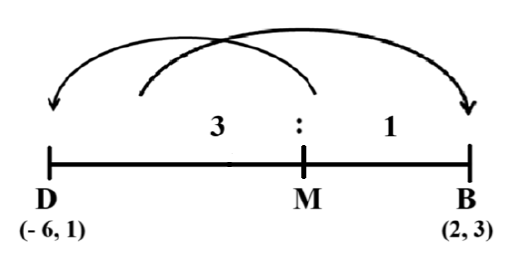
Case Study -3 Trees act the natural filters. By planting trees in and around school premises, we create cleaner and healthier air for students and local residents, reducing respiratory problems. A school in Noida has proposed and organised a community drive on tree plantation under the title "Save Earth, Plant Trees". Students of that school have planted saplings in the field such that it formed a quadrilateral as shown in the figure ABCD. Based on the information given above, answer the following questions : (i) Find the distance between the two saplings at A and D. (ii) (a) One student plants one sapling at the mid-point of AD. Then he moves along a straight line parallel to DB and sows another sapling on AB. What are the coordinates of the positions of these two new saplings? OR (ii) (b) A new sapling is kept at a point M on DB such that DM : MB = $3:1$. Find the coordinates of M. (iii) The line segments AC and BD bisect each other at P$(-2, 2)$. Find the coordinates of C.
Show SolutionHide Solution↓
(i) Observing the graph, coordinators of points are A $(-5, 9)$ and D $(-6, 1)$ AD = $\sqrt{(-6 + 5)^2 + (1 - 9)^2} = \sqrt{65}$ (ii) (a) Mid point of AD = $\left(\frac{-6-5}{2}, \frac{1+9}{2}\right)$ i.e. $\left(-\frac{11}{2}, 5\right)$ Student will sow another sapling at mid point of AB. Point B is $(2, 3)$ Mid point of AB = $\left(\frac{2-5}{2}, \frac{3+9}{2}\right)$ i.e. $\left(-\frac{3}{2}, 6\right)$ OR (b) Coordinates of M = $\left(\frac{3 \times 2 + 1 \times (-6)}{3+1}, \frac{3 \times 3 + 1 \times 1}{3+1}\right)$ i.e. $\left(0, \frac{5}{2}\right)$ (iii) Coordinates of C are $(1, -5)$



._a_1.png)
_a_1.png)

_a_1.png)