Assertion (A) : The probability that a leap year has $53$ Sundays is $\frac{2}{7}$. Reason (R) : The probability that a non-leap year has $53$ Sundays is $\frac{5}{7}$.
(a)Both Assertion (A) and Reason (R) are true and Reason (R) is the correct explanation of Assertion (A).
(b)Both Assertion (A) and Reason (R) are true and Reason (R) is not the correct explanation of Assertion (A).
(c)Assertion (A) is true but Reason (R) is false.
(d)Assertion (A) is false but Reason (R) is true.
Show SolutionHide Solution↓
Sol. (c) Assertion (A) is true but Reason (R) is false
A bag contains 5 pink, 8 blue and 7 yellow balls. One ball is drawn at random from the bag. What is the probability of getting neither a blue nor a pink ball?
A bag contains $3$ red balls, $5$ white balls and $7$ black balls. The probability that a ball drawn from the bag at random will be neither red nor black is :
Letters A to F are mentioned on six faces of a die such that each face has a different letter. Two such die are thrown simultaneously. The probability that vowels turn up on both the dice is :
A piggy bank contains ₹ 1 coins and ₹ 2 coins in the ratio 9 : 11 respectively. The piggy bank is accidently dropped and a coin pops out of it. The probability that it is a ₹ 2 coin is
A bag contains red coloured, blue coloured and green coloured balls in the ratio $2 : 3 : 4$. A ball is drawn at random from the given bag. The probability that the ball so drawn being not of blue colour is
A bag contains 4 red, 3 blue and 2 yellow balls. One ball is drawn at random from the bag. Find the probability that drawn ball is (i) red (ii) yellow.
Show SolutionHide Solution↓
Total No of Balls=9 (i) P(drawn ball is red) = $\frac{4}{9}$ (ii) P(drawn ball is yellow) = $\frac{2}{9}$
A carton consists of $60$ shirts of which $48$ are good, $8$ have major defects and $4$ have minor defects. Nigam, a trader, will accept the shirts which are good but Anmol, another trader, will only reject the shirts which have major defects. One shirt is drawn at random from the carton. Find the probability that it is acceptable to Anmol.
Show SolutionHide Solution↓
Number of Shirts without major defects = $52$ $P(\text{ Anmol will accept the shirt}) = \frac{52}{60} \text{ or } \frac{13}{15}$
Two friends Anil and Ashraf were born in the December month in the year $2010$. Find the probability that : (i) they share same date of birth. (ii) they have different dates of birth.
Show SolutionHide Solution↓
Number of days in December $2010 = 31$ (i) P (same date of birth) = $\frac{1}{31}$ (ii) P (different dates of birth) = $\frac{30}{31}$
If $65\%$ of the population has black eyes, $25\%$ have brown eyes and the remaining have blue eyes, what is the probability that a person selected at random has : (a) blue eyes? (b) brown or black eyes?
Show SolutionHide Solution↓
Population having blue eyes = $$\begin{aligned}& (100 - 65 - 25)\% = 10\% \\ & (a) \text{ P(blue eyes)} = 10\% \text{ or } \frac{1}{10} \\ & (b) \text{ P(brown or black eyes)} = 90\% \text{ or } \frac{9}{10}\end{aligned}$$
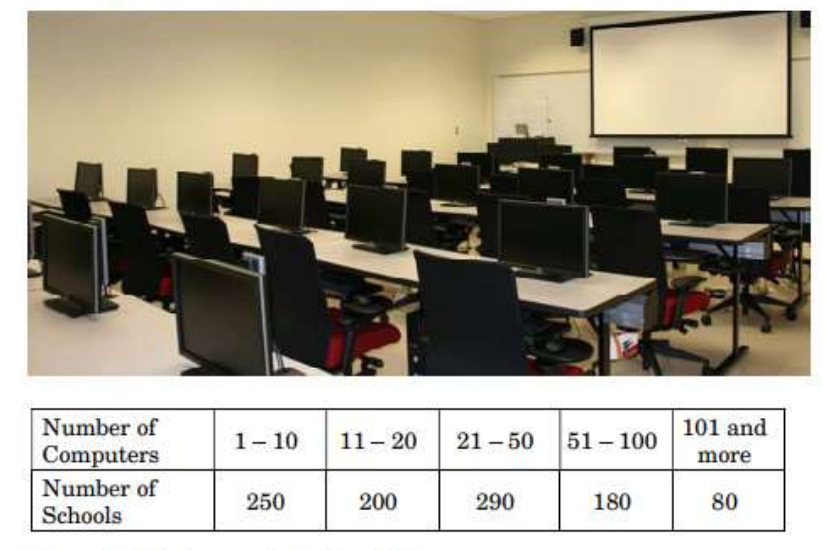
Case Study - 3 Computer-based learning (CBL) refers to any teaching methodology that makes use of computers for information transmission. At an elementary school level, computer applications can be used to display multimedia lesson plans. A survey was done on $1000$ elementary and secondary schools of Assam and they were classified by the number of computers they had. Number of Computers Number of Schools 1-10 250 11-20 200 21-50 290 51-100 180 101 and more 80 One school is chosen at random. Then : (i) Find the probability that the school chosen at random has more than $100$ computers. (ii) (a) Find the probability that the school chosen at random has $50$ or fewer computers. OR (ii) (b) Find the probability that the school chosen at random has no more than $20$ computers. (iii) Find the probability that the school chosen at random has $10$ or less than $10$ computers.
Show SolutionHide Solution↓
(i) P (more than $100$ computers) = $\frac{80}{1000}$ or $0.08$ (ii)(a) $50$ or fewer computers = $250 + 200 + 290 = 740$ Required probability = $\frac{740}{1000}$ or $0.74$ OR (ii)(b) No more than $20$ computers = $250 + 200 = 450$ Required probability = $\frac{450}{1000}$ or $0.45$ (iii) P ($10$ or less than $10$ computer) = $\frac{250}{1000}$ or $0.25$
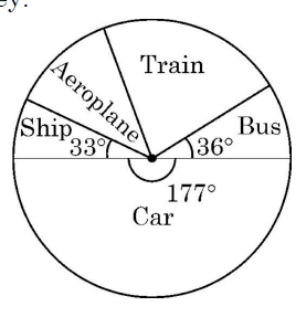
In a survey on holidays, $120$ people were asked to state which type of transport they used on their last holiday. The following pie chart shows the results of the survey. Observe the pie chart and answer the following questions : (i) If one person is selected at random, find the probability that he/she travelled by bus or ship. (ii) Which is most favourite mode of transport and how many people used it? (iii) (a) A person is selected at random. If the probability that he did not use train is $4/5$, find the number of people who used train. OR (iii) (b) The probability that randomly selected person used aeroplane is $7/60$. Find the revenue collected by air company at the rate of ₹5,000 per person.
Show SolutionHide Solution↓
(i) $P$ (travelling by bus or ship) $= \frac{36+33}{360} = \frac{69}{360}$ or $\frac{23}{120}$ (ii) Car Number of people who used car $= \frac{177}{360} \times 120 = 59$ (iii) (a) $P$ (person used train)$= 1 - \frac{4}{5} = \frac{1}{5}$ $\therefore$ Number of people who used train $= \frac{1}{5} \times 120 = 24$ OR (iii) (b) Number of people who used aeroplane $= \frac{7}{60} \times 120 = 14$ $\therefore$ Revenue generated$= 14 \times 5000 = \text{Rs}70,000$
A bag contains $100$ cards numbered $1$ to $100$. A card is drawn at random from the bag. What is the probability that the number on the card is a perfect cube ?
A box contains $90$ discs, numbered from $1$ to $90$. If one disc is drawn at random from the box, the probability that it bears a prime number less than $23$ is
Cards bearing numbers $3$ to $20$ are placed in a bag and mixed thoroughly. A card is taken out of the bag at random. What is the probability that the number on the card taken out is an even number ?
From the data $1, 4, 7, 9, 16, 21, 25$, if all the even numbers are removed, then the probability of getting at random a prime number from the remaining is :
A box contains cards numbered $6$ to $55$. A card is drawn at random from the box. The probability that the drawn card has a number which is a perfect square, is
A box contains cards numbered 6 to 55. A card is drawn at random from the box. The probability that the drawn card has a number which is a perfect square, is
One ticket is drawn at random from a bag containing tickets numbered $1$ to $40$. The probability that the selected ticket has a number which is a multiple of $7$ is:
Cards numbered $10, 11, 12, \dots, 30$ are kept in a box and shuffled thoroughly. Rohit draws a card at random from the box. The probability that the number on the card is a multiple of $4$ or $5$ is :
Cards numbered 10, 11, 12, ..., 30 are kept in a box and shuffled thoroughly. Rohit draws a card at random from the box. The probability that the number on the card is a multiple of 4 or 5 is :
A bag contains cards which are numbered from $5$ to $100$ such that each card bears a different number. A card is drawn at random. Find the probability that number on the card is (i) a perfect square (ii) a $2$-digit number
Show SolutionHide Solution↓
Total possible outcomes = $96$ (i) Number of favourable outcomes for perfect square = $8$ $P(\text{perfect square}) = \frac{8}{96}$ or $\frac{1}{12}$ (ii) Number of favourable outcomes for a $2$-digit number = $90$ $P(\text{a } 2\text{-digit number}) = \frac{90}{96}$ or $\frac{15}{16}$
A bag contains balls numbered $2$ to $91$ such that each ball bears a different number. A ball is drawn at random from the bag. Find the probability that (i) it bears a $2$-digit number (ii) it bears a multiple of $1$.
Show SolutionHide Solution↓
Total possible outcomes = $90$ (i) Number of favourable outcomes for a $2$-digit number = $82$ $P(2\text{-digit number}) = \frac{82}{90}$ or $\frac{41}{45}$ (ii) Number of favourable outcomes for multiple of $1 = 90$ $P(\text{a number multiple of } 1) = \frac{90}{90}$ or $1$
A box contains $90$ discs which are numbered $1$ to $90$. If one disc is drawn at random from the box, find the probability that it bears a : (i) $2$-digit number less than $40$. (ii) number divisible by $5$ and greater than $50$. (iii) a perfect square number.
Show SolutionHide Solution↓
Total outcomes $$\begin{aligned}& = 90 \\ & \text{(i) P (2 digit number less than 40) } = \frac{30}{90} \text{ or } \frac{1}{3} \\ & \text{(ii) P (a number divisible by 5 and greater than 50) } = \frac{8}{90} \text{ or } \frac{4}{45} \\ & \text{(iii) P (a perfect square number) } = \frac{9}{90} \text{ or } \frac{1}{10}\end{aligned}$$
Rahul is a lucky charm for his cricket team. He has a jar of cards with numbers from $10$ to $74$. Before each match, he draws a card from the jar. If the card bears an even number, the team wins. If the number is even and divisible by $5$, they win by a big margin. If the number is an odd number less than $30$, they win by a small margin. And if the number is a prime number between $50$ and $74$, they lose. Answer the following questions if Rahul draws a card today: (i) What is the probability that Rahul draws a card with an even number? (ii) What is the probability that Rahul draws a card with an odd number less than $30$? (iii) (a) What is the probability that Rahul draws a card with a prime number between $50$ and $74$? OR (b) What is the probability that Rahul draws a card with an even number divisible by $5$?
Show SolutionHide Solution↓
(i) Total possible outcomes = $74 - 10 + 1 = 65$ P (even number) = $\frac{33}{65}$ (ii) P (odd number less than $30$) = $\frac{10}{65}$ or $\frac{2}{13}$ (iii) (a) Favourable outcomes are $53, 59, 61, 67, 71, 73$ Number of favourable outcomes = $6$ P (prime number between $50$ and $74$) = $\frac{6}{65}$ OR (b) Favourable outcomes are $10, 20, 30, 40, 50, 60, 70$ Number of favourble outcomes = $7$ P (even number divisble by $5$) = $\frac{7}{65}$
Three coins are tossed simultaneously. What is the probability of getting (i) at least one head? (ii) exactly two tails ? (iii) at most one tail?
Show SolutionHide Solution↓
Total number of outcomes $$\begin{aligned}& = 8 \\ & \text{(i) P (at least one head) } = \frac{7}{8} \\ & \text{(ii) P (exactly 2 tails) } = \frac{3}{8} \\ & \text{(iii) P (at most one tail) } = \frac{4}{8} \text{ or } \frac{1}{2}\end{aligned}$$
Three unbiased coins are tossed simultaneously. Find the probability of getting : (i) at least one head. (ii) exactly one tail. (iii) two heads and one tail.
Show SolutionHide Solution↓
Total number of possible outcomes = $8$ (i) $P(\text{at least one head}) = \frac{7}{8}$ (ii) $P (\text{exactly one tail}) = \frac{3}{8}$ (iii) $P (\text{2 heads and one tail}) = \frac{3}{8}$
A girl calculates that the probability of her winning the first prize in a lottery is $0.08$. If $6000$ tickets are sold, how many tickets has she bought?
A bag contains $5$ red balls and $n$ green balls. If the probability of drawing a green ball is three times that of a red ball, then the value of $n$ is :
The probability of getting a chocolate flavoured ice cream at random, in a lot of $600$ ice creams is $0.055$. The number of chocolate flavoured ice creams in the lot is :
The probability of guessing the correct answer to a certain test question is $\frac{x}{6}$. If the probability of not guessing the correct answer to this question is $\frac{2}{3}$, then the value of $x$ is:
The number of red balls in a bag is $10$ more than the number of black balls. If the probability of drawing a red ball at random from this bag is $\frac{3}{5}$, then the total number of balls in the bag is :
The probability of guessing the correct answer of a certain test question is $\frac{x}{12}$. If the probability of not guessing the correct answer is $\frac{5}{6}$, then find the value of $x$.
The number of red balls in a bag is three more than the number of black balls. If the probability of drawing a red ball at random from the given bag is $\frac{12}{23}$, find the total number of balls in the given bag.
Show SolutionHide Solution↓
Let number of black balls = $x$, then number of red balls = $x+3$. $\therefore$ total number of balls = $2x+3$ ($\frac{1}{2}$ mark). ATQ, $\frac{x+3}{2x+3} = \frac{12}{23}$ ($\frac{1}{2}$ mark). $x = 33$ ($\frac{1}{2}$ mark). Total number of balls = 69 ($\frac{1}{2}$ mark).
A jar contains $54$ marbles, each of which is blue, green or white. The probability of selecting a blue marble at random from the jar is $\frac{1}{3}$, and the probability of selecting a green marble at random is $\frac{4}{9}$. How many white marbles does this jar contain ?
Show SolutionHide Solution↓
Let number of white marbles in the jar = $x$ $\therefore P(\text{white marbles}) = \frac{x}{54}$ (1 Mark) $P(\text{white}) = 1 - \frac{1}{3} - \frac{4}{9} = \frac{9-3-4}{9} = \frac{2}{9}$ (1 Mark) $\frac{x}{54} = \frac{2}{9}$ $x = 12$ (1 Mark) Hence, the number of white marbles = $12$
Creating sample space from given situation and find probability
A number is chosen from the numbers $1, 2, 3$ and denoted as $x$, and a number is chosen from the numbers $1, 4, 9$ and denoted as $y$. Then $P(xy < 9)$ is:
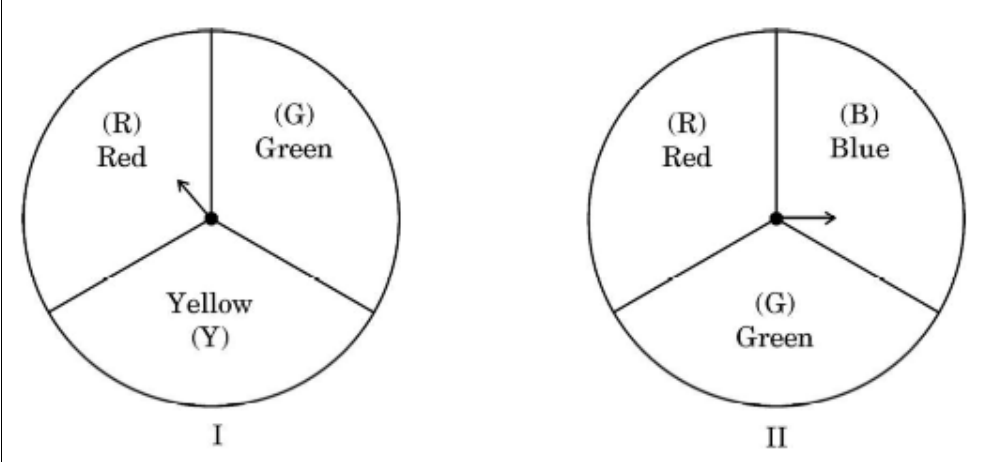
A middle school decided to run the following spinner game as a fund-raiser on Christmas Carnival. Making Purple: Spin each spinner once. Blue and red make purple. So, if one spinner shows Red (R) and another Blue (B), then you 'win'. One such outcome is written as 'RB'. Based on the above, answer the following questions : (i) List all possible outcomes of the game. (ii) Find the probability of 'Making Purple'. (iii) (a) For each win, a participant gets ₹10, but if he/she loses, he/she has to pay ₹5 to the school. If $99$ participants played, calculate how much fund could the school have collected. OR (iii) (b) If the same amount of ₹5 has been decided for winning or losing the game, then how much fund had been collected by school? (Number of participants = $99$)
Show SolutionHide Solution↓
(i) All possible outcomes: RR, RG, RB, GR, GB, GG, YR, YB, YG (ii) Number of favourable outcome (RB) $= 1$ $P (\text{Making purple}) = \frac{1}{9}$ (iii)(a) As $P(\text{winning}) = \frac{1}{9}$ Therefore, number of people must win $= \frac{1}{9} \times 99 = 11$ $\therefore$ Game lost by $88$ persons. Funds collected $= 5 \times 88 - 10 \times 11 = \text{Rs}330$ OR (iii)(b) Number of participants $= 99$ $P(\text{winning the game}) = \frac{1}{9}$ Number of persons won $= 11$ Number of persons lost $= 88$ Funds collected $= 88 \times 5 - 11 \times 5 = \text{Rs}385$
"Eight Ball" is a game played on a pool table with 15 balls numbered 1 to 15 and a "cue ball" that is solid and white. Of the 15 numbered balls, eight are solid (non-white) coloured and numbered 1 to 8 and seven are striped balls numbered 9 to 15. The 15 numbered pool balls (no cue ball) are placed in a large bowl and mixed, then one ball is drawn out at random. Based on the above information, answer the following questions : (i) What is the probability that the drawn ball bears number 8 ? (ii) What is the probability that the drawn ball bears an even number? OR What is the probability that the drawn ball bears a number, which is a multiple of 3? (iii) What is the probability that the drawn ball is a solid coloured and bears an even number?
Show SolutionHide Solution↓
(i)P (drawing ball bearing number 8) $= \frac{1}{15}$ (ii)Even numbers = 2, 4, 6, 8, 10, 12, 14 No. of favourable outcomes = 7 P (even number ball) $= \frac{7}{15}$ OR (ii)Multiples of 3 are 3, 6, 9, 12, 15 No. of favourable outcomes = 5 $\therefore P(\text{multiple of } 3) = \frac{5}{15} = \frac{1}{3}$ (iii) Solid colour and even number 2, 4, 6, 8 P(solid colour and bear an even no.) $= \frac{4}{15}$
Questions number $19$ and $20$ are Assertion and Reason based questions carrying $1$ mark each. Two statements are given, one labelled as Assertion (A) and the other is labelled as Reason (R). Select the correct answer to these questions from the codes (a), (b), (c) and (d) as given below. (a) Both Assertion (A) and Reason (R) are true and Reason (R) is the correct explanation of the Assertion (A). (b) Both Assertion (A) and Reason (R) are true, but Reason (R) is not the correct explanation of the Assertion (A). (c) Assertion (A) is true, but Reason (R) is false. (d) Assertion (A) is false, but Reason (R) is true. Assertion (A): Two players, Sania and Ashnam play a tennis match. The probability of Sania winning the match is $0.79$ and that of Ashnam winning the match is $0.21$. Reason (R): The sum of probabilities of two complementary events is $1$.
Show SolutionHide Solution↓
(a) Both Assertion (A) and Reason (R) are true and Reason (R) is the correct explanation of the Assertion (A).
Probability of happening of an event is denoted by $p$ and probability of non-happening of the event is denoted by $q$. Relation between $p$ and $q$ is
Probability of happening of an event is denoted by $p$ and probability of non-happening of the event is denoted by $q$. Relation between $p$ and $q$ is
Assertion (A): In a cricket match, a batsman hits a boundary $9$ times out of $45$ balls he plays. The probability that in a given ball, he does not hit the boundary is $\frac{4}{5}$. Reason (R): $P(E) + P(\text{not } E) = 1$
Show SolutionHide Solution↓
(A) Both Assertion (A) and Reason(R) are true and Reason (R) is the correct explanation of the Assertion (A).
Directions : Questions number $19$ and $20$ are Assertion and Reason based questions carrying $1$ mark each. Two statements are given, one labelled as Assertion (A) and the other is labelled as Reason (R). Select the correct answer to these questions from the codes (A), (B), (C) and (D) as given below: (A) Both Assertion (A) and Reason (R) are true and Reason (R) is the correct explanation of the Assertion (A). (B) Both Assertion (A) and Reason (R) are true, but Reason (R) is not the correct explanation of the Assertion (A). (C) Assertion (A) is true, but Reason (R) is false. (D) Assertion (A) is false, but Reason (R) is true. Assertion (A): In a cricket match, a batsman hits a boundary $9$ times out of $45$ balls he plays. The probability that in a given ball, he does not hit the boundary is $\frac{4}{5}$. Reason (R): $P(E) + P(\text{not } E) = 1$
Show SolutionHide Solution↓
(A) Both Assertion (A) and Reason(R) are true and Reason (R) is the correct explanation of the Assertion (A).
Assertion (A): The probability of selecting a number at random from the numbers $1$ to $20$ is $1$. Reason (R): For any event $E$, if $P(E) = 1$, then $E$ is called a sure event.
(a)Both Assertion (A) and Reason (R) are true and Reason (R) is the correct explanation of the Assertion (A).
(b)Both Assertion (A) and Reason (R) are true, but Reason (R) is not the correct explanation of the Assertion (A).
(c)Assertion (A) is true, but Reason (R) is false.
(d)Assertion (A) is false, but Reason (R) is true.
Show SolutionHide Solution↓
(A) Both Assertion (A) and Reason (R) are true and Reason (R) is the correct explanation of the Assertion (A).
Questions number $19$ and $20$ are Assertion and Reason based questions. Two statements are given, one labelled as Assertion (A) and the other is labelled as Reason (R). Select the correct answer to these questions from the codes (A), (B), (C) and (D) as given below. (A) Both Assertion (A) and Reason (R) are true and Reason (R) is the correct explanation of the Assertion (A). (B) Both Assertion (A) and Reason (R) are true, but Reason (R) is not the correct explanation of the Assertion (A). (C) Assertion (A) is true, but Reason (R) is false. (D) Assertion (A) is false, but Reason (R) is true. Assertion (A): The probability of selecting a number at random from the numbers $1$ to $20$ is $1$. Reason (R): For any event E, if P(E) = 1, then E is called a sure event.
Show SolutionHide Solution↓
(A) Both Assertion (A) and Reason (R) are true and Reason (R) is the correct explanation of the Assertion (A).
In an experiment of throwing a die, Assertion (A): Event $E_1$: getting a number less than 3 and Event $E_2$: getting a number greater than 3 are complementary events. Reason (R): If two events $E$ and $F$ are complementary events, then $P(E) + P(F) = 1$.
(a)Both Assertion (A) and Reason (R) are true and Reason (R) is correct explanation of Assertion (A).
(b)Both Assertion (A) and Reason (R) are true, but Reason (R) is not the correct explanation of Assertion (A).
(c)Assertion (A) is true, but Reason (R) is false.
(d)Assertion (A) is false, but Reason (R) is true.
Show SolutionHide Solution↓
(D) Assertion (A) is false, but Reason (R) is true.
Assertion (A): A fair die is thrown once. The probability of getting a prime number is $\frac{1}{2}$. Reason (R): A natural number is a prime number if it has only two factors.
Show SolutionHide Solution↓
(a) Both Assertion (A) and Reason (R) are true and Reason (R) is the correct explanation of the Assertion (A).
Two dice are thrown at the same time and the product of the numbers appearing on them is noted. The probability that the product of the numbers lies between $8$ and $13$ is:
Two dice are thrown simultaneously and the product of the numbers appearing on the tops is noted. The probability of the product to be less than $6$ is:
Two dice are rolled together. Find the probability of getting: (i) a multiple of $2$ on one and a multiple of $3$ on the other die. (ii) the product of two numbers on the top of the two dice is a perfect square number.
Show SolutionHide Solution↓
Total outcomes = $36$ (i) $(2, 3), (2, 6), (3, 2), (3, 4), (3, 6), (4, 3), (4, 6), (6, 2), (6, 3), (6, 4), (6, 6)$ Number of outcomes having multiple of $2$ on one die and a multiple of $3$ on other die = $11$ Hence, $P(E) = \frac{11}{36}$ (ii) $(1, 1), (2, 2), (3, 3), (1, 4), (4, 1), (4, 4), (5, 5), (6, 6)$ Number of outcomes having product of two numbers on the top of the dice is a perfect square number = $8$ $P(E) = \frac{8}{36}$ or $\frac{2}{9}$
All queens, jacks and aces are removed from a pack of $52$ playing cards. The remaining cards are well-shuffled and one card is picked up at random from it. The probability of that card to be a king is :
In a pack of $52$ playing cards one card is lost. From the remaining cards, a card is drawn at random. Find the probability that the drawn card is queen of heart, if the lost card is a black card.
Show SolutionHide Solution↓
Sol. Total number of remaining cards = $51$ P (getting queen of heart) = $\frac{1}{51}$
One card is drawn at random from a well shuffled deck of $52$ cards. Find the probability that the card drawn (i) is queen of hearts; (ii) is not a jack.
Show SolutionHide Solution↓
Total outcomes = $52$ (i) $P (\text{card is queen of hearts}) = \frac{1}{52}$ (ii) $P (\text{not a jack}) = \frac{48}{52}$ or $\frac{12}{13}$
This section comprises Very Short Answer (VSA) type questions of $2$ marks each The king, queen and ace of clubs and diamonds are removed from a deck of $52$ playing cards and the remaining cards are shuffled. A card is randomly drawn from the remaining cards. Find the probability of getting (i) a card of clubs. (ii) a red coloured card.
Show SolutionHide Solution↓
Total cards left $= 52 - 3 - 3 = 46$ (i) $P$ (card of clubs) $= \frac{10}{46}$ or $\frac{5}{23}$ (ii) $P$ (red coloured card) $= \frac{23}{46}$ or $\frac{1}{2}$
From a pack of $52$ playing cards, jack, queen and king of diamonds are removed. A card is drawn at random from the remaining cards. Find the probability of getting a face card or a card of spades.
Show SolutionHide Solution↓
Number of cards after removing jack, queen and king of diamonds = $52 – 3 = 49$ Favourable outcomes = $19$ P (getting a face card or a card of spades) = $\frac{19}{49}$
While shuffling a pack of 52 cards, one card was accidentally dropped. Find the probability that the dropped card (i) is not a face card. (ii) is a black king.
Show SolutionHide Solution↓
(i) $P(\text{not a face card}) = \frac{40}{52}$ or $\frac{10}{13}$ (ii) $P(\text{black king}) = \frac{2}{52}$ or $\frac{1}{26}$
All the face cards are removed from the pack of 52 cards and a card is drawn at random from the remaining cards. Find the probability that the card so drawn is (i) a spade. (ii) not an ace.
Show SolutionHide Solution↓
Remaining cards = 52 - 12 = 40 (i) $P (a \text{ spade}) = \frac{10}{40}$ or $\frac{1}{4}$ (ii) $P (\text{not an ace}) = \frac{36}{40}$ or $\frac{9}{10}$
From a pack of $52$ cards, all aces and all kings are removed. A card is drawn at random from the remaining cards. Find the probability that the card so drawn is (i) a face card. (ii) a card of red colour.
Show SolutionHide Solution↓
Remaining cards = $52 - 8 = 44$ (i) $P(\text{a face card}) = \frac{8}{44}$ or $\frac{2}{11}$ (ii) $P(\text{a card of red colour}) = \frac{22}{44}$ or $\frac{1}{2}$
All face cards of spades are removed from a pack of $52$ playing cards and the remaining pack is shuffled well. A card is then drawn at random from the remaining pack. Find the probability of getting : (a) a face card (b) an ace or a jack
Show SolutionHide Solution↓
Sol. After removing face cards of spades, total number of cards $$\begin{aligned}& = 52 - 3 = 49 \\ & (a) P(\text{a face card}) = \frac{9}{49} \\ & (b) P(\text{an ace or a jack}) = \frac{7}{49} \text{ or } \frac{1}{7}\end{aligned}$$