Two water taps together can fill a tank in $3\frac{1}{3}$ hours. The tap of larger diameter takes $5$ hours less than the smaller one to fill the tank separately. Find the time in which each tap can fill the tank separately.
Show SolutionHide Solution↓
Let the time taken by the tap of smaller diameter to fill the tank separately be '$x$' hours and the time taken by the tap of larger diameter to fill the tank separately be $(x - 5)$ hours. A.T.Q. $\frac{1}{x} + \frac{1}{x-5} = \frac{3}{10}$ $\Rightarrow 3x^2 - 35x + 50 = 0$ $\Rightarrow (x - 10) (3x - 5) = 0$ $x = 10$ or $x = \frac{5}{3}$ But $x = \frac{5}{3}$ is not possible, so $x = 10$ $\therefore$ time taken by the tap of smaller diameter to fill the tank separately is $10$ hours and time taken by the tap of larger diameter to fill the tank separately is $10-5=5$ hours
Sum of the areas of two squares is $468$ m$^2$. If the difference of their perimeters is $24$ m, find the lengths of the sides of the two squares.
Show SolutionHide Solution↓
Sol. Let the lengths of the sides of the two squares be '$x$' m and '$y$' m s.t. $x > y$ A.T.Q. $x^2 + y^2 = 468$ -----(1) (1/2 Mark) $4x - 4y = 24$ $\Rightarrow x-y=6$ -----(2) (1/2 Mark) From (1) and (2), we get $y^2 + 6y - 216 = 0$ $\Rightarrow y = 12$ and $y = -18$ (1 Mark) But side of a square is always positive, So, $y = 12$ and $x = 18$ (1 Mark) Hence, the lengths of the sides of two squares are $12$ m and $18$ m.
In a $2$-digit number, the digit at the unit's place is $5$ less than the digit at the ten's place. The product of the digits is $36$. Find the number.
Show SolutionHide Solution↓
Let digit at ten's place be $x$ then digit at unit's place $= x - 5$ $x(x - 5) = 36$ $\Rightarrow x^2 - 5x - 36 = 0$ $(x-9)(x + 4) = 0$ $x \ne -4$ so, $x = 9$ $\therefore$ Required number is $94$
Three consecutive integers are such that sum of the square of second and product of other two is $161$. Find the three integers.
Show SolutionHide Solution↓
Let the three numbers be $x, x+1$ and $x+2$ ($\frac{1}{2}$) $(x + 1)^2 + x(x + 2) = 161$ $\Rightarrow x^2+2x-80 = 0$ (1) $\Rightarrow (x+10)(x-8)=0$ $\therefore x= 8$ or $-10$ (1) So, the numbers are $8, 9, 10$ or $-10, -9, -8$ ($\frac{1}{2}$)
A dealer sells an article for ₹75 and gains as much percent as the cost price of the article. Find the cost price of the article.
Show SolutionHide Solution↓
Let the cost price of the article be $x$ $\therefore$ Gain % $= x$ $x = \frac{75-x}{x} \times 100$ $\Rightarrow x^2+ 100x - 7500 = 0$ $\Rightarrow (x - 50)(x + 150) = 0$ $x \ne -150 \therefore x = 50$ So, the cost price of the article is ₹50
SECTION E This section comprises of $3$ case-study based questions of $4$ marks each. Case Study – 1 In an auditorium, seats are arranged in rows and columns. The number of rows are equal to the number of seats in each row in the beginning. When the number of rows are doubled and the number of seats in each row is reduced by $10$, the total number of seats increases by $300$. Based on the above, answer the following questions : (a) Taking $x$ as the number of rows in the beginning, represent the above situation by a quadratic equation. (b) (i) How many rows are there in the original arrangement ? OR (ii) How many seats are there in the auditorium in the beginning? (c) How many seats are there in the auditorium after re-arrangement ?
Show SolutionHide Solution↓
Let no. of rows be $x = $ no. of seats in each row. Total seats in beginning $= x \times x = x^2$. New number of rows $= 2x$. New number of seats in each row $= x-10$. New total seats $= 2x(x-10)$. According to the problem, new total seats = original total seats + $300$. (a) $2x(x - 10) = x^2 + 300$ $2x^2 - 20x = x^2 + 300$ $x^2 - 20x - 300 = 0$ (b) (i) To find $x$ (number of rows in original arrangement): $x^2 - 20x - 300 = 0$ $(x - 30)(x + 10) = 0$ $x = 30$ or $x = -10$. Since number of rows cannot be negative, $x = 30$. So, there are $30$ rows in the original arrangement. OR (ii) Number of seats in the auditorium in the beginning $= x^2 = 30^2 = 900$. (c) Number of seats after re-arrangement $= x^2 + 300 = 900 + 300 = 1200$.
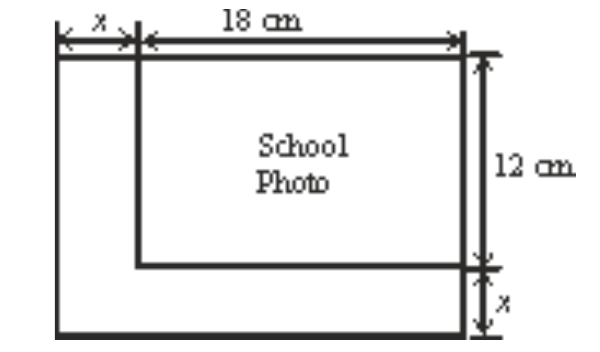
While designing the school year book, a teacher asked the student that the length and width of a particular photo is increased by $x$ units each to double the area of the photo. The original photo is 18 cm long and 12 cm wide. Based on the above information, answer the following questions: (I) Write an algebraic equation depicting the above information. (II) Write the corresponding quadratic equation in standard form. (III) What should be the new dimensions of the enlarged photo? OR Can any rational value of $x$ make the new area equal to $220\text{cm}^2$
Show SolutionHide Solution↓
(i) $(18 + x) (12 + x) = 2(18\times12)$ (ii) $x^2 + 30x - 216 = 0$ (iii) Solving : $x^2 + 30x – 216 = 0$ $\Rightarrow (x + 36) (x – 6) = 0$ $x \neq -36 \therefore x = 6$. new dimensions are $24$ cm $\times 18$ cm OR (iii) If $(18+ x) (12 + x) = 220$ then $x^2 + 30x - 4=0$ Here $D = 900 + 16 = 916$ which is not a perfect square. Thus we can't have any such rational value of $x$.
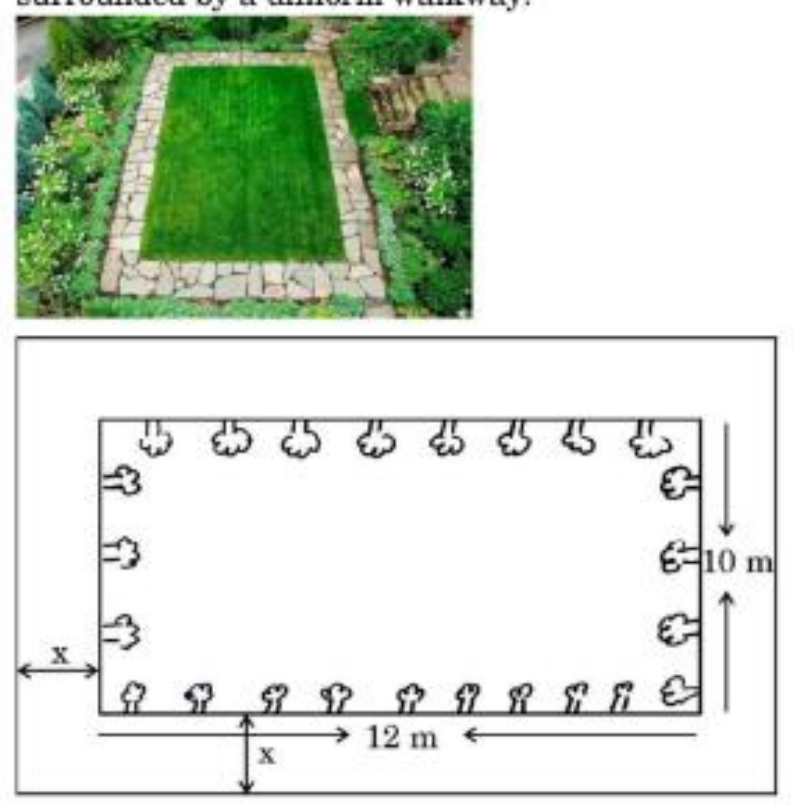
A garden designer is planning a rectangular lawn that is to be surrounded by a uniform walkway. The total area of the lawn and the walkway is $360$ square metres. The width of the walkway is same on all sides. The dimensions of the lawn itself are $12$ metres by $10$ metres. Based on the information given above, answer the following questions: (i) Formulate the quadratic equation representing the total area of the lawn and the walkway, taking width of walkway $= x \operatorname{m}$. (ii) (a) Solve the quadratic equation to find the width of the walkway 'x'. OR (b) If the cost of paving the walkway at the rate of ₹50 per square metre is ₹12,000, calculate the area of the walkway. (iii) Find the perimeter of the lawn.
Show SolutionHide Solution↓
Sol. (i) $(12 + 2x)(10 + 2x) = 360$ $4x^2 + 44x - 240 = 0$ or $x^2 + 11x - 60 = 0$ (ii)(a) $(x + 15)(x - 4) = 0$ $x = 4$ $\therefore$ width of the walkway $= 4 \operatorname{m}$ OR (ii)(b) Area of the walkway $= \frac{12000}{50}$ $= 240 \operatorname{m}^2$ (iii) Perimeter of the lawn $= 2(12 + 10) = 44 \operatorname{m}$
A train travels at a certain average speed for a distance of $54$ km and then travels a distance of $63$ km at an average speed of $6$ km/h more than the first speed. If it takes $3$ hours to complete the journey, what was its first average speed ?
Show SolutionHide Solution↓
Let first average speed of the train be $x$ km/hr. $\frac{54}{x} + \frac{63}{x + 6} = 3$ $\Rightarrow 54(x + 6) + 63x = 3x^2 + 18x$ $\Rightarrow 3x^2 - 99x - 324 = 0$ or $x^2 - 33x - 108 = 0$ $\Rightarrow (x - 36) (x + 3) = 0$ $\Rightarrow x = 36, -3$ (rejected) Therefore, first average speed of the train was $36$ km/hr.
Two pipes together can fill a tank in $\frac{15}{8}$ hours. The pipe with larger diameter takes $2$ hours less than the pipe with smaller diameter to fill the tank separately. Find the time in which each pipe can fill the tank separately.
Show SolutionHide Solution↓
Let the time taken by smaller diameter tap be $x$ hrs. Time taken by larger diameter tap is $(x - 2)$ hrs. Therefore $\frac{1}{x-2} + \frac{1}{x} = \frac{8}{15}$ $\Rightarrow 15(2x - 2) = 8x(x - 2)$ $\Rightarrow 8x^2 - 46x + 30 = 0$ $\Rightarrow 4x^2 - 23x + 15 = 0$ $\Rightarrow (4x - 3)(x - 5) = 0$ $\Rightarrow x = \frac{3}{4}$ as $x-2 < 0$ (rejected) or $x = 5$ Smaller diameter tap fills in $5$ hrs. Larger diameter tap fills in $3$ hrs.
If Nidhi were $7$ years younger than what she actually is, then the square of her age (in years) would be $1$ more than $5$ times her actual age. What is her present age?
Show SolutionHide Solution↓
Let the present age of Nidhi be $x$ years. According to question, $(x - 7)^2 = 5x + 1$ $x^2- 19x + 48 = 0$ $(x - 16)(x - 3) = 0$ $x = 16,3$ $x \neq 3$ $\therefore x = 16$ Hence, the present age of Nidhi $= 16$ years
A shopkeeper buys a number of books for ₹1,800. If he had bought $15$ more books for the same amount, then each book would have cost him ₹20 less. Find how many books he bought initially.
Show SolutionHide Solution↓
Let the number of books bought initially be $x$ According to question, $\frac{1800}{x} - \frac{1800}{x+15} = 20$ $x^2 + 15x - 1350 = 0$ $(x + 45)(x - 30) = 0$ $x = -45$ $\therefore x = 30$ So, the number of books bought initially $= 30$
Some students planned a picnic. The total budget for food was ₹500, but $5$ of them failed to go and thus the cost of food for each student increased by ₹5. How many students attended the picnic?
Show SolutionHide Solution↓
Sol. Let number of students who attended picnic be $x$. A.T.Q. $\frac{500}{x} - \frac{500}{x+5} = 5$ $\Rightarrow x^2 + 5x - 500 = 0$ $\Rightarrow (x + 25) (x - 20) = 0$ $x = -25, x = 20$ But number of students can't be negative. Hence, $x = 20$ Therefore, number of students who attended picnic is $20$.
In a flight of $2800 \text{ km}$, an aircraft was slowed down due to bad weather. Its average speed is reduced by $100 \text{ km/h}$ and by doing so, the time of flight is increased by $30$ minutes. Find the original duration of the flight.
Show SolutionHide Solution↓
Let original speed of aircraft be $x \text{ km/hr}$. A.T.Q. $\frac{2800}{x-100} - \frac{2800}{x} = \frac{1}{2}$ $\Rightarrow x^2 - 100x - 560000 = 0$ $\Rightarrow (x-800)(x + 700) = 0$ $x \neq -700$ So, $x = 800$ Original Duration $\frac{2800}{800} = \frac{7}{2}$ hrs or $3$ hrs $30$ min.
The denominator of a fraction is one more than twice the numerator. If the sum of the fraction and its reciprocal is $\frac{16}{21}$, find the fraction.
Show SolutionHide Solution↓
Let numerator be $x$, then denominator be $(2x + 1)$ Fraction = $\frac{x}{2x+1}$ A.T.Q. $\frac{x}{2x+1} + \frac{2x+1}{x} = \frac{58}{21}$ $\Rightarrow 11x^2 - 26x - 21 = 0$ $\Rightarrow (x - 3)(11x + 7) = 0$ $x \neq -\frac{7}{11}$ So, $x = 3$ $\therefore$ Fraction = $\frac{3}{7}$
A train travels a distance of $90$ km at a constant speed. Had the speed been $15$ km/h more, it would have taken $30$ minutes less for the journey. Find the original speed of the train.
Show SolutionHide Solution↓
Let the original speed be $x$ km/h New speed $= (x + 15)$ km/h A.T.Q. $$\begin{aligned}& \frac{90}{x} - \frac{90}{x+15} = \frac{1}{2} \\ & \Rightarrow x^2 + 15x - 2700 = 0 \\ & \Rightarrow(x + 60) (x - 45) = 0 \\ & x \neq -60 \text{ , } x = 45 \\ & \text{The original speed of the train } = 45\text{km/h}\end{aligned}$$
A $2$-digit number is such that the product of its digits is $18$. When $63$ is subtracted from the number, the digits interchange their places. Find the number.
Show SolutionHide Solution↓
Let the required no. be $10x + y$ Here $xy = 18$ ---- (i) $(10x + y) - 63 = 10y + x$ or $x - y = 7$ ---- (ii) Solving (i) and (ii) to get $x=9$ and $y=2$ Hence required number is $92$.
The age of a man is twice the square of the age of his son. Eight years hence, the age of the man will be $4$ years more than three times the age of his son. Find their present ages.
Show SolutionHide Solution↓
Let present age of son = $x$ years and present age of man = $2x^2$ years A.T.Q. $$\begin{aligned}& 3(x + 8) + 4 = 2x^2 + 8 \\ & \Rightarrow 2x^2 - 3x - 20 = 0 \\ & \Rightarrow (2x+5) (x - 4) = 0 \\ & x \neq -\frac{5}{2}\end{aligned}$$ So, $x = 4$ Present age of son = $4$ years Present age of man = $32$ years
The side of a square exceeds the side of another square by $4$ cm and the sum of the areas of the two squares is $400$ cm$^2$. Find the sides of the squares.
Show SolutionHide Solution↓
Let the side of first square = $x$ cm (1/2 Mark) $\therefore$ Side of second square = $(x + 4)$ cm (1/2 Mark) $x^2 + (x + 4)^2 = 400$ (1 Mark) $x^2 + x^2 + 8x + 16 = 400 \Rightarrow 2x^2 + 8x - 384 = 0 \Rightarrow x^2 + 4x - 192 = 0$ (1 Mark) $(x + 16)(x - 12) = 0$ (1/2 Mark) $x = 12$ (as $x \neq -16$) (1/2 Mark) Side of squares = $12$cm and $16$cm (1 Mark)
At present, Sourav's age is $3$ years more than the square of his son Ravi's age. When Ravi grows to his father's present age, Sourav's age would be $6$ years less than $13$ times the present age of Ravi. Find present ages of Ravi and Sourav.
Show SolutionHide Solution↓
Let the present age of Ravi be 'r' years and the present age of Sourav be 's' years Therefore, $s = 3 + r^2$ --- (1) Ravi grows to father's present age in $(s - r)$ years. $\therefore$ father's age after $(s - r)$ years = $(2s - r)$ years and Ravi's age after $(s - r)$ years = 's' years Therefore, $2s - r = 13r - 6$ or $s = 7r - 3$ --- (2) Using (1) and (2), $r^2 - 7r + 6 = 0$ $\Rightarrow (r - 6)(r - 1) = 0$ $\Rightarrow r = 6, 1$ Ignoring $r = 1$ as $s \neq 4$ r = $6$ Hence $s = 39$
A train travels a distance of $480$ km at a uniform speed. If the speed had been $8$ km/h less, then it would have taken $3$ hours more to cover the same distance. Find the speed of the train.
Show SolutionHide Solution↓
Let speed be $x$ km/h. $\frac{480}{x - 8} - \frac{480}{x} = 3 \implies x^2 - 8x - 1280 = 0 \implies (x - 40)(x + 32) = 0 \implies x = 40$. Speed $= 40$ km/h.
A two-digit number is such that the product of its digits is $12$. When $36$ is added to this number, the digits interchange their places. Find the number.
Show SolutionHide Solution↓
Let unit digit be $y$ and ten's digit = $x$ hence, the two digit number = $10x + y$, (1/2) ATQ $xy = 12$ ..............(i) (1) $10x + y + 36 = 10y + x$ $x - y + 4 = 0$ ....... (ii) (1) From (i) and (ii) $x^2 + 4x - 12 = 0$ (1/2) $(x + 6)(x - 2) = 0$ (1/2) Hence, $x = 2$ and $y = 6$ (1/2) $\therefore$ Number = $26$ (1/2)
A student scored a total of $32$ marks in class tests in Mathematics and Science. Had he scored $2$ marks less in Science and $4$ marks more in Mathematics, the product of his marks would have been $253$. Find his marks in the two subjects.
Show SolutionHide Solution↓
Let marks scored in Mathematics be $x$ and marks scored in Science be $y$ ATQ, $x + y = 32$ ..............(i) (1) and $(x + 4)(y - 2) = 253$ ...... (ii) (1) from (i) and (ii) $x^2 - 26x + 133 = 0$ (1) $(x - 19)(x - 7) = 0$ (1) $x = 19, 7$ (1/2) $x = 19 \Rightarrow y = 13$ $x = 7 \Rightarrow y = 25$ (1/2) Hence, marks in Mathematics and Science are $19, 13$ or $7, 25$
The sum of the areas of two squares is $52$ cm$^2$ and difference of their perimeters is $8$ cm. Find the lengths of the sides of the two squares.
Show SolutionHide Solution↓
Let the lengths of the sides of two squares be 'x' cm and 'y' cm such that $x > y$. ATQ $x^2 + y^2 = 52$ ----- (1) $4x - 4y = 8$ or $x - y = 2$ ----- (2) From (1) and (2), we have $y^2 + 2y - 24 = 0$ $\Rightarrow (y + 6) (y - 4) = 0$ $\therefore y = 4$ So, $x = 2 + 4 = 6$ $\therefore$ Lengths of the sides of two squares are $6$ cm and $4$ cm respectively.
The time taken by a person to travel an upward distance of $150$ km was $2 \frac{1}{2}$ hours more than the time taken in the downward return journey. If he returned at a speed of $10$ km/h more than the speed while going up, find the speeds in each direction.
Show SolutionHide Solution↓
Let the speed in upward direction be 'x' km/h and the speed in downward direction = $(x + 10)$ km/h ATQ $\frac{150}{x} - \frac{150}{x+10} = \frac{5}{2}$ $\Rightarrow x^2 + 10 x - 600 = 0$ $\Rightarrow (x+30)(x - 20) = 0$ $\therefore x = 20$ and $x + 10 = 20 + 10 = 30$ Therefore, speeds in upward and downward direction are $20$ km/h and $30$ km/h respectively.
The numerator of a fraction is $3$ less than its denominator. If $2$ is added to both numerator and denominator, then the sum of the new fraction and the original fraction is $\frac{29}{20}$. Find the original fraction.
A train travelling at a uniform speed for $360$ km would have taken $48$ minutes less to travel the same distance if its speed were $5$ km/h more. Find the original speed of the train.
Show SolutionHide Solution↓
Let the original speed of train be 'x' km/h ATQ $\frac{360}{x} - \frac{360}{x + 5} = \frac{48}{60}$ ($2$) $\Rightarrow x^2 + 5x - 2250 = 0$ ($1$) $\Rightarrow (x + 50)(x - 45) = 0$ ($1$) So, $x = 45$ $\therefore$ Original speed of the train is $45$ km/h. ($1$)
The sides of a right triangle are such that the longest side is $4$ m more than the shortest side and the third side is $2$ m less than the longest side. Find the length of each side of the triangle. Also, find the difference between the numerical values of the area and the perimeter of the given triangle.
Show SolutionHide Solution↓
Let the length of shortest side be $x$ m $\therefore$ length of longest side = $(x + 4)$ m and length of third side = $(x + 2)$ m Now, $(x + 4)^2 = x^2 + (x + 2)^2$ $\Rightarrow x^2 - 4x - 12 = 0$ $\Rightarrow (x – 6)(x + 2) = 0$ $\Rightarrow x = 6$ $\therefore$ sides are $6$ m, $8$ m and $10$ m Area = $\frac{1}{2} \times 6 \times 8 = 24$ m$^2$ Perimeter = $6+8+10 = 24$ m Difference = $0$
A 2-digit number is seven times the sum of its digits and two (2) more than 5 times the product of its digits. Find the number.
Show SolutionHide Solution↓
Let digit at unit place be $x$ and digit at tens place be $y$ $\therefore$ number $= 10y + x$ $ATQ$ $10y + x = 7(x + y)$ $\implies 3y = 6x$ or $y = 2x$ --- (1) Also, $10y + x = 5xy + 2$ --- (2) from (1) and (2), we get $10x^2 - 21x + 2 = 0$ $\implies (x - 2)(10x - 1) = 0$ $\therefore x = 2$ So, $y = 4$ $\therefore$ Required number is 42.
There is a circular park of diameter $65$ m as shown in the following figure, where AB is a diameter. An entry gate is to be constructed at a point P on the boundary of the park such that distance of P from A is $35$ m more than the distance of P from B. Find distance of point P from A and B respectively.
Show SolutionHide Solution↓
Let distance of gate at P from point B is $x$ m. Then distance of gate at P from point A is $(35 + x)$ m. In right $\Delta APB$, $(x + 35)^2 + x^2 = (65)^2 \implies x^2 + 35x - 1500 = 0 \implies (x + 60)(x - 25) = 0 \implies x = 25$. Hence, $x + 35 = 60$. Distance of P from $A = 60$ m, Distance of P from $B = 25$ m.
Express the equation $\frac{x-2}{x-3} + \frac{x-4}{x-5} = \frac{10}{3}$; $(x\neq3,5)$ as a quadratic equation in standard form. Hence, find the roots of the equation so formed.
Show SolutionHide Solution↓
$\frac{x-2}{x-3} + \frac{x-4}{x-5} = \frac{10}{3}$ $\frac{(x-2)(x-5)+(x-4)(x-3)}{(x-3)(x-5)} = \frac{10}{3}$ Simplifying, we get $2 x^2 - 19x + 42 = 0$ $\Rightarrow (x – 6)(2x – 7) = 0$ $\Rightarrow x = 6$ or $x = \frac{7}{2}$
A rectangular floor area can be completely tiled with $200$ square tiles. If the side length of each tile is increased by $1$ unit, it would take only $128$ tiles to cover the floor. (i) Assuming the original length of each side of a tile be $x$ units, make a quadratic equation from the above information. (ii) Write the corresponding quadratic equation in standard form. (iii) (a) Find the value of $x$, the length of side of a tile by factorisation. OR (b) Solve the quadratic equation for $x$, using quadratic formula.
Assertion (A) : The quadratic equation $x^2 + 4x + 5 = 0$ has real roots. Reason (R): The quadratic equation $ax^2 + bx + c = 0$, $a \neq 0$ has real roots if $b^2 - 4ac \geq 0$.
Show SolutionHide Solution↓
(D) Assertion (A) is false, but Reason (R) is true.
Find the value(s) of $p$ for which the quadratic equation given as $(p + 4)x^2 - (p + 1)x + 1 = 0$ has real and equal roots. Also, find the roots of the equation(s) so obtained.
Show SolutionHide Solution↓
For real and equal roots, $D = 0$ $\therefore [-(p + 1)]^2 - 4(p + 4) = 0$ $\implies p^2 - 2p - 15 = 0$ $\implies (p - 5)(p + 3) = 0$ $\therefore p = 5, -3$ For $p = 5, 9x^2 - 6x + 1 = 0 \implies (3x - 1)(3x - 1) = 0 \therefore x = \frac{1}{3}, \frac{1}{3}$ For $p = -3, x^2 + 2x + 1 = 0 \implies (x + 1)(x + 1) = 0 \therefore x = -1, -1$ Hence roots are $\frac{1}{3}, \frac{1}{3}$ and $-1, -1$ for $p = 5$ and $p = -3$ respectively.
Find the smallest value of $p$ for which the quadratic equation $x^2 - 2(p+1)x + p^2 = 0$ has real roots. Hence, find the roots of the equation so obtained.
Show SolutionHide Solution↓
For real roots, $D \geq 0$. $[-2(p+1)]^2 - 4p^2 \geq 0 \Rightarrow p \geq -\frac{1}{2}$ ($\frac{1}{2} + \frac{1}{2} + 1$ marks). $\therefore$ smallest value of $p = -\frac{1}{2}$ ($\frac{1}{2}$ mark). At $p = -\frac{1}{2}$ given equation becomes $x^2 - 2(-\frac{1}{2} + 1)x + (-\frac{1}{2})^2 = 0$ ($\frac{1}{2}$ mark). $x^2 - x + \frac{1}{4} = 0$ or $4x^2 - 4x + 1 = 0$ (1 mark). $(2x-1)(2x-1) = 0$. $\therefore$ roots are $\frac{1}{2}, \frac{1}{2}$ ($\frac{1}{2} + \frac{1}{2}$ marks).
_q_1.png)