Circles — Class 10 Maths PYQs

139 previous-year board questions (2023–2025) with marking-scheme solutions, grouped by topic and marks.

Try each question first, then press (or tap Show Solution) to reveal the answer. Press again for the next question.

Tangents & All

1 Mark Questions
11 Mark · July 2023 · Standardopen ↗
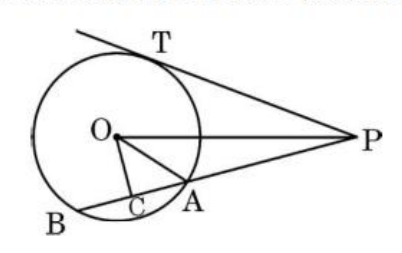
The length of the tangent drawn from a point P, whose distance from the centre of a circle is $25$ cm, and the radius of the circle is $7$ cm, is:
  • (a)$22$ cm
  • (b)$24$ cm
  • (c)$25$ cm
  • (d)$28$ cm
Show SolutionHide Solution
(b) $24$ cm
21 Mark · July 2023 · Standardopen ↗
The length of the tangent drawn from a point $\text{P}$, whose distance from the centre of a circle is $25$ cm, and the radius of the circle is $7$ cm, is:
  • (a)$22$ cm
  • (b)$24$ cm
  • (c)$25$ cm
  • (d)$28$ cm
Show SolutionHide Solution
(b) $24$ cm
31 Mark · July 2023 · Standardopen ↗
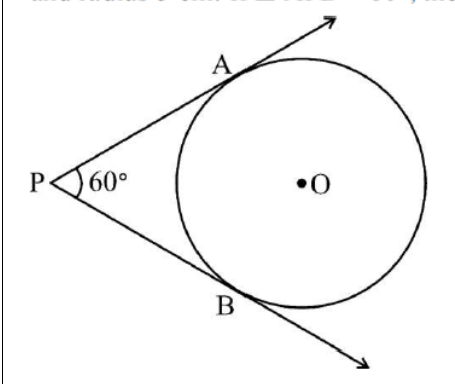
If two tangents inclined at an angle of $60^\circ$ are drawn to a circle of radius $5$ cm from an external point, then the length of each tangent is equal to :
  • (a)$\frac{5\sqrt{3}}{2}$ cm
  • (b)$10$ cm
  • (c)$\frac{5}{\sqrt{3}}$ cm
  • (d)$5\sqrt{3}$ cm
Show SolutionHide Solution
Ans. (d) $5\sqrt{3}$ cm
41 Mark · July 2023 · Standardopen ↗
For Questions number $19$ and $20$, two statements are given $-$ one labelled as Assertion (A) and the other labelled as Reason (R). Select the correct answer to these questions from the codes (a), (b), (c) and (d) as given below.
(a) Both Assertion (A) and Reason (R) are true and Reason (R) is the correct explanation of the Assertion (A).
(b) Both Assertion (A) and Reason (R) are true, but Reason (R) is not the correct explanation of the Assertion (A).
(c) Assertion (A) is true and Reason (R) is false.
(d) Assertion (A) is false and Reason (R) is true.
Assertion (A) : The tangents drawn at the end points of a diameter of the circle are parallel to each other.
Reason (R) : The tangent to a circle is perpendicular to the radius at the point of contact.
Show SolutionHide Solution
Ans. (a) Both Assertion (A) and Reason (R) are true and Reason (R) is the correct explanation of Assertion (A).
51 Mark · March 2023 · Standardopen ↗
Assertion (A): A tangent to a circle is perpendicular to the radius through the point of contact.
Reason (R): The lengths of tangents drawn from an external point to a circle are equal.
Show SolutionHide Solution
(b) Both Assertion (A) and Reason (R) are true, but Reason (R) is not the correct explanation of the Assertion (A).
61 Mark · March 2023 · Standardopen ↗
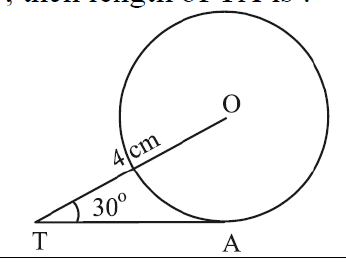
In the given figure, $TA$ is a tangent to the circle with centre $O$ such that $OT = 4$ cm, $\angle OTA = 30^\circ$, then length of $TA$ is :
figure for this question
  • (a)$2\sqrt{3}$ cm
  • (b)$2$ cm
  • (c)$2\sqrt{2}$ cm
  • (d)$\sqrt{3}$ cm
Show SolutionHide Solution
Sol. (a) $2\sqrt{3}$ cm
71 Mark · March 2023 · Standardopen ↗
The length of tangent drawn to a circle of radius $9$ cm from a point $41$ cm from the centre is :
  • (a)$40$ cm
  • (b)$9$ cm
  • (c)$41$ cm
  • (d)$50$ cm
Show SolutionHide Solution
(a) $40$ cm
81 Mark · March 2024 · Standardopen ↗
Directions:
In Q. No. $19$ and $20$ a statement of Assertion (A) is followed by a statement of Reason (R). Choose the correct option.
(a) Both, Assertion (A) and Reason (R) are true and Reason (R) is correct explanation of Assertion (A).
(b) Both, Assertion (A) and Reason (R) are true but Reason (R) is not correct explanation for Assertion (A).
(c) Assertion (A) is true but Reason (R) is false.
(d) Assertion (A) is false but Reason (R) is true.
Assertion (A): The tangents drawn at the end points of a diameter of a circle, are parallel.
Reason (R) : Diameter of a circle is the longest chord.
Show SolutionHide Solution
Sol. (b) Both Assertion (A) and Reason (R) are true but Reason (R) is not the correct explanation for Assertion (A).
91 Mark · March 2024 · Standardopen ↗
Assertion (A): The tangents drawn at the end points of a diameter of a circle, are parallel.
Reason (R) : Diameter of a circle is the longest chord.
Show SolutionHide Solution
(b) Both Assertion (A) and Reason (R) are true but Reason (R) is not the correct explanation for Assertion (A).
101 Mark · March 2024 · Standardopen ↗
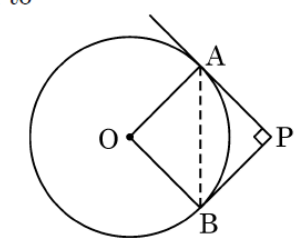
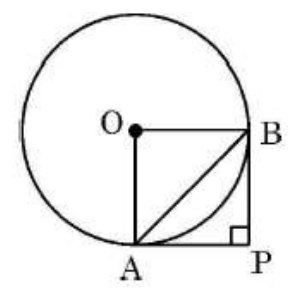
In the given figure, tangents $PA$ and $PB$ to the circle centred at $O$, from point $P$ are perpendicular to each other. If $PA = 5$ cm, then length of $AB$ is equal to
figure for this question
  • (a)$5$ cm
  • (b)$2\sqrt{5}$ cm
  • (c)$5\sqrt{2}$ cm
  • (d)$10$ cm
Show SolutionHide Solution
(B) $5\sqrt{2}$ cm
111 Mark · March 2024 · Standardopen ↗
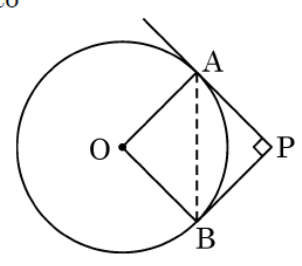
In the given figure, tangents PA and PB to the circle centred at O, from point P are perpendicular to each other. If PA = 5 cm, then length of AB is equal to
figure for this question
  • (a)5 cm
  • (b)$5\sqrt{2}$ cm
  • (c)$2\sqrt{5}$ cm
  • (d)10 cm
Show SolutionHide Solution
(B) $5\sqrt{2}$ cm
121 Mark · March 2024 · Standardopen ↗
Maximum number of common tangents that can be drawn to two circles intersecting at two distinct points is :
  • (a)$4$
  • (b)$3$
  • (c)$2$
  • (d)$1$
Show SolutionHide Solution
(C) $2$
131 Mark · July 2025 · Standardopen ↗
Assertion (A): If a chord AB subtends an angle of $60^{\circ}$ at the centre of a circle, then the angle between the tangents at A and B is also $60^{\circ}$.
Reason (R): The length of the tangent from an external point P on a circle with centre O is always less than OP.
Show SolutionHide Solution
(D) Assertion (A) is false, but Reason (R) is true.
141 Mark · March 2025 · Standardopen ↗
The tangents drawn at the extremities of the diameter of a circle are always:
  • (a)parallel
  • (b)perpendicular
  • (c)equal
  • (d)intersecting
Show SolutionHide Solution
(A) parallel
151 Mark · March 2025 · Standardopen ↗
Assertion (A): Tangents drawn at the end points of a diameter of a circle are always parallel to each other.
Reason (R) : The lengths of tangents drawn to a circle from a point outside the circle are always equal.
Show SolutionHide Solution
(b) Both Assertion (A) and Reason (R) are true but Reason (R) is not the correct explanation of Assertion (A).
161 Mark · March 2025 · Standardopen ↗
Assertion (A) : A line drawn perpendicular to the tangent at point of contact passes through the centre of the circle. Reason (R) : Lengths of tangents drawn from external point to a circle are equal.
  • (a)Both, Assertion (A) and Reason (R) are true and Reason (R) is correct explanation of Assertion (A).
  • (b)Both, Assertion (A) and Reason (R) are true but Reason (R) is not the correct explanation of Assertion (A).
  • (c)Assertion (A) is true but Reason (R) is false.
  • (d)Assertion (A) is false but Reason (R) is true.
Show SolutionHide Solution
(b) Both Assertion (A) and Reason (R) are true but Reason (R) is not the correct explanation of Assertion (A).
171 Mark · March 2025 · Standardopen ↗
Which of the following statements is false?
  • (a)Infinite number of tangents can be drawn to a circle.
  • (b)Infinite number of tangents can be drawn to a circle from a point outside the circle.
  • (c)Infinite number of secants can be drawn to a circle from a point outside the circle.
  • (d)Angle between tangent and diameter at point of contact is $90^\circ$.
Show SolutionHide Solution
(B) Infinite number of tangents can be drawn to a circle from a point outside the circle.
181 Mark · March 2025 · Standardopen ↗
Which of the following statements is false ?
Show SolutionHide Solution
(B) Infinite number of tangents can be drawn to a circle from a point outside the circle.
191 Mark · March 2025 · Standardopen ↗
For a circle with centre $O$ and radius 5 cm, which of the following statements is true? $P$: Distance between every pair of parallel tangents is 5 cm. $Q$: Distance between every pair of parallel tangents is 10 cm. $R$: Distance between every pair of parallel tangents must be between 5 cm and 10 cm. $S$: There does not exist a point outside the circle from where length of tangent is 5 cm.
  • (a)P
  • (b)Q
  • (c)R
  • (d)S
Show SolutionHide Solution
(B) Q
2 Marks Questions
202 Marks · March 2023 · Standardopen ↗
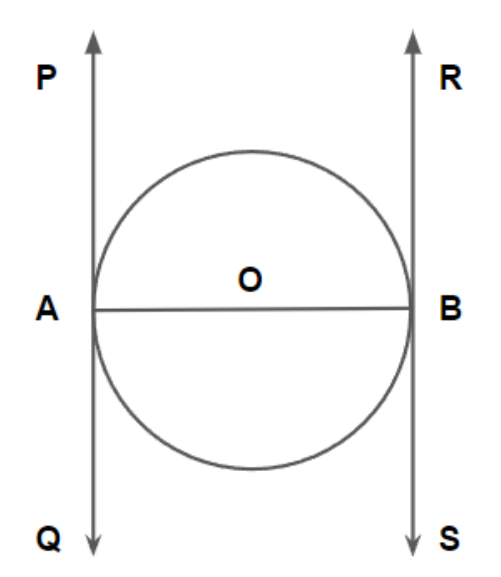
Prove that the tangents drawn at the ends of a diameter of a circle are parallel.
Show SolutionHide Solution
Correct figure $1$ Mark
Let $PQ$ and $RS$ be tangents at the end of diameter $AB$.
$\angle PAO = \angle RBO = 90^{\circ}$
$\implies PQ \parallel RS$
figure for this question
212 Marks · July 2024 · Standardopen ↗
Prove that the line segment joining the points of contact of two parallel tangents to a circle passes through its centre.
Show SolutionHide Solution
Sol.
QQ' $||$ PP'
Let P and Q be the points of contact and O is the centre of the circle.
Join OP and OQ. Draw OA $||$ QQ'.
$\therefore$ QQ' $\perp$ OQ $\Rightarrow \angle 1 = 90^{\circ} \Rightarrow \angle 2 = 90^{\circ}$ ----- (i)
Since OQ' $||$ PP'
$\therefore$ OA $||$ PP' and hence $\angle 4 = 90^{\circ}$ ----- (ii)
Adding (i) and (ii),
$\angle 2 + \angle 4 = 180^{\circ}$ or $\angle POQ = 180^{\circ}$
$\therefore$ POQ is a straight line.
figure for this question
222 Marks · March 2024 · Standardopen ↗
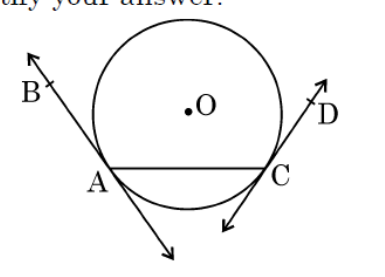
In the given figure, $AB$ and $CD$ are tangents to a circle centred at $O$. Is $\angle BAC = \angle DCA$? Justify your answer.
figure for this question
Show SolutionHide Solution
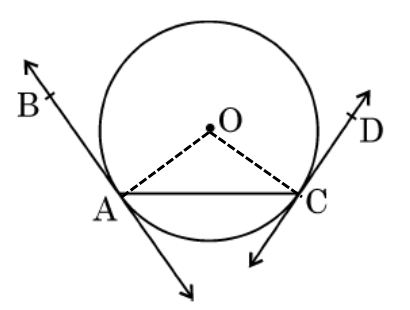
Join $OA$ and $OC$
$OA = OC$
$\angle OAC = \angle OCA$
Also, $\angle OAB = \angle OCD$
$\Rightarrow \angle OAC + \angle OAB = \angle OCA + \angle OCD$
$\Rightarrow \angle BAC = \angle DCA$
figure for this question
232 Marks · March 2024 · Standardopen ↗
If two tangents inclined at an angle of $60^{\circ}$ are drawn to a circle of radius $3 \text{ cm}$, then find the length of each tangent.
Show SolutionHide Solution
Correct Figure
$\angle APO = 30^{\circ}$
$\tan 30^{\circ} = \frac{1}{\sqrt{3}} = \frac{3}{AP}$
$AP = 3\sqrt{3} \text{ cm}$
figure for this question
242 Marks · March 2024 · Standardopen ↗
Prove that the tangents drawn at the ends of a diameter of a circle are parallel.
Show SolutionHide Solution
Correct Figure
$\angle OAY = \angle OBP = 90^{\circ}$
But they are forming alternate interior angles
Therefore, $PQ \parallel XY$
figure for this question
252 Marks · March 2025 · Standardopen ↗
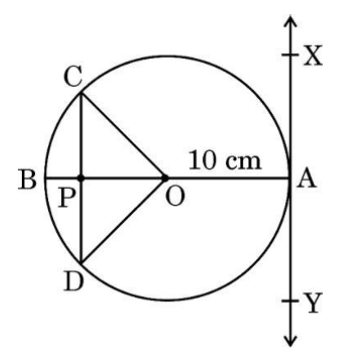
At point A on the diameter AB of a circle of radius $10$ cm, tangent XAY is drawn to the circle. Find the length of the chord CD parallel to XY at a distance of $16$ cm from A.
figure for this question
Show SolutionHide Solution
AP = $16$ cm
$\therefore OP = 16 - 10 = 6$ cm
XY $||$ CD
$\therefore \angle CPO = 90^\circ$
In right $\triangle OPC$,
$CP = \sqrt{(10)^2 - (6)^2} = 8$ cm
CD = $2 \times CP$
$= 2 \times 8 = 16$ cm
262 Marks · March 2025 · Standardopen ↗
Prove that the tangents drawn at the ends of a diameter of a circle are parallel.
Show SolutionHide Solution
Sol.
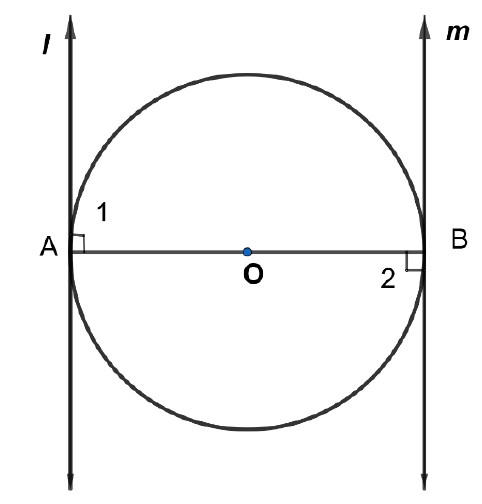
Tangents $l$ and $m$ are drawn at the end points A and B of the diameter AB of the circle
$\angle 1 = 90^{\circ}$, $\angle 2 = 90^{\circ}$
$\therefore \angle 1 = \angle 2$
But these are alternate interior angles.
$\therefore l \parallel m$
figure for this question
3 Marks Questions
273 Marks · July 2024 · Standardopen ↗
Prove that the tangents drawn at the ends of a diameter of a circle are parallel.
Show SolutionHide Solution
Sol.
PQ is diameter of the circle.
Therefore $\angle P'PQ = \angle Q'QP = 90^{\circ}$
$\angle PPQ + \angle Q'QP = 180^{\circ}$
$\Rightarrow$ PP' $||$ QQ'
figure for this question
283 Marks · March 2025 · Standardopen ↗
Prove that the intercept of a tangent between two parallel tangents to a circle subtends right angle at the centre.
Show SolutionHide Solution
Let $XY \parallel X'Y'$ be two parallel tangents with $LM$ as diameter. $\Delta OAL \cong \Delta OAC \implies \angle 1 = \angle 2$. Similarly, $\angle 3 = \angle 4$. But $\angle 1 + \angle 2 + \angle 3 + \angle 4 = 180^\circ \implies 2 \angle 1 + 2 \angle 3 = 180^\circ$ or $\angle 1 + \angle 3 = 90^\circ \implies AB$ subtends right angle at the centre.
figure for this question
5 Marks Questions
295 Marks · July 2023 · Standardopen ↗
Prove that the lengths of the tangents drawn from an external point to a circle are equal.
Show SolutionHide Solution
Correct Given, To prove and Construction
Correct Proof

Find angles

1 Mark Questions
301 Mark · July 2023 · Standardopen ↗
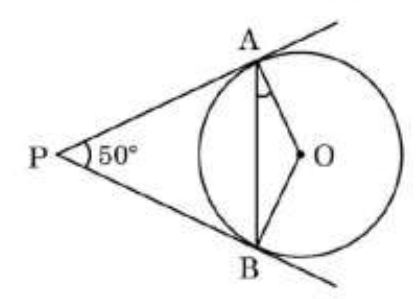
In the figure, PA and PB are two tangents to the circle with centre O such that $\angle APB = 50^\circ$. Then, the measure of $\angle OAB$ is:
figure for this question
  • (a)$25^\circ$
  • (b)$75^\circ$
  • (c)$50^\circ$
  • (d)$100^\circ$
Show SolutionHide Solution
(a) $25^\circ$
311 Mark · March 2023 · Standardopen ↗
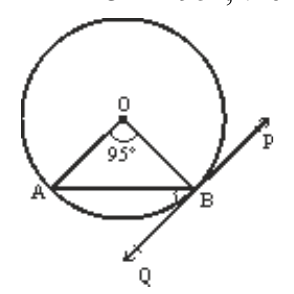
In the given figure, $PQ$ is tangent to the circle centred at $O$. If $\angle AOB = 95^\circ$, then the measure of $\angle ABQ$ will be
figure for this question
  • (a)$47.5^\circ$
  • (b)$42.5^\circ$
  • (c)$85^\circ$
  • (d)$95^\circ$
Show SolutionHide Solution
(A) $47.5^\circ$
321 Mark · March 2023 · Standardopen ↗
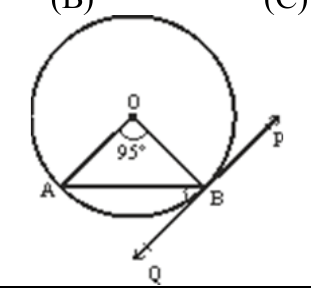
In the given figure, $PQ$ is tangent to the circle centred at $O$. If $\angle AOB = 95^{\circ}$, then the measure of $\angle ABQ$ will be
figure for this question
  • (a)$47.5^{\circ}$
  • (b)$42.5^{\circ}$
  • (c)$85^{\circ}$
  • (d)$95^{\circ}$
Show SolutionHide Solution
(A) $47.5^{\circ}$
331 Mark · March 2023 · Standardopen ↗
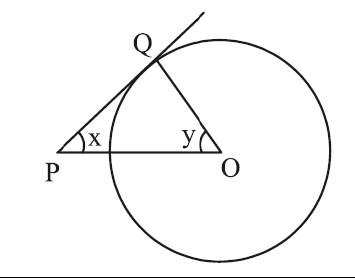
In the given figure, $PQ$ is a tangent to the circle with centre $O$. If $\angle OPQ = x$, $\angle POQ = y$, then $x + y$ is :
figure for this question
  • (a)$45^\circ$
  • (b)$90^\circ$
  • (c)$60^\circ$
  • (d)$180^\circ$
Show SolutionHide Solution
Sol. (b) $90^\circ$
341 Mark · March 2023 · Standardopen ↗
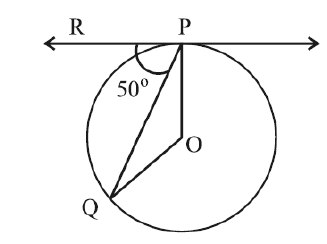
In the given figure, $O$ is the centre of the circle and $PQ$ is the chord. If the tangent $PR$ at $P$ makes an angle of $50^\circ$ with $PQ$, then the measure of $\angle POQ$ is :
figure for this question
  • (a)$50^\circ$
  • (b)$40^\circ$
  • (c)$100^\circ$
  • (d)$130^\circ$
Show SolutionHide Solution
(c) $100^\circ$
351 Mark · March 2023 · Standardopen ↗
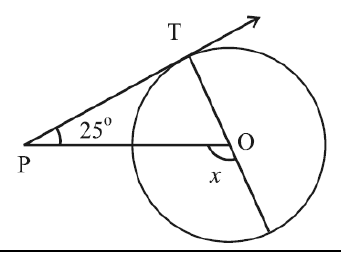
In the given figure, PT is a tangent at T to the circle with centre O. If $\angle TPO = 25^\circ$, then $x$ is equal to :
figure for this question
  • (a)$25^\circ$
  • (b)$65^\circ$
  • (c)$90^\circ$
  • (d)$115^\circ$
Show SolutionHide Solution
(d) $115^\circ$
361 Mark · March 2023 · Standardopen ↗
In the given figure, $AB$ is a tangent to the circle centered at $O$. If $OA = 6$ cm and $\angle OAB = 30^{\circ}$, then the radius of the circle is :
  • (a)$3$ cm
  • (b)$3\sqrt{3}$ cm
  • (c)$2$ cm
  • (d)$\sqrt{3}$ cm
Show SolutionHide Solution
(a) $3$ cm
371 Mark · March 2023 · Standardopen ↗
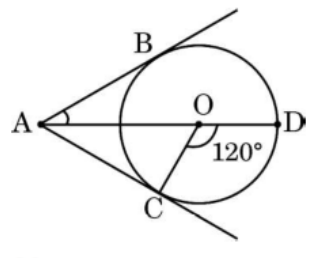
In the given figure, $AC$ and $AB$ are tangents to a circle centered at $O$. If $\angle COD = 120^{\circ}$, then $\angle BAO$ is equal to :
figure for this question
  • (a)$30^{\circ}$
  • (b)$60^{\circ}$
  • (c)$45^{\circ}$
  • (d)$90^{\circ}$
Show SolutionHide Solution
(a) $30^{\circ}$
381 Mark · March 2023 · Standardopen ↗
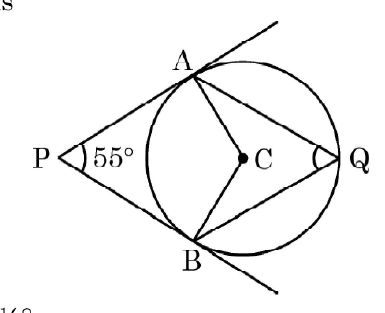
In the given figure, $PA$ and $PB$ are tangents from external point $P$ to a circle with centre $C$ and $Q$ is any point on the circle. Then the measure of $\angle AQB$ is
figure for this question
  • (a)$62\frac{1}{2}^{\circ}$
  • (b)$55^{\circ}$
  • (c)$125^{\circ}$
  • (d)$90^{\circ}$
Show SolutionHide Solution
(A) $62\frac{1}{2}$
391 Mark · March 2024 · Standardopen ↗
In the given figure, PA and PB are two tangents drawn to the circle with centre O and radius $5$ cm. If $\angle APB = 60^\circ$, then the length of PA is :
figure for this question
  • (a)$\frac{5}{\sqrt{3}}$ cm
  • (b)$5\sqrt{3}$ cm
  • (c)$\frac{10}{\sqrt{3}}$ cm
  • (d)$10$ cm
Show SolutionHide Solution
(B) $5\sqrt{3}$ cm
401 Mark · March 2024 · Standardopen ↗
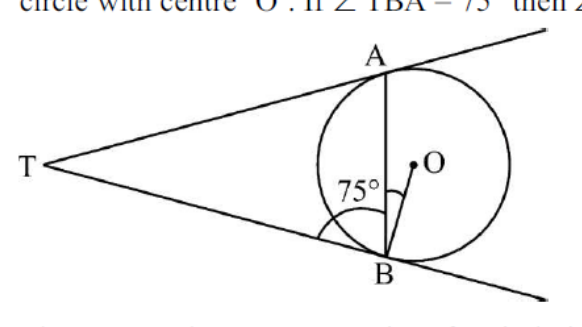
Assertion (A): TA and TB are two tangents drawn from an external point T to a circle with centre 'O'. If $\angle TBA = 75^\circ$ then $\angle ABO = 25^\circ$.
Reason (R): The tangent drawn at any point of a circle is perpendicular to the radius through the point of contact.
figure for this question
Show SolutionHide Solution
(D) Assertion (A) is not true but Reason (R) is true.
411 Mark · July 2024 · Standardopen ↗
Directions : In Question $19$ and $20$, Assertion (A) and Reason (R) are given. Select the correct option from the following :
(A) Both Assertion (A) and Reason (R) are true. Reason (R) is the correct explanation of Assertion (A).
(B) Both Assertion (A) and Reason (R) are true. Reason (R) does not give correct explanation of (A).
(C) Assertion (A) is true but Reason (R) is not true.
(D) Assertion (A) is not true but Reason (R) is true.
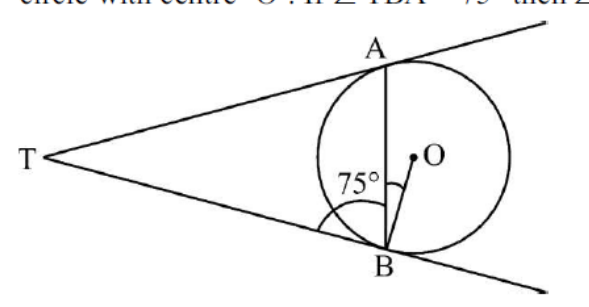
Assertion (A): TA and TB are two tangents drawn from an external point T to a circle with centre 'O'. If $\angle TBA = 75^\circ$ then $\angle ABO = 25^\circ$.
Reason (R): The tangent drawn at any point of a circle is perpendicular to the radius through the point of contact.
figure for this question
Show SolutionHide Solution
(D) Assertion (A) is not true but Reason (R) is true.
421 Mark · March 2024 · Standardopen ↗
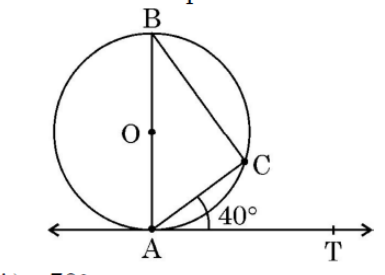
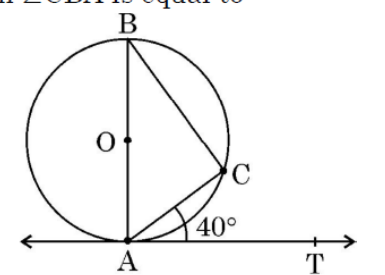
In the given figure, $AT$ is tangent to a circle centred at $O$. If $\angle CAT = 40^\circ$, then $\angle CBA$ is equal to
figure for this question
  • (a)$70^\circ$
  • (b)$65^\circ$
  • (c)$50^\circ$
  • (d)$40^\circ$
Show SolutionHide Solution
(D) $40^\circ$
431 Mark · March 2024 · Standardopen ↗
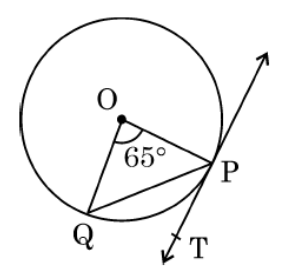
In the given figure, PT is tangent to a circle with centre O. Chord PQ subtends an angle of $65^\circ$ at the centre. The measure of $\angle QPT$ is :
figure for this question
  • (a)$65^\circ$
  • (b)$57.5^\circ$
  • (c)$67.5^\circ$
  • (d)$32.5^\circ$
Show SolutionHide Solution
(D) $32.5^\circ$
441 Mark · March 2024 · Standardopen ↗
In the given figure, AT is tangent to a circle centred at O. If $\angle CAT = 40^\circ$, then $\angle CBA$ is equal to
figure for this question
  • (a)$70^\circ$
  • (b)$50^\circ$
  • (c)$65^\circ$
  • (d)$40^\circ$
Show SolutionHide Solution
(D) $40^\circ$
451 Mark · March 2024 · Standardopen ↗
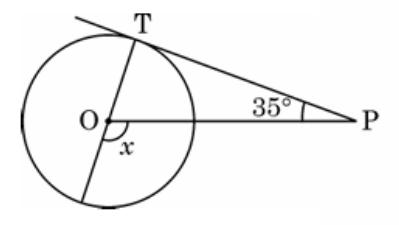
In the given figure, if PT is a tangent to a circle with centre O and $\angle TPO = 35^\circ$, then the measure of $\angle x$ is:
figure for this question
  • (a)$110^\circ$
  • (b)$115^\circ$
  • (c)$120^\circ$
  • (d)$125^\circ$
Show SolutionHide Solution
(D) $125^\circ$
461 Mark · March 2024 · Standardopen ↗
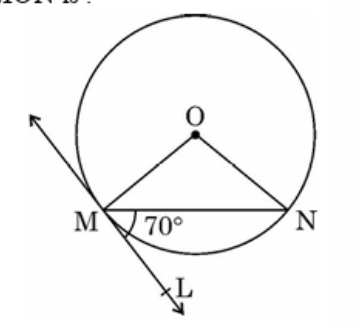
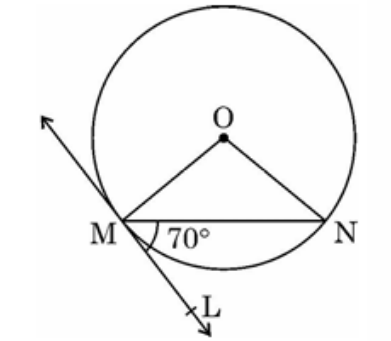
In the given figure, O is the centre of the circle. MN is the chord and the tangent ML at point M makes an angle of $70^\circ$ with MN. The measure of $\angle MON$ is:
figure for this question
  • (a)$120^\circ$
  • (b)$140^\circ$
  • (c)$70^\circ$
  • (d)$90^\circ$
Show SolutionHide Solution
(B) $140^\circ$
471 Mark · March 2024 · Standardopen ↗
In the given figure, O is the centre of the circle. MN is the chord and the tangent ML at point M makes an angle of $70^\circ$ with MN. The measure of $\angle MON$ is:
figure for this question
  • (a)$120^\circ$
  • (b)$70^\circ$
  • (c)$140^\circ$
  • (d)$90^\circ$
Show SolutionHide Solution
(B) $140^\circ$
481 Mark · March 2024 · Standardopen ↗
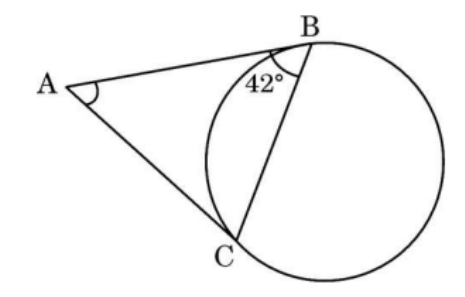
In the given figure, $AB$ and $AC$ are tangents to the circle. If $\angle ABC = 42^\circ$, then the measure of $\angle BAC$ is :
figure for this question
  • (a)$96^\circ$
  • (b)$106^\circ$
  • (c)$42^\circ$
  • (d)$86^\circ$
Show SolutionHide Solution
(A) $96^\circ$
491 Mark · July 2025 · Standardopen ↗
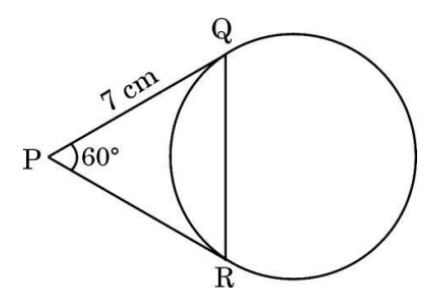
In the given figure, PQ and PR are tangents to the circle such that PQ = $7$ cm and $\angle RPQ = 60^{\circ}$. The length of chord QR is :
figure for this question
  • (a)$5$ cm
  • (b)$7$ cm
  • (c)$9$ cm
  • (d)$14$ cm
Show SolutionHide Solution
(B) $7$ cm
501 Mark · March 2025 · Standardopen ↗
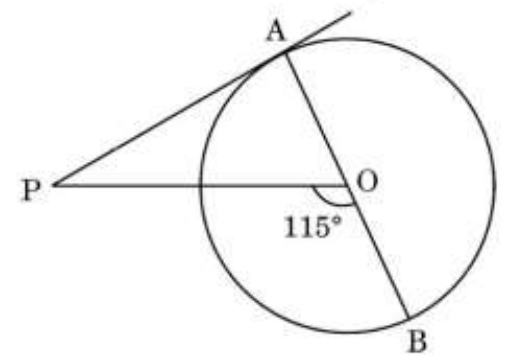
In the given figure, $PA$ is a tangent from an external point $P$ to a circle with centre $O$. If $\angle POB = 115^\circ$, then $\angle APO$ is equal to:
figure for this question
  • (a)$25^\circ$
  • (b)$65^\circ$
  • (c)$90^\circ$
  • (d)$35^\circ$
Show SolutionHide Solution
(A) $25^\circ$
511 Mark · March 2025 · Standardopen ↗
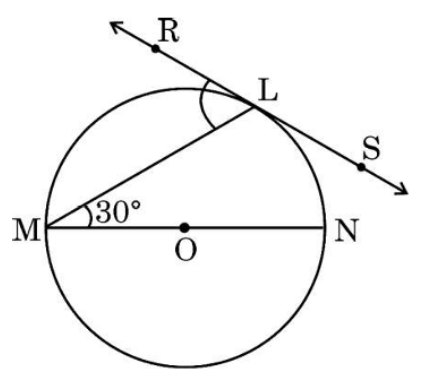
In the given figure, RS is the tangent to the circle at the point L and MN is the diameter. If $\angle NML = 30^\circ$, then $\angle RLM$ is :
figure for this question
  • (a)$30^\circ$
  • (b)$60^\circ$
  • (c)$90^\circ$
  • (d)$120^\circ$
Show SolutionHide Solution
(B) $60^\circ$
521 Mark · March 2025 · Standardopen ↗
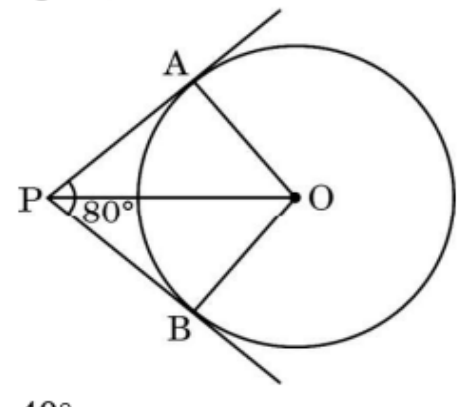
If tangents PA and PB drawn from an external point P to the circle with centre O are inclined to each other at an angle of $80^{\circ}$ as shown in the given figure, then the measure of $\angle POA$ is :
figure for this question
  • (a)$40^{\circ}$
  • (b)$50^{\circ}$
  • (c)$60^{\circ}$
  • (d)$80^{\circ}$
Show SolutionHide Solution
Sol. (B) $50^{\circ}$
531 Mark · March 2025 · Standardopen ↗
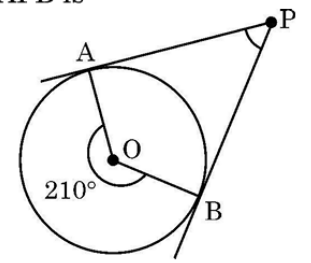
In the adjoining figure, $PA$ and $PB$ are tangents to a circle with centre $O$. The measure of angle $APB$ is
figure for this question
  • (a)$210^\circ$
  • (b)$150^\circ$
  • (c)$105^\circ$
  • (d)$30^\circ$
Show SolutionHide Solution
(D) $30^\circ$
541 Mark · March 2025 · Standardopen ↗
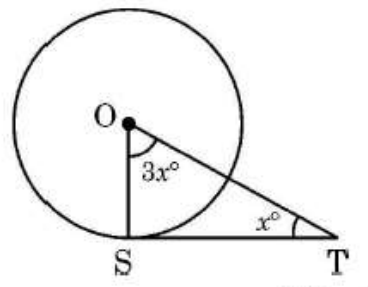
In the adjoining figure, $TS$ is a tangent to a circle with centre $O$. The value of $2x^\circ$ is.
figure for this question
  • (a)22.5
  • (b)45
  • (c)67.5
  • (d)90
Show SolutionHide Solution
(B) 45
551 Mark · March 2025 · Standardopen ↗
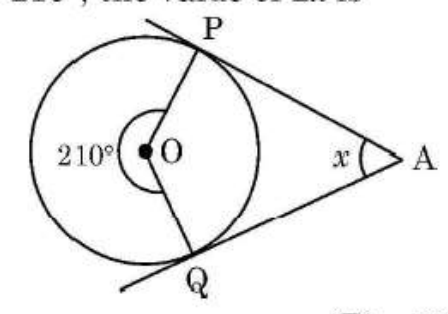
In the adjoining figure, AP and AQ are tangents to the circle with centre O. If reflex $\angle POQ = 210^{\circ}$, the value of $2x$ is
figure for this question
  • (a)$30^{\circ}$
  • (b)$60^{\circ}$
  • (c)$120^{\circ}$
  • (d)$300^{\circ}$
Show SolutionHide Solution
(B) $60^{\circ}$
2 Marks Questions
562 Marks · March 2023 · Standardopen ↗
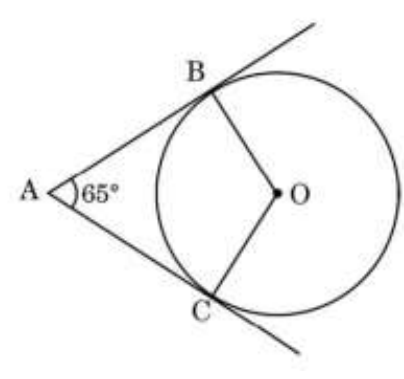
In the given figure, O is the centre of the circle. AB and AC are tangents drawn to the circle from point A. If $\angle BAC = 65^\circ$, then find the measure of $\angle BOC$.
figure for this question
Show SolutionHide Solution
$\angle BAC + \angle BOC = 180^\circ$
$\Rightarrow \angle BOC = 180^\circ - 65^\circ$
$\Rightarrow \angle BOC = 115^\circ$
572 Marks · March 2023 · Standardopen ↗
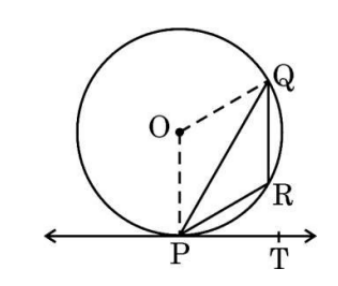
In the given figure, $PQ$ is a chord of the circle centered at $O$. $PT$ is a tangent to the circle at $P$. If $\angle QPT = 55^\circ$, then find $\angle PRQ$.
figure for this question
Show SolutionHide Solution
$\angle QPT = 55^\circ$
Since $OP \perp PT$ (radius is perpendicular to tangent at point of contact)
$\angle OPQ = 90^\circ - \angle QPT = 90^\circ - 55^\circ = 35^\circ$
In $\triangle OPQ$, $OP = OQ$ (radii of same circle)
$\Rightarrow \angle OQP = \angle OPQ = 35^\circ$
$\angle POQ = 180^\circ - (\angle OPQ + \angle OQP) = 180^\circ - (35^\circ + 35^\circ) = 180^\circ - 70^\circ = 110^\circ$
The angle subtended by an arc at the centre is double the angle subtended by it at any point on the remaining part of the circle.
$\angle PRQ = \frac{1}{2} \times \text{reflex } \angle POQ$
Reflex $\angle POQ = 360^\circ - 110^\circ = 250^\circ$
Hence $\angle PRQ = \frac{1}{2} \times 250^\circ = 125^\circ$
582 Marks · March 2023 · Standardopen ↗
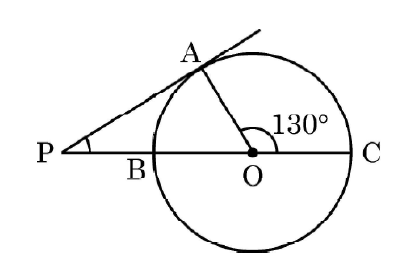
In the given figure, $PA$ is a tangent to the circle drawn from the external point $P$ and $PBC$ is the secant to the circle with $BC$ as diameter. If $\angle AOC = 130^{\circ}$, then find the measure of $\angle APB$, where $O$ is the centre of the circle.
figure for this question
Show SolutionHide Solution
$\angle AOB = 180^{\circ} - 130^{\circ} = 50^{\circ}$
$\angle OAP = 90^{\circ}$
$\therefore \angle APB = 180 - (50^{\circ} + 90^{\circ}) = 40^{\circ}$
592 Marks · March 2024 · Standardopen ↗
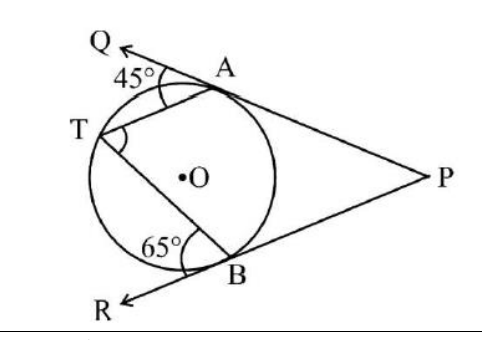
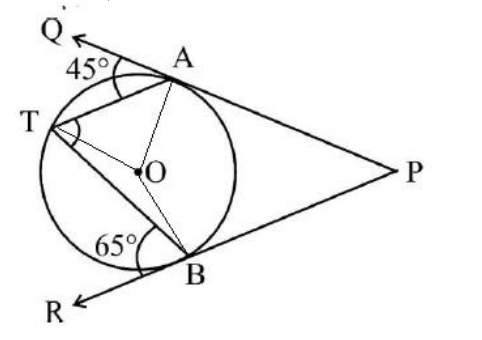
In the given figure, PAQ and PBR are tangents to the circle with centre 'O' at the points A and B respectively. If $\angle QAT = 45^\circ$ and $\angle TBR = 65^\circ$, then find $\angle ATB$.
figure for this question
Show SolutionHide Solution
Join OA, OB and OT
Now $\angle ATO = \angle TAO = 90^\circ - 45 = 45^\circ$
and $\angle BTO = \angle TBO = 90^\circ - 65^\circ = 25^\circ$
$\Rightarrow \angle ATB = \angle ATO + \angle BTO$
$= 45^\circ + 25^\circ = 70^\circ$
figure for this question
602 Marks · March 2024 · Standardopen ↗
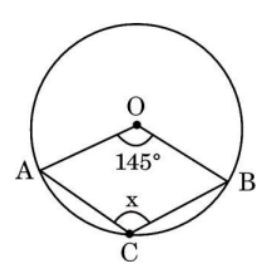
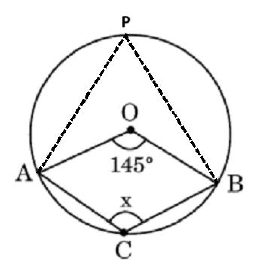
In the given figure, $O$ is the centre of the circle. If $\angle AOB = 145^\circ$, then find the value of $x$.
figure for this question
Show SolutionHide Solution
Take a point $P$ on circumference and join $$\begin{aligned}& AP \& BP. \\ & \angle APB = \frac{1}{2} \times 145^\circ = 72.5^\circ \\ & \angle APB + \angle ACB = 180^\circ \\ & \Rightarrow \angle ACB = 107.5^\circ \text{ or } x = 107.5^\circ\end{aligned}$$
figure for this question
3 Marks Questions
613 Marks · March 2023 · Standardopen ↗
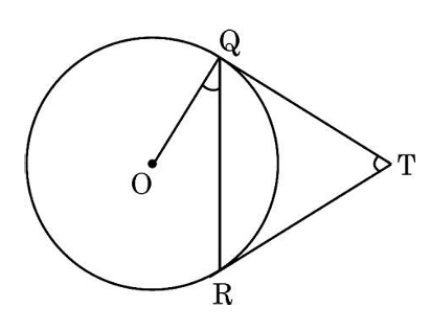
Two tangents $TP$ and $TQ$ are drawn to a circle with centre $O$ from an external point $T$. Prove that $\angle PTQ = 2\angle OPQ$ .
figure for this question
Show SolutionHide Solution
$TP = TQ$
$\Rightarrow \angle TPQ = \angle TQP$
Let $\angle PTQ$ be $\theta$
$\Rightarrow \angle TPQ = \angle TQP = \frac{180^\circ - \theta}{2} = 90^\circ - \frac{\theta}{2}$
Now $\angle OPT = 90^\circ$
$\Rightarrow \angle OPQ = 90^\circ - (90^\circ-\frac{\theta}{2}) = \frac{\theta}{2}$
$\angle PTQ = 2 \angle OPQ$
623 Marks · March 2023 · Standardopen ↗
In the given figure, O is the centre of the circle and QPR is a tangent to it at P. Prove that $\angle QAP + \angle APR = 90^\circ$.
figure for this question
Show SolutionHide Solution
OA = OP
$\therefore$ In $\triangle OAP$, $\angle OPA = \angle OAP$ ... (i)
$\angle OPA + \angle APR = 90^\circ$
$\Rightarrow \angle OAP + \angle APR = 90^\circ$ Using (i)
$\Rightarrow \angle QAP + \angle APR = 90^\circ$
633 Marks · March 2023 · Standardopen ↗
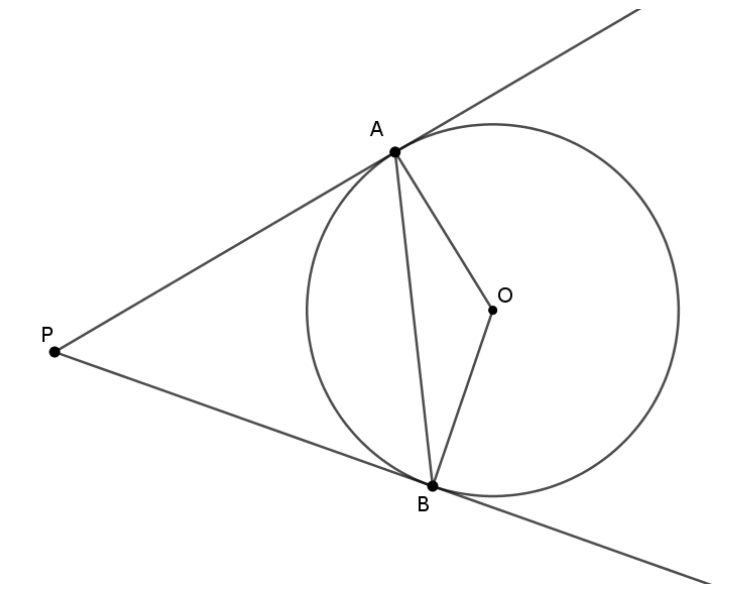
Prove that the angle between the two tangents drawn from an external point to a circle is supplementary to the angle subtended by the line-segment joining the points of contact at the centre.
Show SolutionHide Solution
Sol. PA and PB are tangents drawn from the external point P to the circle with centre O.
In quad. OAPB,
$\angle OAP + \angle APB + \angle OBP + \angle AOB = 360^\circ$
$90^\circ + \angle APB + 90^\circ + \angle AOB = 360^\circ$ (Tangent $\perp$ radius)
$\angle APB + \angle AOB = 360^\circ – 180^\circ = 180^\circ$
figure for this question
643 Marks · March 2024 · Standardopen ↗
In the given figure, $PQ$ is tangent to a circle centred at $O$ and $\angle BAQ = 30^\circ$; show that $BP = BQ$.
figure for this question
Show SolutionHide Solution
Join $OQ$
$OQ=OA$
$\Rightarrow \angle 2 = 30^\circ$
$\angle 3 = 90^\circ - 30^\circ = 60^\circ$
$\angle 4 = 90^\circ - 60^\circ = 30^\circ$
$\angle 6 = \angle 1 + \angle 2 = 60^\circ$
Hence $\angle 5 = 90^\circ - 60^\circ = 30^\circ = \angle 4$
$\therefore BP=BQ$
figure for this question
653 Marks · March 2025 · Standardopen ↗
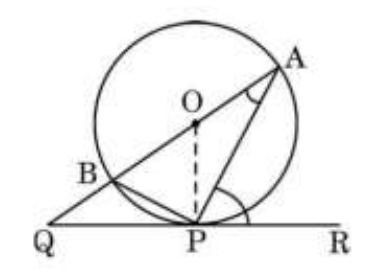
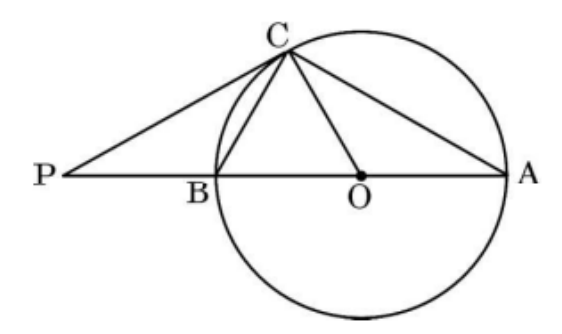
In the given figure, PC is a tangent to the circle at C. AOB is the diameter which when extended meets the tangent at P. Find $\angle CBA$ and $\angle BCO$, if $\angle PCA = 110^{\circ}$.
figure for this question
Show SolutionHide Solution
Sol. $\angle ACB = \angle OCB + \angle OCA = 90^{\circ}$
$\angle PCB + \angle OCB + \angle OCA = 110^{\circ}$
$\angle PCB = 110^{\circ} - 90^{\circ} = 20^{\circ}$
$\angle PCB + \angle OCB = 90^{\circ}$
$\angle OCB = 90^{\circ} - 20^{\circ} = 70^{\circ}$
As $OB = OC \Rightarrow \angle OBC = \angle OCB$
$\angle OBC = \angle OCB = 70^{\circ}$
663 Marks · March 2025 · Standardopen ↗
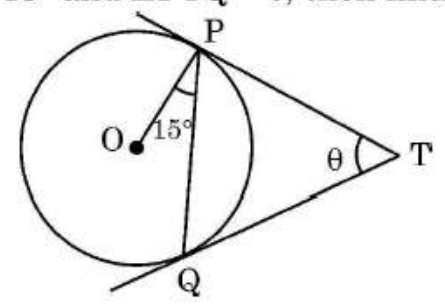
In the adjoining figure, $TP$ and $TQ$ are tangents drawn to a circle with centre $O$. If $\angle OPQ = 15^\circ$ and $\angle PTQ = \theta$, then find the value of $\sin 2\theta$.
figure for this question
Show SolutionHide Solution
$\angle QPT = 75^\circ$ ($\frac{1}{2}$ mark). $\angle PQT = 75^\circ$ ($\frac{1}{2}$ mark). $\theta = 30^\circ$ (1 mark). $\sin 2\theta = \sin 2(30^\circ) = \sin 60^\circ = \frac{\sqrt{3}}{2}$ ($\frac{1}{2} + \frac{1}{2}$ marks).
5 Marks Questions
675 Marks · March 2023 · Standardopen ↗
OR
In the given figure, tangents PQ and PR are drawn to a circle such that $\angle RPQ = 30^{\circ}$. A chord RS is drawn parallel to the tangent PQ. Find the measure of $\angle RQS$.
figure for this question
Show SolutionHide Solution
$PQ = PR$ (tangents drawn from an external point to the circle)
$\therefore \angle PQR = \angle PRQ$
In $\triangle PQR$, $\angle PQR = \angle PRQ = \frac{1}{2}(180^{\circ} - 30^{\circ}) = 75^{\circ}$
Draw a perpendicular QL from Q to QP
Now, $\angle PQL = 90^{\circ}$
$\therefore \angle RQL = 90^{\circ} - 75^{\circ} = 15^{\circ}$
$\triangle RQL \cong \triangle SQL$ (SAS )
$\therefore \angle RQL = \angle SQL = 15^{\circ}$
$\therefore \angle RQS = 15^{\circ} +15^{\circ} = 30^{\circ}$
figure for this question

Concentric Circles

1 Mark Questions
681 Mark · July 2024 · Standardopen ↗
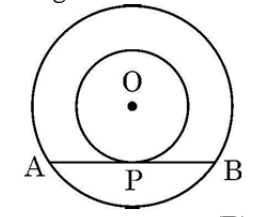
Two concentric circles have radii $4$ cm and $5$ cm. XY is a chord of the outer circle which touches the inner circle. Find the length of XY.
Show SolutionHide Solution
Correct figure
In $\triangle OMY$,
$MY = \sqrt{5^2 – 4^2} = 3$ cm
$\therefore XY = 2 \times 3 = 6$ cm
691 Mark · July 2024 · Standardopen ↗
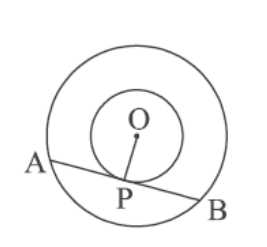
In two concentric circles with centre O, the radius of the outer circle is $50$ cm. Chord AB of the outer circle is tangent to the inner circle at D. If length of AB is $96$ cm, then the radius of the inner circle is :
  • (a)$14$ cm
  • (b)$7$ cm
  • (c)$24$ cm
  • (d)$15$ cm
Show SolutionHide Solution
Sol. (A) $14$ cm
701 Mark · March 2024 · Standardopen ↗
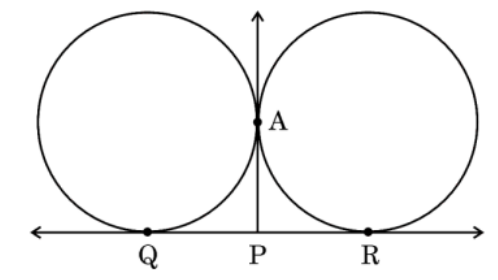
In the given figure, $QR$ is a common tangent to the two given circles touching externally at $A$. The tangent at $A$ meets $QR$ at $P$. If $AP = 4.2$ cm, then the length of $QR$ is :
figure for this question
  • (a)$4.2$ cm
  • (b)$2.1$ cm
  • (c)$8.4$ cm
  • (d)$6.3$ cm
Show SolutionHide Solution
(C) $8.4$ cm
711 Mark · July 2025 · Standardopen ↗
If the radii of two concentric circles are $4$ cm and $5$ cm, then the length of each chord of one circle which is tangent to the other circle is :
  • (a)$3$ cm
  • (b)$1$ cm
  • (c)$6$ cm
  • (d)$9$ cm
Show SolutionHide Solution
(C) $6$ cm
721 Mark · March 2025 · Standardopen ↗
In the adjoining figure, AB is the chord of the larger circle touching the smaller circle. The centre of both the circles is O. If AB = $2r$ and OP = $r$, then the radius of larger circle is :
figure for this question
  • (a)$2r$
  • (b)$3r$
  • (c)$2\sqrt{2}r$
  • (d)$\sqrt{2}r$
Show SolutionHide Solution
(d) $\sqrt{2}r$
731 Mark · March 2025 · Standardopen ↗
In the adjoining figure, AC is diameter of larger circle with centre O. AB is tangent to smaller circle with centre O. If OD = $r$, then BC is equal to :
  • (a)$r$
  • (b)$\frac{3r}{2}$
  • (c)$2r$
  • (d)$4r$
Show SolutionHide Solution
(c) $2r$
741 Mark · March 2025 · Standardopen ↗
In the adjoining figure, the sum of radii of two concentric circles is 16 cm. The length of chord $AB$ which touches the inner circle at $P$ is 16 cm. The difference of the radii of the given circles is
figure for this question
  • (a)8 cm
  • (b)4 cm
  • (c)2 cm
  • (d)3 cm
Show SolutionHide Solution
(B) 4 cm
751 Mark · March 2025 · Standardopen ↗
Two circles of radii $10$ cm and $17$ cm intersect at $P$ and $Q$. If $A$ and $B$ are their centres and $PQ = 16$ cm, then the distance $AB$ is equal to
  • (a)$30$ cm
  • (b)$12$ cm
  • (c)$21$ cm
  • (d)$16$ cm
Show SolutionHide Solution
(C) $21$ cm
3 Marks Questions
763 Marks · March 2023 · Standardopen ↗
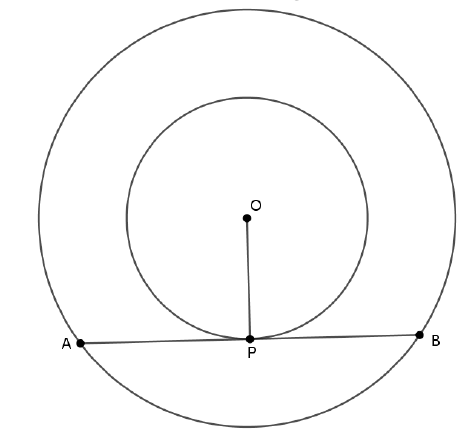
Two concentric circles are of radii $5$ cm and $3$ cm. Find the length of the chord of the larger circle which touches the smaller circle.
Show SolutionHide Solution
Sol. AB is the chord of larger circle touching the smaller circle at P.
OA = $5$ cm, OP = $3$ cm
To find AB
OP $\perp$ AB (radius $\perp$ tangent)
AB is the chord of larger circle and OP $\perp$ AB
$\therefore AP = PB$
In right-angled $\Delta AOP$, $AP^2 = 5^2-3^2 = 16$
$AP = 4$ cm
figure for this question
773 Marks · March 2024 · Standardopen ↗
In the given figure, two concentric circles have radii $3$ cm and $5$ cm. Two tangents TR and TP are drawn to the circles from an external point T such that TR touches the inner circle at R and TP touches the outer circle at P. If TR = $4\sqrt{10}$ cm, then find the length of TP.
figure for this question
Show SolutionHide Solution
Join OR, OP and OT
In $\triangle ORT$,
$OT^2 = OR^2 + TR^2 = 3^2 + (4\sqrt{10})^2 = 169$
$\therefore OT = 13$ cm
In $\triangle OPT$,
$TP^2 = OT^2 - OP^2 = 13^2 - 5^2 = 144$
$\therefore TP = 12$ cm
figure for this question
783 Marks · March 2025 · Standardopen ↗
In two concentric circles, a chord of length $24$ cm of the larger circle is a tangent to the smaller circle whose radius is $5$ cm. Find the radius of the larger circle.
Show SolutionHide Solution
Let the radius of larger circle be $R$. $\angle S = 90^\circ$. $PS = \frac{24}{2} = 12$ cm. $12^2 + 5^2 = R^2 \implies R = 13$ cm
figure for this question
5 Marks Questions
795 Marks · March 2023 · Standardopen ↗
Two circles with centres $O$ and $O'$ of radii $6$ cm and $8$ cm, respectively intersect at two points $P$ and $Q$ such that $OP$ and $O'P$ are tangents to the two circles. Find the length of the common chord $PQ$.
figure for this question
Show SolutionHide Solution
$OO' = \sqrt{6^2 + 8^2} = 10$ cm
quad $\{OP \perp O'P\}$
Let $OA = x, O'A = 10 - x$
$AP^2 = 36 - x^2$
Also $AP^2 = 64 - (10 - x)^2$
Therefore $36 - x^2 = 64 - (10 - x)^2$
$\Rightarrow 36 - x^2 = 64 - 100 - x^2 + 20 x$
$\Rightarrow x = 3.6$
In $\triangle PAO, AP^2 = 36 - (3.6)^2 = 23.04$
$AP = 4.8$
Length $PQ = 2 \times AP = 9.6$ cm

Triangle & Circle

1 Mark Questions
801 Mark · March 2023 · Standardopen ↗
In the given figure, $AB = BC = 10$ cm. If $AC = 7$ cm, then the length of $BP$ is:
figure for this question
  • (a)$3.5$ cm
  • (b)$7$ cm
  • (c)$6.5$ cm
  • (d)$5$ cm
Show SolutionHide Solution
(c) $6.5$ cm
811 Mark · March 2023 · Standardopen ↗
PQ is tangent to a circle centered at O. If the radius of the circle is $5$ cm, then the length of the tangent PQ is :
figure for this question
  • (a)$5\sqrt{3}$ cm
  • (b)$10$ cm
  • (c)$\frac{10}{\sqrt{3}}$ cm
  • (d)$\frac{5}{\sqrt{3}}$ cm
Show SolutionHide Solution
(a) $5\sqrt{3}$ cm
821 Mark · March 2024 · Standardopen ↗
$AB$ and $CD$ are two chords of a circle intersecting at $P$. Choose the correct statement from the following:
  • (a)$\triangle ADP \sim \triangle CBA$
  • (b)$\triangle ADP \sim \triangle BPC$
  • (c)$\triangle ADP \sim \triangle BCP$
  • (d)$\triangle ADP \sim \triangle CBP$
Show SolutionHide Solution
(D) $\triangle ADP \sim \triangle CBP$
831 Mark · July 2025 · Standardopen ↗
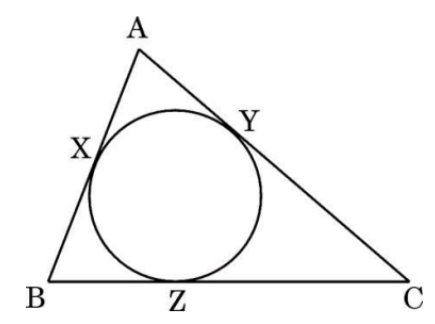
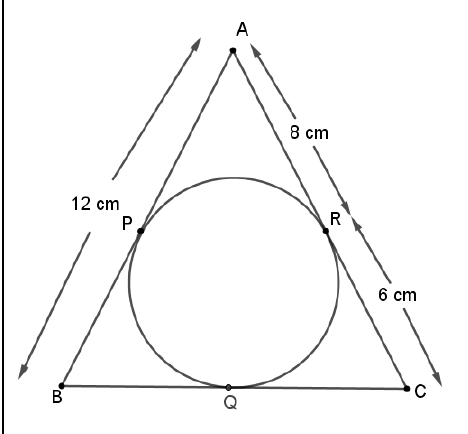
In the given figure, a circle inscribed in $\triangle ABC$, touches AB, BC and CA at X, Z and Y, respectively. If AB = $12$ cm, AY = $8$ cm and CY = $6$ cm, then the length of BC is :
figure for this question
  • (a)$14$ cm
  • (b)$12$ cm
  • (c)$10$ cm
  • (d)$8$ cm
Show SolutionHide Solution
(C) $10$ cm
2 Marks Questions
842 Marks · July 2023 · Standardopen ↗
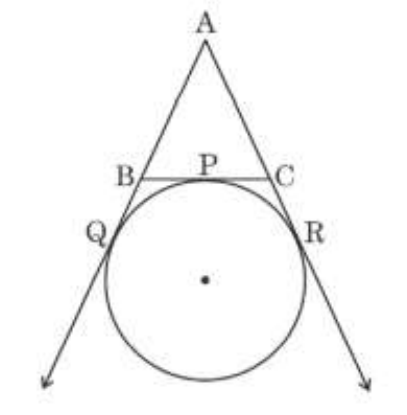
A circle is touching the side BC of a $\triangle ABC$ at the point P and touching AB and AC produced at points Q and R respectively.
Prove that $AQ = \frac{1}{2}$ (Perimeter of $\triangle ABC$).
figure for this question
Show SolutionHide Solution
Perimeter of $\triangle ABC = AB + BC + CA$
$= AB + BP + CP + CA$
$= AB + BQ + CR + CA$
$[BP = BQ \; ; \; CP = CR]$
$= AQ + AR$
$= AQ + AQ$
$[AQ = AR]$
$= 2 AQ$
$\therefore AQ = \frac{1}{2}$ (Perimeter of $\triangle ABC$)
852 Marks · March 2023 · Standardopen ↗
In the given figure, $PT$ is a tangent to the circle centered at $O$. $OC$ is perpendicular to chord $AB$. Prove that $PA \cdot PB = PC^2 - AC^2$.
figure for this question
Show SolutionHide Solution
$PA \cdot PB = (PC - AC) \cdot (PC + BC)$
$= (PC - AC) \cdot (PC + AC)$
quad $[AC = BC]$
$= PC^2 - AC^2$
862 Marks · July 2024 · Standardopen ↗
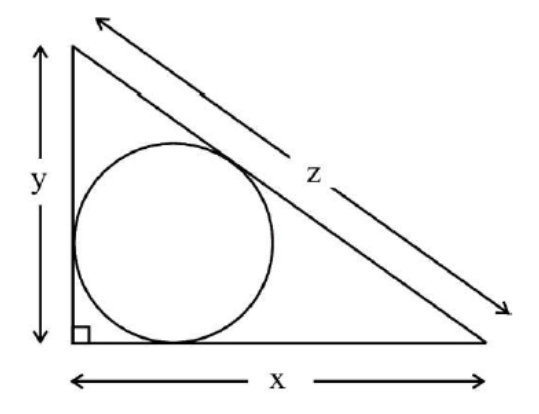
In the given figure, $x, y$ and $z$ are the sides of a right triangle, where $z$ is the hypotenuse. Prove that the radius $r$ of the circle which touches the sides of the triangle is given by $r = \frac{x+y-z}{2}$.
figure for this question
Show SolutionHide Solution
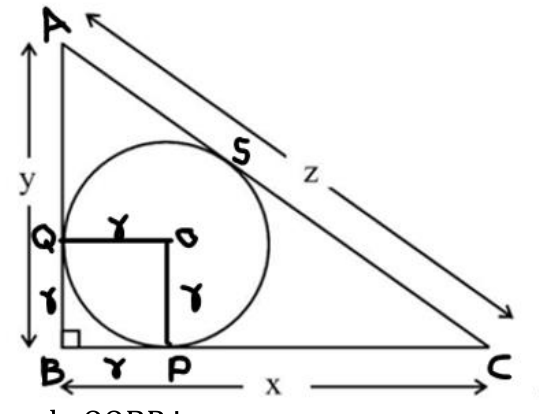
Clearly OQBP is a square
$OP = OQ = QB = BP = r$
$CS = PC = x-r$
$AS = AQ = y -r$
$AC = z = AS + CS = x - r + y-r$
Gives $r = \frac{x+y-z}{2}$
figure for this question
872 Marks · March 2024 · Standardopen ↗
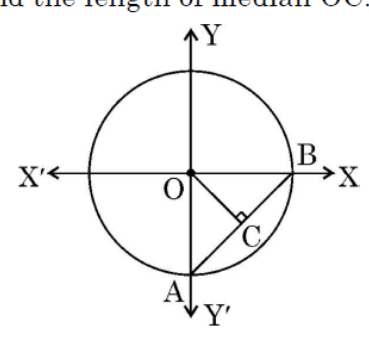
In the given figure, a circle centred at origin O has radius 7 cm, OC is median of $\Delta OAB$. Find the length of median OC.
figure for this question
Show SolutionHide Solution
$\angle AOB = 90^\circ$
$\therefore AB^2 = 7^2 +7^2$
$\Rightarrow AB = 7\sqrt{2}$ cm
$\Rightarrow AC = \frac{7\sqrt{2}}{2}$ cm
Now In $\Delta AOC$,
$OC^2 = 7^2 - (\frac{7\sqrt{2}}{2})^2$
$\therefore OC = \frac{7\sqrt{2}}{2}$ cm
882 Marks · March 2024 · Standardopen ↗
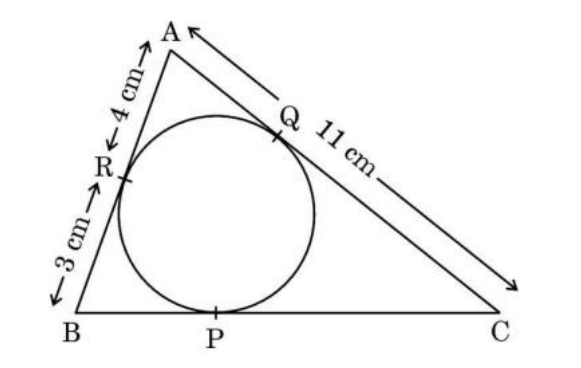
In the given figure, $\Delta ABC$ is circumscribing a circle. Find the length of BC, if AR = $4$ cm, BR = $3$ cm and AC = $11$ cm.
figure for this question
Show SolutionHide Solution
$BP = BR = 3$ cm and $AQ = AR = 4$ cm
$QC = AC - AQ = 11 - 4 = 7$ cm
$PC = QC = 7$ cm
$\therefore BC = BP + PC = 3 + 7 = 10$ cm
892 Marks · July 2025 · Standardopen ↗
PX and PY are two tangents drawn from an external point P to a circle with centre O. If $\angle XPY = 120^{\circ}$, then prove that PX + PY = PO.
figure for this question
Show SolutionHide Solution
Join OX and OY.
$\angle XPY = 120^{\circ} \Rightarrow \angle XPO = 60^{\circ}$
Now, $\cos 60^{\circ} = \frac{PX}{OP} = \frac{1}{2}$
$\Rightarrow 2 PX = OP$
As PX = PY
$\therefore PX + PY = OP$
figure for this question
902 Marks · July 2025 · Standardopen ↗
In the given figure, TQ and TR are tangents to the circle with centre O. Prove that $\angle$ QTR $= 2 \angle$ OQR.
figure for this question
Show SolutionHide Solution
Since TQ = TR
$\therefore \angle$TQR $= \angle$TRQ
Also, $\angle$QTR $= 180^\circ - (\angle$TQR $+ \angle$TRQ)
$\Rightarrow \angle$QTR $= 180^\circ - 2 \angle$TQR --- (1)
Now TQ $\perp$ OQ
$\therefore \angle$OQR $= 90^\circ - \angle$TQR
Using (1), we get
$2 \angle$OQR $= 180^\circ - 2\angle$TQR $= \angle$QTR
912 Marks · March 2025 · Standardopen ↗
A circle is inscribed in a $\Delta ABC$ touching $AB$, $BC$ and $AC$ at $P$, $Q$ and $R$ respectively. If $AB = 12$ cm, $AR = 8$ cm and $CR = 6$ cm, then find the length of $BC$.
Show SolutionHide Solution
$AR = AP = 8$ cm
$\therefore BP = 12 - 8 = 4$ cm $= BQ$
Also $CR = CQ = 6$ cm
$\therefore BC = BQ + CQ = 4 + 6 = 10$ cm
figure for this question
3 Marks Questions
923 Marks · March 2024 · Standardopen ↗
In the given figure, AB is a diameter of the circle with centre O. AQ, BP and PQ are tangents to the circle. Prove that $\angle POQ = 90^\circ$.
figure for this question
Show SolutionHide Solution
Sol. Join OR.
$\triangle AOQ \cong \triangle ROQ \Rightarrow \angle AOQ = \angle ROQ$ ----- (i)
$\triangle BOP \cong \triangle ROP \Rightarrow \angle BOP = \angle ROP$ ----- (ii)
Since $\angle AOR + \angle ROB = 180^\circ$
$\Rightarrow 2\angle QOR + 2\angle ROP = 180^\circ$
$\Rightarrow \angle QOR + \angle ROP = \angle POQ = 90^\circ$
figure for this question
933 Marks · March 2024 · Standardopen ↗
Prove that the tangents drawn at the end points of a chord of a circle makes equal angles with the chord.
Show SolutionHide Solution
Correct figure
Let AB be the chord of circle.
In $\triangle PAB$
$PA = PB$
$\angle PAB = \angle PBA$
figure for this question
943 Marks · March 2024 · Standardopen ↗
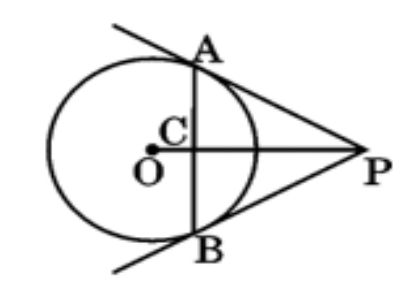
From an external point P, two tangents PA and PB are drawn to the circle with centre O. Prove that OP is the perpendicular bisector of chord AB.
Show SolutionHide Solution
Sol.
Correct Fig.
$\triangle$ACP $\cong \triangle$BCP
AC=BC
$\angle$ACP = $\angle$BCP
$\angle$ACP + $\angle$BCP = $180^{\circ}$
$\angle$ACP = $90^{\circ}$
$\Rightarrow$ OP $\perp$ AB
Hence OP is perpendicular bisector of chord AB.
figure for this question
953 Marks · March 2024 · Standardopen ↗
A circle is inscribed in a right-angled triangle ABC, right-angled at B. If BC = $7$ cm and AB = $24$ cm, find the radius of the circle.
Show SolutionHide Solution
$AC = \sqrt{24^2 + 7^2} = 25$ cm
Let the radius of the circle be '$r$' cm
$$\begin{aligned}& \frac{1}{2} \times 24 \times 7 = \frac{1}{2} \times r \times 7 + \frac{1}{2} \times r \times 24 + \frac{1}{2} \times r \times 25 \\ & \Rightarrow r = 3 \\ & \therefore\end{aligned}$$ radius of circle is $3$ cm.
figure for this question
963 Marks · March 2024 · Standardopen ↗
From an external point P, two tangents PA and PB are drawn to a circle with centre O. At a point E on the circle, a tangent is drawn which intersects PA and PB at C and D respectively. If PA = $10$ cm, find the perimeter of $\triangle PCD$.
Show SolutionHide Solution
Perimeter of $$\begin{aligned}& \triangle PCD = PC + CD + DP \\ & = PC + CE + ED + DP \\ & = PC + CA + DB + DP \\ & = PA + PB \\ & = PA + PA \\ & = 2 PA \\ & = 2 \times 10 = 20\end{aligned}$$ cm
figure for this question
973 Marks · March 2025 · Standardopen ↗
In the given figure, $O$ is the centre of the circle and $BCD$ is tangent to it at $C$. Prove that $\angle BAC + \angle ACD = 90^\circ$.
figure for this question
Show SolutionHide Solution
In $\Delta OAC, OA = OC \implies \angle OCA = \angle OAC$. Now, $\angle OCD = 90^\circ \implies \angle OCA + \angle ACD = 90^\circ \implies \angle OAC + \angle ACD = 90^\circ$ or $\angle BAC + \angle ACD = 90^\circ$.
983 Marks · March 2025 · Standardopen ↗
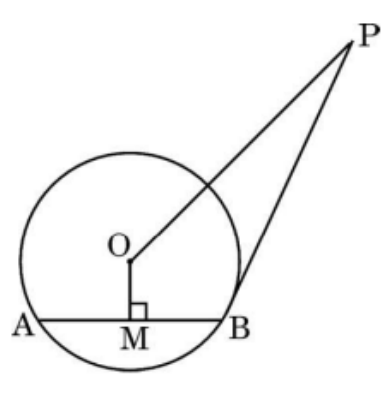
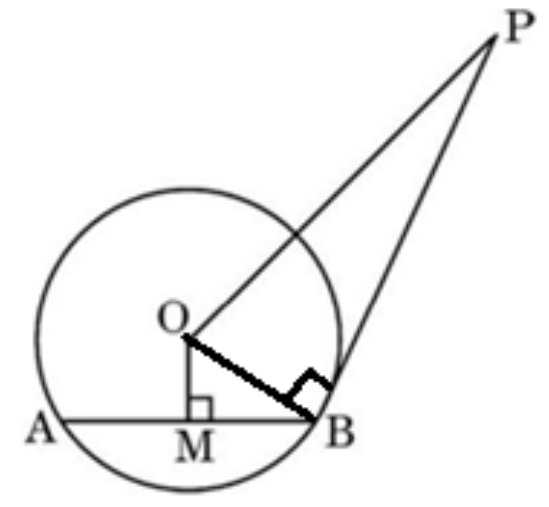
In the given figure, $PB$ is a tangent to the circle with centre $O$ at $B$. $AB$ is a chord of the circle of length $24$ cm and at a distance of $5$ cm from the centre of the circle. If the length $PB$ of the tangent is $20$ cm, find the length of $OP$.
figure for this question
Show SolutionHide Solution
Sol.
Join $OB$
$AB = 24$ cm, $OM = 5$ cm, $PB = 20$ cm
$AM = MB = 12$ cm
In $\triangle OMB$, $OB = \sqrt{5^2 + 12^2} = 13$ cm
As $PB$ is tangent $\Rightarrow PB \perp OB\\$ In rt $\triangle OBP$, $OP = \sqrt{13^2 + 20^2} = \sqrt{569}$ cm
figure for this question
993 Marks · March 2025 · Standardopen ↗
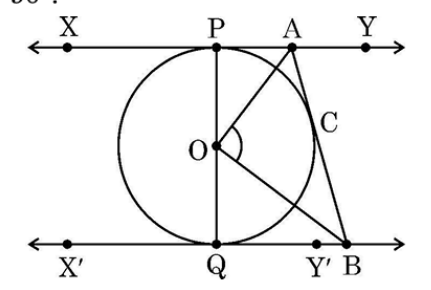
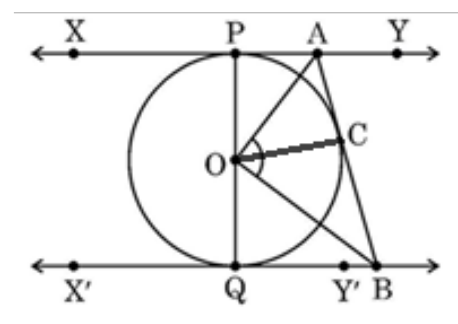
In the adjoining figure, $XY$ and $X'Y'$ are parallel tangents to a circle with centre $O$. Another tangent $AB$ touches the circle at $C$ intersecting $XY$ at $A$ and $X'Y'$ at $B$. Prove that $AB$ subtends right angle at the centre of the circle; or $\angle AOB = 90^\circ$.
figure for this question
Show SolutionHide Solution
Join $OC$.
$\Delta POA \cong \Delta COA$
$\angle POA = \angle COA$
Similarly, $\angle QOB = \angle COB$
$\angle POA + \angle QOB + \angle COA + \angle COB = 180^\circ$
$\implies 2(\angle COA + \angle COB) = 180^\circ$
$\implies \angle COA + \angle COB = 90^\circ$
$\therefore \angle AOB = 90^\circ$
figure for this question
5 Marks Questions
1005 Marks · March 2023 · Standardopen ↗
A triangle $ABC$ is drawn to circumscribe a circle of radius $4$ cm such that the segments $BD$ and $DC$ are of lengths $10$ cm and $8$ cm respectively. Find the lengths of the sides $AB$ and $AC$, if it is given that area $\triangle ABC = 90 \text{ cm}^2$.
figure for this question
Show SolutionHide Solution
Join $OA, OB, OC$ and draw $OE \perp AC$ and $OF \perp AB$.
$BF = 10$ cm, $CE = 8$ cm, Let $AF = AE = x$
$ar \triangle ABC = ar \triangle BOC + ar \triangle COA + ar \triangle AOB$
$90 = \frac{1}{2} \cdot 4 (BC + CA + AB)$
$90 = 2(18 + 8 + x + 10 + x)$
$90 = 4(18 + x)$
$x = 4.5$
$AB = 14.5$ cm and $AC = 12.5$ cm
figure for this question
1015 Marks · March 2023 · Standardopen ↗
Two tangents $TP$ and $TQ$ are drawn to a circle with centre $O$ from an external point $T$. Prove that $\angle PTQ = 2 \angle OPQ$.
figure for this question
Show SolutionHide Solution
$TP = TQ$
$\Rightarrow \angle TPQ = \angle TQP$
Let $\angle PTQ$ be $\theta$
$\Rightarrow \angle TPQ = \angle TQP = \frac{180^{\circ} - \theta}{2} = 90^{\circ} - \frac{\theta}{2}$
Now $\angle OPT = 90^{\circ}$
$\Rightarrow \angle OPQ = 90^{\circ} - (90^{\circ} - \frac{\theta}{2}) = \frac{\theta}{2}$
$\angle PTQ = 2 \angle OPQ$
1025 Marks · March 2023 · Standardopen ↗
A circle touches the side $BC$ of a $\triangle ABC$ at a point $P$ and touches $AB$ and $AC$ when produced at $Q$ and $R$ respectively. Show that $AQ = \frac{1}{2}$ (Perimeter of $\triangle ABC$).
figure for this question
Show SolutionHide Solution
$AQ = AR$
$2AQ = AQ + AR$
$= AB + BQ + AC + CR$
$= AB + AC + (BP + CP)$
$= AB + AC + BC$
$AQ = \frac{1}{2} (AB + AC + BC) = \frac{1}{2} (\text{Perimeter of } \triangle ABC)$
1035 Marks · July 2025 · Standardopen ↗
A triangle ABC is drawn to circumscribe a circle of radius $4$ cm such that the segments BD and DC into which BC is divided by the point of contact D are of lengths $8$ cm and $6$ cm respectively. Find the lengths of sides AB and AC.
Show SolutionHide Solution
Area ($\triangle$ ABC) = Area ($\triangle$ BOC) + Area ($\triangle$ AOC) + Area ($\triangle$ AOB)
$= \frac{1}{2} \times 4 \times 14 + \frac{1}{2} \times 4 \times (6 + x) + \frac{1}{2} \times 4 \times (8 + x)$
$= (56 + 4x)$ or $4(14 + x)$ --- (1)
Semi perimeter of $\triangle$ ABC = $\frac{14+(6+x)+(8+x)}{2} = (14 + x)$
Also, area ($\triangle$ ABC) = $\sqrt{(14 + x)(14 + x – 14)[(14 + x) – (6 + x)][(14 + x) – (8 + x)]}$
$= \sqrt{48x(14 + x)}$ --- (2)
From (1) and (2), we get
$x=7$
$\therefore AB = 15$ cm and $AC = 13$ cm
figure for this question

Quad & Circle

1 Mark Questions
1041 Mark · March 2023 · Standardopen ↗
In the given figure, the quadrilateral PQRS circumscribes a circle. Here PA + CS is equal to:
figure for this question
  • (a)QR
  • (b)PR
  • (c)PS
  • (d)PQ
Show SolutionHide Solution
(c) PS
1051 Mark · March 2023 · Standardopen ↗
Assertion (A): If $PA$ and $PB$ are tangents drawn from an external point $P$ to a circle with centre $O$, then the quadrilateral $AOBP$ is cyclic.
Reason (R): The angle between two tangents drawn from an external point to a circle is supplementary to the angle subtended by the line segment joining the points of contact at the centre.
  • (a)Both Assertion (A) and Reason (R) are true, and Reason (R) is the correct explanation of the Assertion (A).
  • (b)Both Assertion (A) and Reason (R) are true, but Reason (R) is not the correct explanation of the Assertion (A).
  • (c)Assertion (A) is true, but Reason (R) is false.
  • (d)Assertion (A) is false, but Reason (R) is true.
Show SolutionHide Solution
(a) Both Assertion (A) and Reason (R) are true, and Reason (R) is the correct explanation of the Assertion (A).
1061 Mark · March 2025 · Standardopen ↗
Assertion (A): If two tangents are drawn to a circle from an external point, then they subtend equal angles at the centre of the circle.
Reason (R): A parallelogram circumscribing a circle is a rhombus.
Show SolutionHide Solution
Sol. (B) Both Assertion (A) and Reason (R) are true, but Reason (R) is not the correct explanation of the Assertion (A).
1071 Mark · March 2025 · Standardopen ↗
Questions number $19$ and $20$ are Assertion and Reason based questions. Two statements are given, one labelled as Assertion (A) and the other is labelled as Reason (R). Select the correct answer to these questions from the codes (A), (B), (C) and (D) as given below.
(A) Both Assertion (A) and Reason (R) are true and Reason (R) is the correct explanation of the Assertion (A).
(B) Both Assertion (A) and Reason (R) are true, but Reason (R) is
textbf{not} the correct explanation of the Assertion (A).
(C) Assertion (A) is true, but Reason (R) is false.
(D) Assertion (A) is false, but Reason (R) is true.
Assertion (A): If two tangents are drawn to a circle from an external point, then they subtend equal angles at the centre of the circle.
Reason (R): A parallelogram circumscribing a circle is a rhombus.
Show SolutionHide Solution
(B) Both Assertion (A) and Reason (R) are true, but Reason (R) is not the correct explanation of the Assertion (A).
1081 Mark · March 2025 · Standardopen ↗
Questions number $19$ and $20$ are Assertion and Reason based questions. Two statements are given, one labelled as Assertion
  • (a)Both Assertion (A) and Reason (R) are true and Reason (R) is the correct explanation of the Assertion (A).
  • (b)Both Assertion (A) and Reason (R) are true, but Reason (R) is not the correct explanation of the Assertion (A).
  • (c)Assertion (A) is true, but Reason (R) is false.
  • (d)Assertion (A) is false, but Reason (R) is true.
Show SolutionHide Solution
Sol. (B) Both Assertion (A) and Reason (R) are true, but Reason (R) is not the correct explanation of the Assertion (A).
1091 Mark · March 2025 · Standardopen ↗
A parallelogram having one of its sides $5$ cm circumscribes a circle. The perimeter of parallelogram is :
  • (a)$20$ cm
  • (b)less than $20$ cm
  • (c)more than $20$ cm but less than $40$ cm
  • (d)$40$ cm
Show SolutionHide Solution
(a) $20$ cm
1101 Mark · March 2025 · Standardopen ↗
A parallelogram having one of its sides $5$ cm circumscribes a circle. The perimeter of parallelogram is :
  • (a)$20$ cm
  • (b)less than $20$ cm
  • (c)more than $20$ cm but less than $40$ cm
  • (d)$40$ cm
Show SolutionHide Solution
(a) $20$ cm
1111 Mark · March 2025 · Standardopen ↗
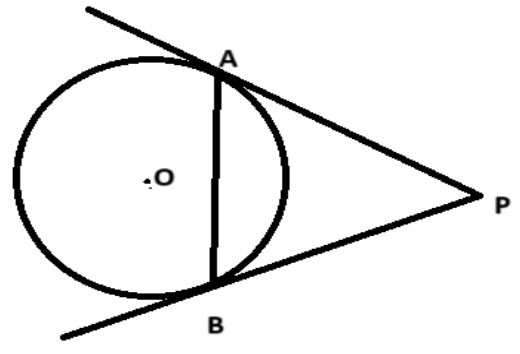
In the adjoining figure, $PA$ and $PB$ are tangents to a circle with centre $O$ such that $\angle P = 90^\circ$. If $AB = 3\sqrt{2}$ cm, then the diameter of the circle is.
figure for this question
  • (a)$3\sqrt{2}$ cm
  • (b)$6\sqrt{2}$ cm
  • (c)3 cm
  • (d)6 cm
Show SolutionHide Solution
(D) 6 cm
2 Marks Questions
1122 Marks · July 2024 · Standardopen ↗
Two tangents PQ and PR are drawn from an external point P to a circle with centre O. Prove that QORP is a cyclic quadrilateral.
Show SolutionHide Solution
Sol.
PQ $\perp$ OQ $\Rightarrow \angle PQO = 90^{\circ}$
and PR $\perp$ OR $\Rightarrow \angle PRO = 90^{\circ}$
$\therefore \angle PQO + \angle PRO = 180^{\circ}$
Since opposite angles of quadrilateral QORP are supplementary, therefore QORP is a cyclic quadrilateral.
figure for this question
1132 Marks · July 2025 · Standardopen ↗
In the given figure, PQRS is a quadrilateral such that $\angle S = 90^{\circ}$. A circle with centre 'O' is inscribed in the quadrilateral. The circle touches PQ, QR, RS and SP at points M, N, T and L respectively. If MQ = 19 cm, RQ = 30 cm and SR = 21 cm, then find the radius of the circle.
figure for this question
Show SolutionHide Solution
NQ = MQ = 19
$\therefore$ RN = $30 - 19 = 11$ cm
$\therefore$ RT = 11 cm
$\therefore$ TS = $21 - 11 = 10$ cm
Since SLOT is a square
Therefore radius of the circle = TS = 10 cm
3 Marks Questions
1143 Marks · March 2023 · Standardopen ↗
In the given figure, a circle is inscribed in a quadrilateral $ABCD$ in which $\angle B = 90^\circ$. If $AD=17$ cm, $AB = 20$ cm and $DS = 3$ cm, then find the radius of the circle.
figure for this question
Show SolutionHide Solution
$DR = DS = 3$ cm
$\therefore AR = AD – DR = 17 – 3 = 14$ cm
$\Rightarrow AQ = AR = 14$ cm
$\therefore QB = AB – AQ = 20 – 14 = 6$ cm
Since $QB = OP = r \therefore$ radius = 6 cm
1153 Marks · March 2023 · Standardopen ↗
From an external point, two tangents are drawn to a circle. Prove that the line joining the external point to the centre of the circle bisects the angle between the two tangents.
Show SolutionHide Solution
Given : PA and PB are tangents drawn from an external point P to the circle with centre O.
To prove: $\angle OPA = \angle OPB\\$Construction: Join OA, OB
Proof: In $\Delta OPA$ and $$\begin{aligned}& \Delta OPB \\ & OP = OP\end{aligned}$$ (common)
OA = OB (radii)
$\angle OAP = \angle OBP$ (each $90^\circ$, radius $\perp$ tangents)
$\therefore \Delta OPA \cong \Delta OPB$ (RHS)
$\Rightarrow \angle OPA = \angle OPB$ (CPCT)
figure for this question
1163 Marks · July 2024 · Standardopen ↗
Prove that the parallelogram circumscribing a circle is a rhombus.
Show SolutionHide Solution
Sol.
Here AP = AS, BP = BQ, CR = CQ, DR = DS
$\therefore$ AB + CD = AP + BP + CR + DR
= AS + BQ + CQ + DS
= (AS + DS) + (BQ + CQ)
= AD + BC
$\Rightarrow 2AB = 2 AD$ ($\because$ AB = CD, BC = AD)
$\Rightarrow$ AB = AD
or ABCD is a rhombus.
figure for this question
1173 Marks · March 2024 · Standardopen ↗
A circle with centre O and radius $8$ cm is inscribed in a quadrilateral ABCD in which P, Q, R, S are the points of contact as shown. If AD is perpendicular to DC, BC = $30$ cm and BS = $24$ cm, then find the length DC.
figure for this question
Show SolutionHide Solution
Sol. Join OP and OQ.
BR = BS = $24$ cm
$\therefore CR = 6$ cm
$\Rightarrow CQ = 6$ cm
Also, DQ = OP = $8$ cm
Hence, DC = $8 + 6 = 14$ cm
figure for this question
1183 Marks · March 2024 · Standardopen ↗
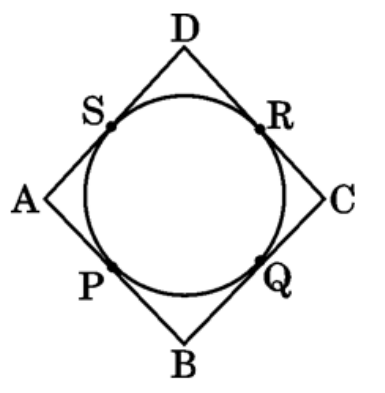
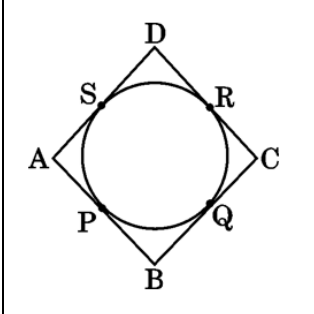
In the given figure, $AB, BC, CD$ and $DA$ are tangents to the circle with centre $O$ forming a quadrilateral $ABCD$.
Show that $\angle AOB + \angle COD = 180^\circ$
figure for this question
Show SolutionHide Solution
Join $OP, OQ, OR$ and $OS$
$\triangle POB \cong \triangle QOB$
$\Rightarrow \angle 1 = \angle 2$
Similarly $\angle 3 = \angle 4, \angle 5 = \angle 6, \angle 7 = \angle 8$
Now, $\angle 1 + \angle 2 + \angle 3 + \angle 4 + \angle 5 + \angle 6 + \angle 7 + \angle 8 = 360^\circ$
$\Rightarrow 2(\angle 1 + \angle 8 + \angle 4 + \angle 5) = 360^\circ$
$\therefore \angle AOB + \angle COD = 180^\circ$
figure for this question
1193 Marks · March 2024 · Standardopen ↗
Prove that the parallelogram circumscribing a circle is a rhombus.
Show SolutionHide Solution
Correct figure
$$\begin{aligned}& AP = AS -----(i) \\ & BP = BQ -----(ii) \\ & CR = CQ -----(iii) \\ & DR = DS -----(iv) \\ & \text{Adding (i), (ii), (iii) \& (iv)} \\ & AP + BP + CR + DR = AS + BQ + CQ + DS \\ & \Rightarrow AB + CD = AD + BC \\ & \text{But ABCD is a parallelogram } \Rightarrow AB = CD \text{ and } AD = BC \\ & \therefore 2AB = 2AD \text{ or } AB = AD \\ & \text{Hence, ABCD is a rhombus.}\end{aligned}$$
figure for this question
1203 Marks · March 2024 · Standardopen ↗
Prove that the parallelogram circumscribing a circle is a rhombus.
Show SolutionHide Solution
Correct figure
$\therefore AP = AS$
$BP = BQ$
$CR = CQ$
$DR = DS$
Adding,
$(AP + BP) + (CR + DR) = (AS + DS) + (BQ + CQ)$
$\Rightarrow AB + CD = AD + BC$
Now $AB = CD$ and $AD = BC$
$\Rightarrow 2 AB = 2 BC$
$\Rightarrow AB = BC$
$\Rightarrow ABCD$ is a rhombus
figure for this question
1213 Marks · July 2025 · Standardopen ↗
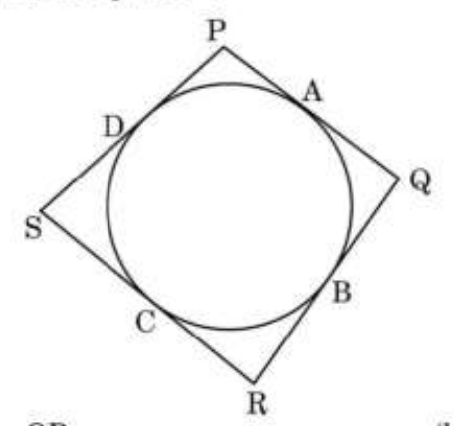
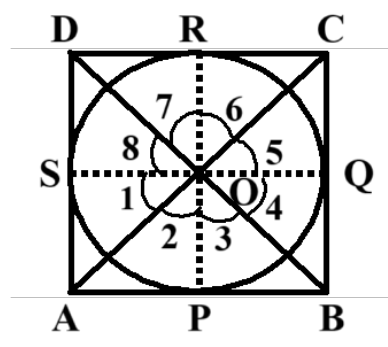
A quadrilateral circumscribes a circle. Prove that the opposite sides of the quadrilateral subtend supplementary angles at the centre of the circle.
Show SolutionHide Solution
Correct figure
$\triangle OPA \cong \triangle OSA$
$\Rightarrow \angle 1 = \angle 2$
Similarly, $\angle 3 = \angle 4$, $\angle 5 = \angle 6$, $\angle 7 = \angle 8$
Now, $\angle 1 + \angle 2 + \angle 3 + \angle 4 + \angle 5 + \angle 6 + \angle 7 + \angle 8 = 360^{\circ}$
$\Rightarrow 2 (\angle 1 + \angle 4 + \angle 5 + \angle 8) = 360^{\circ}$
$\Rightarrow (\angle 1 + \angle 8) + (\angle 4 + \angle 5) = 180^{\circ}$
$\Rightarrow \angle AOD + \angle BOC = 180^{\circ}$
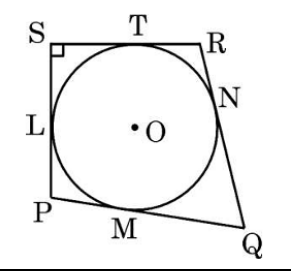
figure for this question
1223 Marks · March 2025 · Standardopen ↗
Prove that opposite sides of a quadrilateral circumscribing a circle subtend supplementary angles at the centre of the circle.
figure for this question
Show SolutionHide Solution
Correct figure. $\Delta OAP \cong \Delta OAS \implies \angle 1 = \angle 2$. Similarly, $\angle 3 = \angle 4, \angle 5 = \angle 6, \angle 7 = \angle 8$. Also, $\angle 1 + \angle 2 + \angle 3 + \angle 4 + \angle 5 + \angle 6 + \angle 7 + \angle 8 = 360^\circ \implies 2(\angle 1 + \angle 4 + \angle 5 + \angle 8) = 360^\circ \implies \angle AOB + \angle COD = 180^\circ$. Similarly, $\angle BOC + \angle AOD = 180^\circ$.
1233 Marks · March 2025 · Standardopen ↗
Prove that opposite sides of a quadrilateral circumscribing a circle subtend supplementary angles at the centre of the circle.
Show SolutionHide Solution
Correct Figure (1/2)
$\triangle$ OAP $\cong \triangle$ OAS
$\therefore \angle 1 = \angle 2$ (1)
Similarly, $\angle 3 = \angle 4$, $\angle 5 = \angle 6$, $\angle 7 = \angle 8$ (1/2)
Also, $\angle 1 + \angle 2 + \angle 3 + \angle 4 + \angle 5 + \angle 6 + \angle 7 + \angle 8 = 360^\circ$ (1/2)
$\Rightarrow 2 (\angle 1 + \angle 4 + \angle 5 + \angle 8) = 360^\circ$
$\Rightarrow \angle$ AOB + $\angle$ COD = $180^\circ$
Similarly, $\angle$ BOC + $\angle$ AOD = $180^\circ$ (1/2)
figure for this question
1243 Marks · March 2025 · Standardopen ↗
Prove that the parallelogram circumscribing a circle is a rhombus.
Show SolutionHide Solution
Correct figure
We know that lengths of tangents drawn from an external point to a circle are equal
$\therefore AP = AS$ --- (1)
$BP = BQ$ --- (2)
$CR = CQ$ --- (3)
$DR = DS$ --- (4)
Adding (1), (2), (3) and (4), we have
$(AP + BP) + (CR + DR) = AS + (BQ + CQ) + DS$
$\Rightarrow AB + CD = BC + AD$
$\therefore AB = CD$ and $BC = AD$
$\therefore AB = BC = CD = AD$
Therefore, ABCD is a rhombus.
figure for this question
1253 Marks · March 2025 · Standardopen ↗
Prove that the angle between the two tangents drawn from an external point to a circle is supplementary to the angle subtended by the line-segment joining the points of contact at the centre.
Show SolutionHide Solution
PA and PB are tangents from the external point P to the circle with centre O.
Correct figure
$\angle OAP = \angle OBP = 90^\circ$
In quadrilateral OAPB,
$\angle APB + \angle OAP + \angle OBP + \angle AOB = 360^\circ$
$\Rightarrow \angle APB + 90^\circ + 90^\circ + \angle AOB = 360^\circ$
$\Rightarrow \angle APB + \angle AOB = 180^\circ$
$\therefore \angle APB$ and $\angle AOB$ are supplementary.
figure for this question
1263 Marks · March 2025 · Standardopen ↗
Rectangle ABCD circumscribes the circle of radius $10$ cm. Prove that ABCD is a square. Hence, find the perimeter of ABCD.
Show SolutionHide Solution
For correct figure
$AP = AS$
$BP = BQ$
$CR = CQ$
$DR = DS$
Adding the above four equations,
$AP + BP + CR + DR = AS + BQ + CQ + DS$
$\Rightarrow AB + CD = AD + CB$ --- (i)
Since ABCD is a rectangle
$\therefore AB = CD$ and $BC = AD$
$\Rightarrow$ from (i), $2 AB = 2 AD$ or $AB = AD$
Hence ABCD is a square
Clearly side of square = diameter of circle = $20$ cm
$\therefore$ Perimeter of square = $4 \times 20$ cm = $80$ cm
figure for this question
5 Marks Questions
1275 Marks · July 2023 · Standardopen ↗
Prove that opposite sides of a quadrilateral circumscribing a circle subtend supplementary angles at the centre of the circle.
Show SolutionHide Solution
Let ABCD be a quadrilateral circumscribing a circle with centre O. Let the sides AB, BC, CD, DA touch the circle at P, Q, R, S respectively.
Join OA, OB, OC, OD, OP, OQ, OR, OS.
In $\triangle AOP$ and $\triangle AOS$:
OP = OS (Radii of the same circle)
OA = OA (Common side)
AP = AS (Tangents from an external point A)
So, $\triangle AOP \cong \triangle AOS$ (SSS congruence criterion)
$\Rightarrow \angle 1 = \angle 2$ (CPCTC)
Similarly, we can prove:
$\triangle BOQ \cong \triangle BOP \Rightarrow \angle 3 = \angle 4$
$\triangle COR \cong \triangle COQ \Rightarrow \angle 5 = \angle 6$
$\triangle DOR \cong \triangle DOS \Rightarrow \angle 7 = \angle 8$
The sum of all angles around the centre O is $360^\circ$.
$\angle 1 + \angle 2 + \angle 3 + \angle 4 + \angle 5 + \angle 6 + \angle 7 + \angle 8 = 360^\circ$
$2(\angle 1 + \angle 3 + \angle 5 + \angle 7) = 360^\circ$ (since $\angle 1=\angle 2, \angle 3=\angle 4, \angle 5=\angle 6, \angle 7=\angle 8$)
$\angle 1 + \angle 3 + \angle 5 + \angle 7 = 180^\circ$
Now, consider angles subtended by opposite sides at the centre:
$\angle AOB + \angle COD = (\angle 1 + \angle 4) + (\angle 5 + \angle 8)$
Since $\angle 1 = \angle 2$, $\angle 3 = \angle 4$, $\angle 5 = \angle 6$, $\angle 7 = \angle 8$
$\angle AOB + \angle COD = (\angle 1 + \angle 3) + (\angle 5 + \angle 7)$ (This step is incorrect in the provided solution, it should be $\angle 1+\angle 4$ and $\angle 5+\angle 8$)
Let's re-evaluate: $\angle AOB = \angle 1 + \angle 4$, $\angle COD = \angle 5 + \angle 8$
$\angle BOC = \angle 3 + \angle 6$, $\angle DOA = \angle 2 + \angle 7$
We know $\angle 1 = \angle 2$, $\angle 3 = \angle 4$, $\angle 5 = \angle 6$, $\angle 7 = \angle 8$.
So, $2(\angle 1 + \angle 3 + \angle 5 + \angle 7) = 360^\circ \Rightarrow \angle 1 + \angle 3 + \angle 5 + \angle 7 = 180^\circ$.
$\angle AOB + \angle COD = (\angle 1 + \angle 4) + (\angle 5 + \angle 8) = (\angle 1 + \angle 3) + (\angle 5 + \angle 7) = 180^\circ$.
Similarly, $\angle BOC + \angle DOA = (\angle 3 + \angle 6) + (\angle 2 + \angle 7) = (\angle 3 + \angle 5) + (\angle 1 + \angle 7) = 180^\circ$.
Thus, opposite sides subtend supplementary angles at the centre.
figure for this question
1285 Marks · March 2023 · Standardopen ↗
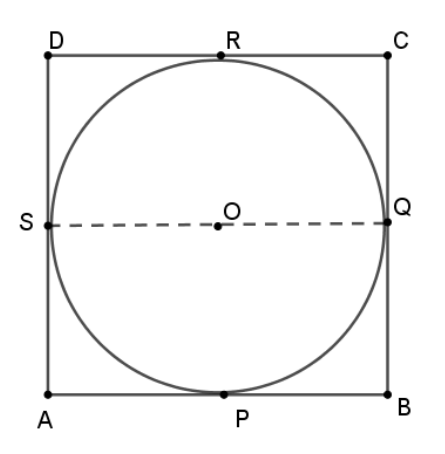
Prove that a parallelogram circumscribing a circle is a rhombus.
Show SolutionHide Solution
ABCD is a parallelogram touching the circle at P, Q, R, S by sides AB, BC, CD, DA respectively.
We know that tangents drawn from the external point to a circle are equal.
$\therefore AP = AS$
quad --------(i)
$PB = BQ$
quad --------(ii)
$CR = CQ$
quad --------(iii)
$DR = DS$
quad ---------(iv)
Adding (i), (ii), (iii), (iv)
$(AP + PB) + (CR + DR) = (AS + DS) + (BQ + CQ)$
$AB + CD = AD + BC$
ABCD is a parallelogram
$\Rightarrow AB = CD, AD = BC$
$\Rightarrow 2AB = 2AD \Rightarrow AB = AD$
$\Rightarrow \text{ABCD is a rhombus.}$
figure for this question
1295 Marks · July 2025 · Standardopen ↗
Prove that the opposite sides of a quadrilateral circumscribing a circle subtend supplementary angles at the centre of the circle.
Show SolutionHide Solution
$\triangle OPA \cong \triangle OSA$
$\Rightarrow \angle 1 = \angle 2$
Similarly, $\angle 3 = \angle 4, \angle 5 = \angle 6, \angle 7 = \angle 8$
Now, $\angle 1 + \angle 2 + \angle 3 + \angle 4 + \angle 5 + \angle 6 + \angle 7 + \angle 8 = 360^{\circ}$
$\Rightarrow 2 (\angle 1 + \angle 4 + \angle 5 + \angle 8) = 360^{\circ}$
$\Rightarrow (\angle 1 + \angle 8) + (\angle 4 + \angle 5) = 180^{\circ}$
$\Rightarrow \angle AOD + \angle BOC = 180^{\circ}$
figure for this question

Hexagon & Circle

2 Marks Questions
1302 Marks · March 2024 · Standardopen ↗
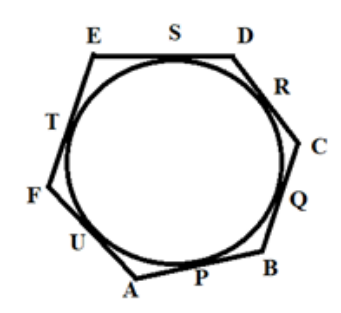
If a hexagon ABCDEF circumscribes a circle, show that AB + CD + EF = BC + DE + FA.
Show SolutionHide Solution
$$\begin{aligned}& PB = BQ \dots (1) \\ & RC = QC \dots (2) \\ & RD = DS \dots (3) \\ & ET = SE \dots (4) \\ & TF = FU \dots (5) \\ & AP = AU \dots (6) \\ & Adding (1), (2), (3), (4), (5)\end{aligned}$$ and $(6)$, we get
$$\begin{aligned}& (AP+ PB)+(RC + RD)+(ET + TF) = (BQ + QC)+(DS + SE)+(FU + AU) \\ & \Rightarrow AB + CD + EF = BC + DE + FA\end{aligned}$$
figure for this question
3 Marks Questions
1313 Marks · March 2024 · Standardopen ↗
If a hexagon PQRSTU circumscribes a circle, prove that,
PQ + RS + TU = QR + ST + UP
figure for this question
Show SolutionHide Solution
Correct figure
In the given figure,
PA = PF ... (1)
AQ = BQ ... (2)
RC = RB ... (3)
CS = DS ... (4)
ET = TD ... (5)
UE = UF ... (6)
Adding (1), (2),(3), (4), (5) and (6),
PA + AQ + RC + CS + ET + UE = PF + BQ + BR + DS + TD + UF
$\Rightarrow$ PQ+RS+TU = UP+ST+QR

Applications

2 Marks Questions
1322 Marks · March 2025 · Standardopen ↗
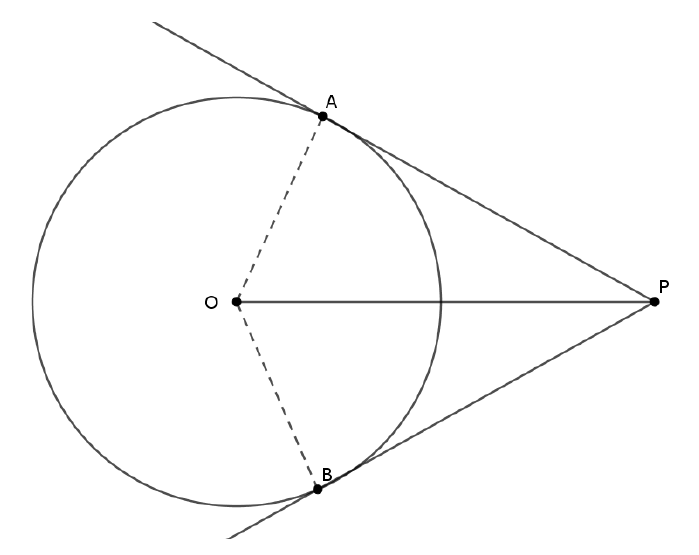
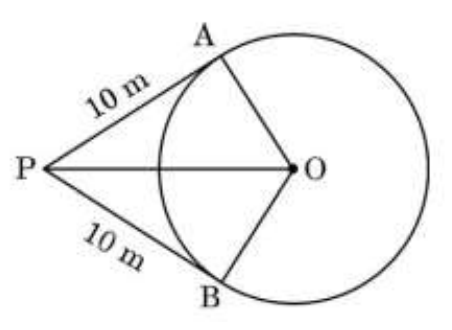
A person is standing at $P$ outside a circular ground at a distance of $26$ m from the centre of the ground. He found that his distances from the points $A$ and $B$ on the ground are $10$ m ($PA$ and $PB$ are tangents to the circle). Find the radius of the circular ground.
figure for this question
Show SolutionHide Solution
$\angle OAP = 90^\circ$. In right $\Delta OAP, (26)^2 = OA^2 + (10)^2 \implies OA = \sqrt{576} = 24$. $\therefore \text{radius} = 24$ m.
4 Marks Questions
1334 Marks · July 2023 · Standardopen ↗
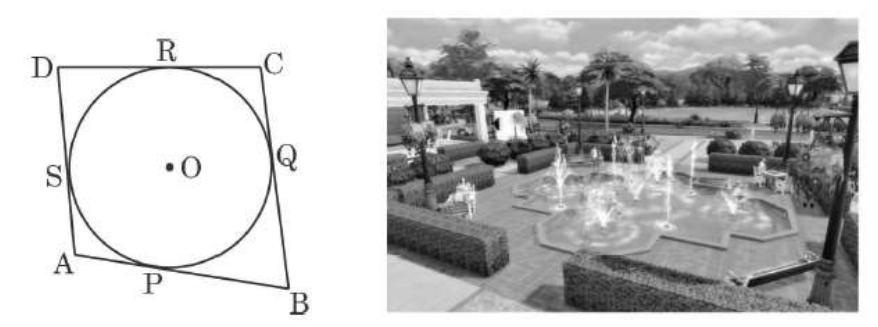
In a park, four poles are standing at positions A, B, C and D around the circular fountain such that the cloth joining the poles AB, BC, CD and DA touches the circular fountain at P, Q, R and S respectively as shown in the figure.
Based on the above information, answer the following questions :
(i) If O is the centre of the circular fountain, then $\angle OSA = ...$
(ii) If AB = AD, then write the name of the figure ABCD.
(iii) (a) If DR = $7$ cm and AD = $11$ cm, then find the length of AP.
OR
(iii) (b) If O is the centre of the circular fountain with $\angle QCR = 60^\circ$, then find the measure of $\angle QOR$.
figure for this question
Show SolutionHide Solution
(i) $90^\circ$
(ii) $AB + DC = BC + DA$
Given, $AB = AD$
$\Rightarrow BC = DC$
So, ABCD is a Kite
(iii) (a) $DS = DR = 7$ cm
$AD = 11$ cm
$7+ SA = 11$
$\Rightarrow SA = 4$ cm
$\therefore AP = SA = 4$ cm
OR
(b) $\angle QOR = 180^\circ - 60^\circ$
$= 120^\circ$
1344 Marks · March 2023 · Standardopen ↗
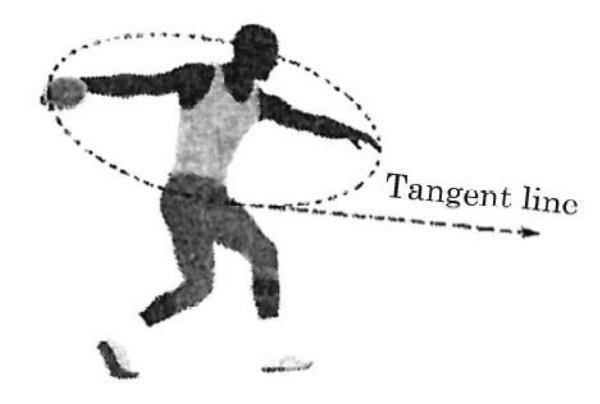
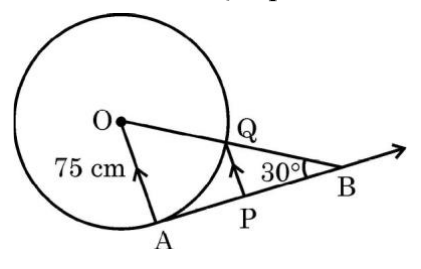
The discus throw is an event in which an athlete attempts to throw a discus. The athlete spins anti-clockwise around one and a half times through a circle, then releases the throw. When released, the discus travels along tangent to the circular spin orbit.
In the given figure, $AB$ is one such tangent to a circle of radius 75 cm. Point $O$ is centre of the circle and $\angle ABO = 30^\circ$. $PQ$ is parallel to $OA$. Based on above information:
(a) find the length of $AB$.
(b) find the length of $OB$.
(c) find the length of $AP$.
OR
Find the length of $PQ$
figure for this question
Show SolutionHide Solution
(i) $\tan 30^\circ = \frac{1}{\sqrt{3}} = \frac{75}{AB}$
$\Rightarrow AB = 75\sqrt{3}$ cm
(ii) $\sin 30^\circ = \frac{1}{2} = \frac{75}{OB}$
$\Rightarrow OB = 150$ cm
(iii) $QB = 150 – 75 = 75$ cm
$\Rightarrow Q$ is mid point. of $OB$
Since $PQ \parallel AO$ therefore $P$ is mid point of $AB$
Hence $AP = \frac{75\sqrt{3}}{2}$ cm.
OR
(iii) $QB = 150 – 75 = 75$ cm
Now, $\triangle BQP \sim \triangle BOA$
$\Rightarrow \frac{QB}{OB} = \frac{PQ}{OA}$
$\Rightarrow \frac{1}{2} = \frac{PQ}{75}$
$\Rightarrow PQ = \frac{75}{2}$ cm
1354 Marks · March 2024 · Standardopen ↗
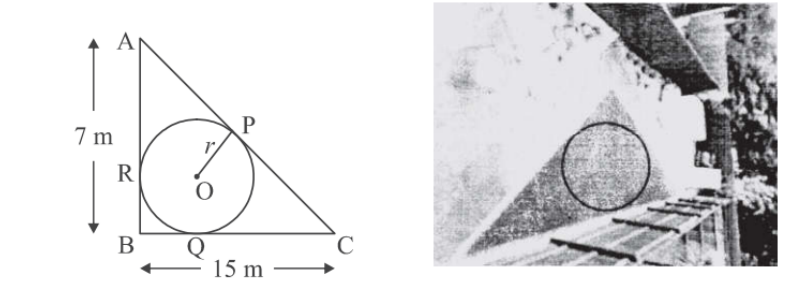
A backyard is in the shape of a triangle ABC with right angle at B. AB = $7$ m and BC = $15$ m. A circular pit was dug inside it such that it touches the walls AC, BC and AB at P, Q and R respectively such that AP = $x$ m.
Based on the above information, answer the following questions :
(i) Find the length of AR in terms of $x$.
(ii) Write the type of quadrilateral BQOR.
(iii) (a) Find the length PC in terms of $x$ and hence find the value of $x$.
OR
(b) Find $x$ and hence find the radius $r$ of circle.
figure for this question
Show SolutionHide Solution
Sol. (i) AR = $x$ m
(ii) Quad. ORBQ is a square.
(iii) (a) PC = $8 + x$
AC$^2 = (8 + 2x)^2 =49 + 225 =274$
$\Rightarrow 8 + 2x = \sqrt{274}$
$x = \frac{-8+\sqrt{274}}{2}$ or $4.28$ approx.
OR
(iii) (b) AC$^2 = (8 + 2x)^2 =49 + 225 =274$
$8 + 2x = \sqrt{274}$
$x = \frac{-8+\sqrt{274}}{2}$ or $4.28$ approx.
Hence, radius $r= 7 - x = 7 - \left(\frac{-4 + \sqrt{274}}{2}\right)$
$= \left(11 - \frac{\sqrt{274}}{2}\right)$ or $2.72$ approx.
Therefore, radius of the circle is $\left(11 - \frac{\sqrt{274}}{2}\right)$ m or $2.72$ m approx.
5 Marks Questions
1365 Marks · March 2025 · Standardopen ↗
There is a circular park of diameter 65 m as shown in the following figure, where $AB$ is a diameter. An entry gate is to be constructed at a point $P$ on the boundary of the park such that distance of $P$ from $A$ is 35 m more than the distance of $P$ from $B$. Find distance of point $P$ from $A$ and $B$ respectively.
figure for this question
Show SolutionHide Solution
Let distance of gate at $P$ from point $B$ is $x$ m. Then distance of gate at $P$ from point $A$ is $(35+x)$ m ($\frac{1}{2}$ mark). In right $\Delta APB$, $(x+35)^2 + x^2 = (65)^2$ (1 mark). $x^2 + 35x - 1500 = 0$ (2 marks). $(x+60)(x-25) = 0$, $x=25$ ($\frac{1}{2}$ mark). Hence, $x+35=60$. Distance of $P$ from $A = 60$ m, Distance of $P$ from $B = 25$ m ($\frac{1}{2} + \frac{1}{2}$ marks).

General

2 Marks Questions
1372 Marks · March 2025 · Standardopen ↗
If $\triangle$ ABC $\sim \triangle$ PQR in which AB = $6$ cm, BC = $4$ cm, AC = $8$ cm and PR = $6$ cm, then find the length of (PQ + QR).
Show SolutionHide Solution
$\frac{6}{\text{PQ}} = \frac{4}{\text{QR}} = \frac{8}{6}$ (1/2)
$\Rightarrow \text{PQ} = \frac{9}{2}$ cm or $4.5$ cm (1/2)
and QR = $3$ cm (1/2)
$\therefore$ PQ + QR = $7.5$cm (1/2)
3 Marks Questions
1383 Marks · March 2023 · Standardopen ↗
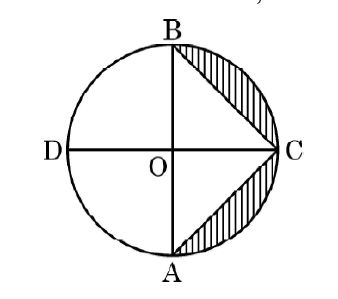
In the given figure, AB and CD are diameters of a circle with centre O perpendicular to each other. If OA = $7$ cm, find the area of shaded region.
figure for this question
Show SolutionHide Solution
Area of quadrant BOC = $\frac{1}{4} \times \frac{22}{7} \times 7 \times 7 = \frac{77}{2}$ cm$^2$
Area of $\triangle BOC = \frac{1}{2} \times OB \times OC = \frac{1}{2} \times 7 \times 7 = \frac{49}{2}$ cm$^2$
Area of shaded region = $2 [\frac{77}{2} - \frac{49}{2}] = 28$ cm$^2$
4 Marks Questions
1394 Marks · March 2025 · Standardopen ↗
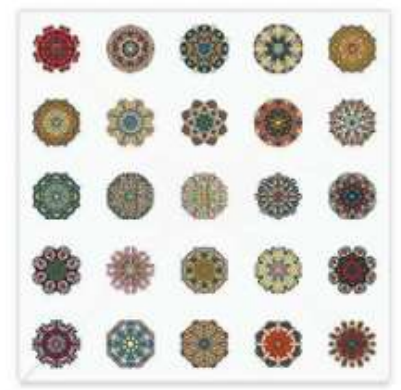
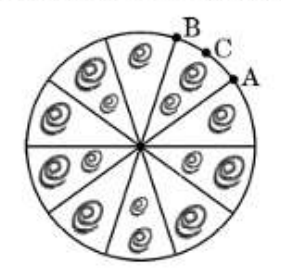
Case Study - 2: A brooch is a decorative piece often worn on clothing like jackets, blouses or dresses to add elegance. Made from precious metals and decorated with gemstones, brooches come in many shapes and designs. One such brooch is made with silver wire in the form of a circle with diameter $35$ mm. The wire is also used in making $5$ diameters which divide the circle into $10$ equal sectors as shown in the figure. (i) Find the central angle of each sector. (ii) Find the length of the arc $ACB$. (iii) (a) Find the area of each sector of the brooch. OR (iii) (b) Find the total length of the silver wire used.
figure for this question
Show SolutionHide Solution
(i) Central angle $= \frac{360^\circ}{10} = 36^\circ$. (ii) Length of arc $ACB = \frac{1}{10} \times 2 \times \frac{22}{7} \times \frac{35}{2} = 11$ mm. (iii)(a) Area $= \frac{1}{10} \times \frac{22}{7} \times \frac{35}{2} \times \frac{35}{2} = 96.25$ mm$^2$. (iii)(b) Length of wire $= 2 \times \frac{22}{7} \times \frac{35}{2} + 5 \times 35 = 285$ mm.