99
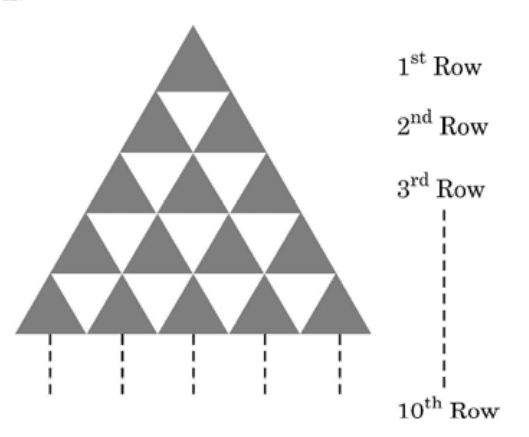
In an equilateral triangle of side 10 cm, equilateral triangles of side 1 cm are formed as shown in the figure below, such that there is one triangle in the first row, three triangles in the second row, five triangles in the third row and so on. Based on given information, answer the following questions using Arithmetic Progression. (i) How many triangles will be there in bottom most row? (ii) How many triangles will be there in fourth row from the bottom? (iii) (a) Find the total number of triangles of side 1 cm each till $8^{th}$ row. OR (iii) (b) How many more number of triangles are there from $5^{th}$ row to $10^{th}$ row than in first 4 rows? Show working.
Show SolutionHide Solution↓
Given A.P. is 1, 3, 5, ...
(i) $a_{10} = 1 + 9 \times 2 = 19$
(ii) $a_4$ (from bottom) $= 19 + 3 \times (-2) = 13$
(iii) (a) $S_8 = \frac{8}{2} \times [2 \times 1 + 7 \times 2] = 64$
(iii) (b) Number of triangles from $5^{th}$ row to $10^{th}$ row $= S_{10} - S_4 = \frac{10}{2} \times [2 \times 1 + 9 \times 2] - \frac{4}{2} \times [2 \times 1 + 3 \times 2] = 84$. Number of triangles in first 4 rows, $S_4 = \frac{4}{2} \times [2 \times 1 + 3 \times 2] = 16$. Required number of triangles $= 84 - 16 = 68$
(i) $a_{10} = 1 + 9 \times 2 = 19$
(ii) $a_4$ (from bottom) $= 19 + 3 \times (-2) = 13$
(iii) (a) $S_8 = \frac{8}{2} \times [2 \times 1 + 7 \times 2] = 64$
(iii) (b) Number of triangles from $5^{th}$ row to $10^{th}$ row $= S_{10} - S_4 = \frac{10}{2} \times [2 \times 1 + 9 \times 2] - \frac{4}{2} \times [2 \times 1 + 3 \times 2] = 84$. Number of triangles in first 4 rows, $S_4 = \frac{4}{2} \times [2 \times 1 + 3 \times 2] = 16$. Required number of triangles $= 84 - 16 = 68$