CBSE has asked these 43 questions in more than one board exam. They are the
highest-yield questions in the entire paper — if you practise nothing else, practise these.
One question has been asked 6 times.
Sorted by how often each question has been repeated. The 🔁 badge on every question lists
the exact exams it appeared in. Filter by year, marks or level below.
13 Marks · 🔁 March 2023 & July 2023 & March 2024 & July 2024 & March 2025 & March 2026 · Basicopen ↗
Prove that $\sqrt{5}$ is an irrational number.
Show SolutionHide Solution↓
Solution: (a) Let $\sqrt{5}$ be a rational number such that $\sqrt{5} = \frac{p}{q}$ ($p$ and $q$ are co-prime numbers, $q \neq 0$) [1/2 mark] $\sqrt{5}q = p \Rightarrow 5q^2 = p^2$ $5$ divides $p^2 \Rightarrow 5$ divides $p$ as well [1 mark] $p = 5m$ (for some integer $m$) $5q^2 = 25m^2 \Rightarrow q^2 = 5m^2$ $5$ divides $q^2 \Rightarrow 5$ divides $q$ as well [1 mark] $p$ and $q$ have a common factor $5$ which is a contradiction as $p$ and $q$ are co-prime. $\therefore \text{our assumption is wrong}$ Hence, $\sqrt{5}$ is an irrational number [1/2 mark]
25 Marks · 🔁 March 2023 & March 2024 & July 2024 & March 2025 & March 2026 · Standardopen ↗
Prove that a parallelogram circumscribing a circle is a rhombus.
Show SolutionHide Solution↓
ABCD is a parallelogram touching the circle at P, Q, R, S by sides AB, BC, CD, DA respectively. We know that tangents drawn from the external point to a circle are equal. $\therefore AP = AS$ quad --------(i) $PB = BQ$ quad --------(ii) $CR = CQ$ quad --------(iii) $DR = DS$ quad ---------(iv) Adding (i), (ii), (iii), (iv) $(AP + PB) + (CR + DR) = (AS + DS) + (BQ + CQ)$ $AB + CD = AD + BC$ ABCD is a parallelogram $\Rightarrow AB = CD, AD = BC$ $\Rightarrow 2AB = 2AD \Rightarrow AB = AD$ $\Rightarrow \text{ABCD is a rhombus.}$
33 Marks · 🔁 March 2023 & March 2024 & July 2024 & March 2025 & March 2026 · Standardopen ↗
Prove that $\sqrt{3}$ is an irrational number.
Show SolutionHide Solution↓
Let $\sqrt{3}$ be a rational number. $\therefore \sqrt{3} = \frac{p}{q}$, let $p \& q$ be co-primes and $q \neq 0$ $3q^2 = p^2 \Rightarrow p^2$ is divisible by $3 \Rightarrow p$ is divisible by $3$ $\Rightarrow p = 3a$, where 'a' is some integer quad ----- (i) $9a^2 = 3q^2 \Rightarrow q^2 = 3a^2 \Rightarrow q^2$ is divisible by $3 \Rightarrow q$ is divisible by $3$ $\Rightarrow q = 3b$, where 'b' is some integer quad ----- (ii) (i) and (ii) leads to contradiction as 'p' and 'q' are co-primes. $\therefore \sqrt{3}$ is an irrational number.
51 Mark · 🔁 March 2024 & July 2024 & March 2025 & July 2025 · Standardopen ↗
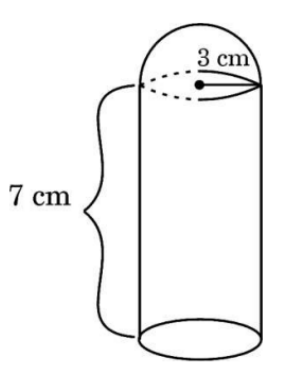
Assertion (A): In the given figure, a toy is in the form of a cylinder surmounted by a hemisphere of the same radius. If the radius of the cylinder is $3$ cm and its height is $7$ cm, then the volume of toy is $81 \pi \text{ cm}^3$. Reason (R): Volume of the given solid is the sum of the volume of the cylinder and the volume of the hemisphere.
(a)Both Assertion (A) and Reason (R) are true and Reason (R) is the correct explanation of the Assertion (A).
(b)Both Assertion (A) and Reason (R) are true, but Reason (R) is
(c)Assertion (A) is true, but Reason (R) is false.
(d)Assertion (A) is false, but Reason (R) is true.
Show SolutionHide Solution↓
(A) Both Assertion (A) and Reason (R) are true and Reason (R) is the correct explanation of the Assertion (A).
65 Marks · 🔁 July 2023 & March 2024 & March 2025 & March 2026 · Basicopen ↗
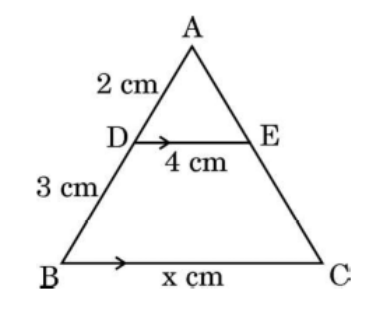
State and Prove "Basic Proportionality Theorem".
Show SolutionHide Solution↓
Statement: If a line is drawn parallel to one side of a triangle to intersect the other two sides in distinct points, the other two sides are divided in the same ratio. (Correct Statement: $1$ mark) Given: In $\Delta ABC, DE \parallel BC$ To Prove: $\frac{AD}{DB} = \frac{AE}{EC}$ Construction: Draw $DM \perp AC, EN \perp AB$, join $BE$ and $CD$ (Given + To prove + Construction + Figure: $1$ mark) Proof: $\frac{ar(\Delta ADE)}{ar(\Delta DBE)} = \frac{\frac{1}{2} \times AD \times EN}{\frac{1}{2} \times DB \times EN} = \frac{AD}{DB} \dots (i)$ [$1$ mark] $\frac{ar(\Delta ADE)}{ar(\Delta ECD)} = \frac{\frac{1}{2} \times AE \times DM}{\frac{1}{2} \times EC \times DM} = \frac{AE}{EC} \dots (ii)$ [$1$ mark] as $\Delta DBE$ and $\Delta DCE$ lie on the same base $DE$ and between same parallels $BC$ and $DE$ $\therefore ar(\Delta DBE) = ar(\Delta ECD)$ or $\frac{ar(\Delta ADE)}{ar(\Delta DBE)} = \frac{ar(\Delta ADE)}{ar(\Delta ECD)} \dots (iii)$ [$\frac{1}{2}$ mark] From $(i), (ii)$ and $(iii)$, we get $\frac{AD}{DB} = \frac{AE}{EC}$ [$\frac{1}{2}$ mark]
83 Marks · 🔁 March 2023 & March 2025 & March 2026 · Basicopen ↗
Prove that $\sqrt{2}$ is an irrational number.
Show SolutionHide Solution↓
Let $\sqrt{2}$ be a rational number such that $\sqrt{2} = \frac{p}{q}$ [$\frac{1}{2}$ mark] ($p$ and $q$ are co-prime numbers, $q \neq 0$) $\sqrt{2}q = p \Rightarrow 2q^2 = p^2$ $2$ divides $p^2 \Rightarrow 2$ divides $p$ as well [$1$ mark] $p = 2m$ (for some integer $m$) $2q^2 = 4m^2 \Rightarrow q^2 = 2m^2$ $2$ divides $q^2 \Rightarrow 2$ divides $q$ as well $p$ and $q$ have a common factor $2$ which is a contradiction as $p$ and $q$ are co-prime. [$1$ mark] $\therefore$ our assumption is wrong Hence, $\sqrt{2}$ is an irrational number [$\frac{1}{2}$ mark]
102 Marks · 🔁 March 2023 & March 2024 · Standardopen ↗
The length of the shadow of a tower on the plane ground is $\sqrt{3}$ times the height of the tower. Find the angle of elevation of the sun.
Show SolutionHide Solution↓
Let AB be the tower of height 'h'. $\therefore$ AC = $\sqrt{3}$ h In $\triangle ABC$, $\tan \theta = \frac{AB}{AC} = \frac{h}{\sqrt{3} h}$ $\Rightarrow \tan \theta = \frac{1}{\sqrt{3}}$ $\Rightarrow \theta = 30^\circ$
115 Marks · 🔁 March 2024 & March 2025 · Standardopen ↗
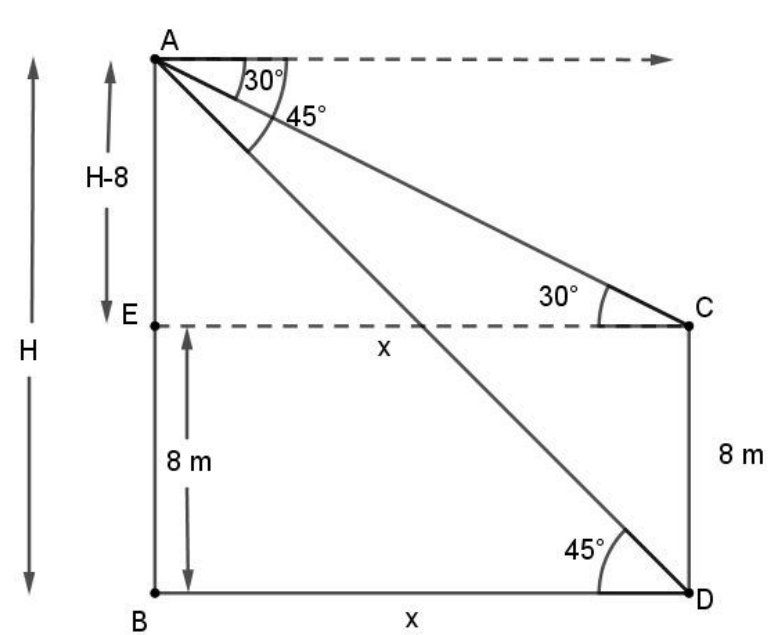
The angles of depression of the top and the bottom of a $8$ m tall building from the top of a multi-storeyed building are $30^\circ$ and $45^\circ$ respectively. Find the height of the multi-storeyed building and the distance between the two buildings.
Show SolutionHide Solution↓
Correct figure Let height of multi storeyed building AB be H m and CD is a tall building. Let the distance between the two buildings be X m. In $\Delta ABD$ $$\begin{aligned}& \tan 45^\circ = 1 = \frac{H}{X} \\ & \Rightarrow H = X \text{---------(i)} \\ & \text{In } \Delta AEC\end{aligned}$$ tan 30^ circ = frac{1}{ sqrt{3}} = frac{H-8}{X}$ \\ $X = sqrt{3} (H-8) ---------(ii) Solving equations (i) & (ii) $X = 4 (3 + \sqrt{3})$ and $H = 4 (3 + \sqrt{3})$ The height of the multi storeyed building is $4 (3 + \sqrt{3})$ m and the distance between the two buildings is $4 (3 + \sqrt{3})$ m.
143 Marks · 🔁 March 2023 & March 2026 · Standardopen ↗
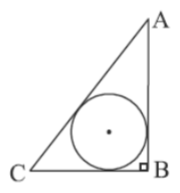
In the given figure, if a circle touches the side $QR$ of $\triangle PQR$ at $S$ and extended sides $PQ$ and $PR$ at $M$ and $N$ respectively, then prove that : $PM = \frac{1}{2} (PQ + QR + PR)$
151 Mark · 🔁 March 2024 & July 2024 · Standardopen ↗
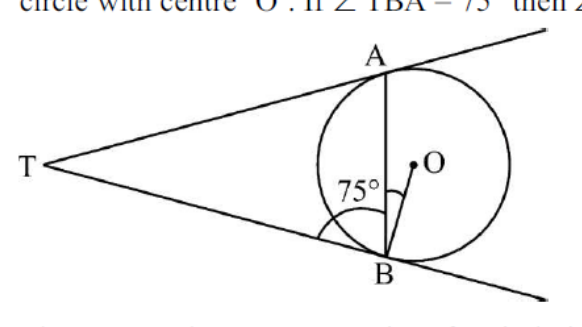
Assertion (A): TA and TB are two tangents drawn from an external point T to a circle with centre 'O'. If $\angle TBA = 75^\circ$ then $\angle ABO = 25^\circ$. Reason (R): The tangent drawn at any point of a circle is perpendicular to the radius through the point of contact.
Show SolutionHide Solution↓
(D) Assertion (A) is not true but Reason (R) is true.
191 Mark · 🔁 March 2024 & March 2026 · Standardopen ↗
Assertion (A): Mid-point of a line segment divides the line segment in the ratio $1:1$. Reason (R): The ratio in which the point $(-3, k)$ divides the line segment joining the points $(-5, 4)$ and $(-2, 3)$ is $1: 2$.
(a)Both Assertion (A) and Reason (R) are true and Reason (R) is the correct explanation of the Assertion (A).
(b)Both Assertion (A) and Reason (R) are true, but Reason (R) is not the correct explanation of the Assertion (A).
(c)Assertion (A) is true, but Reason (R) is false.
(d)Assertion (A) is false, but Reason (R) is true.
203 Marks · 🔁 March 2023 & March 2025 · Basicopen ↗
A fraction becomes $\frac{1}{3}$, when $1$ is subtracted from the numerator and it becomes $\frac{1}{4}$, when $8$ is added to its denominator. Find the fraction.
Show SolutionHide Solution↓
Let the fraction be $\frac{x}{y}$ [$\frac{1}{2}$ mark] $\frac{x - 1}{y} = \frac{1}{3} \Rightarrow 3x - y = 3 \dots (i)$ [$\frac{1}{2}$ mark] $\frac{x}{y + 8} = \frac{1}{4} \Rightarrow 4x - y = 8 \dots (ii)$ [$\frac{1}{2}$ mark] On solving the equations $(i)$ and $(ii)$, we get $x = 5, y = 12$ [$1$ mark] Required fraction is $\frac{5}{12}$ [$\frac{1}{2}$ mark]
233 Marks · 🔁 March 2024 & July 2024 · Standardopen ↗
If $\alpha$ and $\beta$ are the zeroes of the quadratic polynomial $f(x) = 6x^2 + 11x - 10$, find the value of $\frac{\alpha}{\beta} + \frac{\beta}{\alpha}$.
241 Mark · 🔁 March 2023 & March 2026 · Standardopen ↗
Assertion (A) : The probability that a leap year has $53$ Sundays is $\frac{2}{7}$. Reason (R) : The probability that a non-leap year has $53$ Sundays is $\frac{5}{7}$.
(a)Both Assertion (A) and Reason (R) are true and Reason (R) is the correct explanation of Assertion (A).
(b)Both Assertion (A) and Reason (R) are true and Reason (R) is not the correct explanation of Assertion (A).
(c)Assertion (A) is true but Reason (R) is false.
(d)Assertion (A) is false but Reason (R) is true.
Show SolutionHide Solution↓
Sol. (c) Assertion (A) is true but Reason (R) is false
271 Mark · 🔁 July 2023 & March 2024 · Standardopen ↗
Assertion (A): Two players, Sania and Ashnam play a tennis match. The probability of Sania winning the match is $0.79$ and that of Ashnam winning the match is $0.21$. Reason (R): The sum of probabilities of two complementary events is $1$.
(a)Both Assertion (A) and Reason (R) are true and Reason (R) is the correct explanation of the Assertion (A).
(b)Both Assertion (A) and Reason (R) are true, but Reason (R) is not the correct explanation of the Assertion (A).
(c)Assertion (A) is true, but Reason (R) is false.
(d)Assertion (A) is false, but Reason (R) is true.
Show SolutionHide Solution↓
(a) Both Assertion (A) and Reason (R) are true and Reason (R) is the correct explanation of the Assertion (A).
291 Mark · 🔁 March 2023 & July 2023 · Standardopen ↗
Assertion (A): A fair die is thrown once. The probability of getting a prime number is $\frac{1}{2}$. Reason (R): A natural number is a prime number if it has only two factors.
(a)Both Assertion (A) and Reason (R) are true and Reason (R) is the correct explanation of the Assertion (A).
(b)Both Assertion (A) and Reason (R) are true, but Reason (R) is not the correct explanation of the Assertion (A).
(c)Assertion (A) is false, but Reason (R) is true.
Show SolutionHide Solution↓
Sol. (a) Both Assertion (A) and Reason (R) are true and Reason (R) is the correct explanation of the Assertion (A).
301 Mark · 🔁 July 2023 & March 2026 · Standardopen ↗
Assertion (A): The surface area of the cuboid formed by joining two cubes of sides $4$ cm each, end to end, is $160$ cm$^2$. Reason (R) : Surface area of a cuboid of dimensions $l \times b \times h$ is $(lb + bh + hl)$
Show SolutionHide Solution↓
Ans. (c) Assertion (A) is true but Reason (R) is false
322 Marks · 🔁 March 2023 & July 2023 · Standardopen ↗
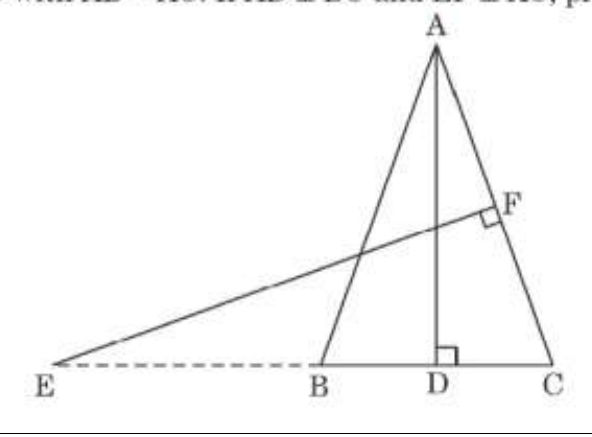
In the figure, E is a point on side CB produced of an isosceles triangle ABC with AB = AC. If AD $\perp$ BC and EF $\perp$ AC, prove that $\triangle ABD \sim \triangle ECF$.
Show SolutionHide Solution↓
In $\triangle ABC$, $AB = AC$ (Given) $\therefore \angle ACB = \angle ABC$ ----- (1) In $\triangle ABD$ and $\triangle ECF$ $\angle ADB = \angle EFC$ (each $90^\circ$) $\angle ABD = \angle ACD$ (from (1)) $\therefore \triangle ABD \sim \triangle ECF$ (AA rule)
343 Marks · 🔁 March 2023 & July 2023 · Standardopen ↗
Sides AB and BC and the median AD of a triangle AВС are respectively proportional to the sides PQ and QR and the median PM of $\triangle PQR$. Show that $\triangle ABC \sim \triangle PQR$.
Show SolutionHide Solution↓
Given $\frac{AB}{PQ} = \frac{BC}{QR} = \frac{AD}{PM}$ Since AD and PM are medians, $BC = 2BD$ and $QR = 2QM$ So, $\frac{AB}{PQ} = \frac{2BD}{2QM} = \frac{AD}{PM} \Rightarrow \frac{AB}{PQ} = \frac{BD}{QM} = \frac{AD}{PM}$ Therefore, $\triangle ABD \sim \triangle PQM$ (SSS similarity criterion) $\Rightarrow \angle B = \angle Q$ (Corresponding angles of similar triangles) Now, in $\triangle ABC$ and $\triangle PQR$ $\frac{AB}{PQ} = \frac{BC}{QR}$ (Given) $\angle B = \angle Q$ (Proved above) Therefore, $\triangle ABC \sim \triangle PQR$ (SAS similarity criterion)
354 Marks · 🔁 March 2023 & March 2026 · Standardopen ↗
In the given figure, CD and RS are respectively the medians of $\triangle ABC$ and $\triangle PQR$. If $\triangle ABC \sim \triangle PQR$ then prove that: (i) $\triangle ADC\sim\triangle PSR$ (ii) $AD \times PR = AC \times PS$
Show SolutionHide Solution↓
(i) $\triangle ABC \sim \triangle PQR$ $\angle A=\angle P$ and $\frac{AB}{PQ} = \frac{AC}{PR}$ $\Rightarrow \frac{2AD}{2PS} = \frac{AC}{PR}$ $\Rightarrow \frac{AD}{PS} = \frac{AC}{PR}$ and $\angle A = \angle P$ Therefore $\triangle ADC \sim \triangle PSR$ (ii)Hence $\frac{AD}{PS} = \frac{AC}{PR}$ $\Rightarrow AD \times PR = AC \times PS$
423 Marks · 🔁 March 2024 & March 2025 · Standardopen ↗
Prove that: $\frac{\sin A + \cos A}{\sin A - \cos A} + \frac{\sin A - \cos A}{\sin A + \cos A} = \frac{2}{2 \sin^2 A - 1}$
Show SolutionHide Solution↓
LHS $= \frac{(\sin A + \cos A)^2 + (\sin A - \cos A)^2}{(\sin A - \cos A)(\sin A + \cos A)} = \frac{\sin^2 A + \cos^2 A + 2 \sin A \cos A + \sin^2 A + \cos^2 A - 2 \sin A \cos A}{\sin^2 A - \cos^2 A} = \frac{1 + 1}{\sin^2 A - (1 - \sin^2 A)} = \frac{2}{2 \sin^2 A - 1} = \text{RHS}$.
_a_1.png)
_a_1.png)
_a_1.png)
_q_1.png)
_q_1.png)
_q_1.png)
_a_1.png)
._q_1.png)