39
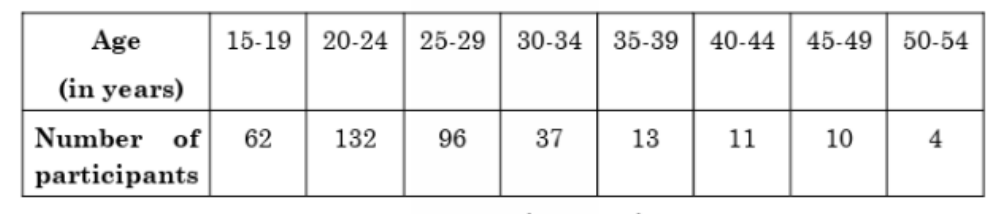
Vocational training complements traditional education by providing practical skills and hands-on experience. While education equips individuals with a broad knowledge base, vocational training focuses on job-specific skills, enhancing employability thus making the student self-reliant. Keeping this in view, a teacher made the following table giving the frequency distribution of students/adults undergoing vocational training from the training institute.
From the above answer the following questions:
(i) What is the lower limit of the modal class of the above data?
(ii) (a) Find the median class of the above data.
OR
(b) Find the number of participants of age less than $50$ years who undergo vocational training.
(iii) Give the empirical relationship between mean, median and mode.
From the above answer the following questions:
(i) What is the lower limit of the modal class of the above data?
(ii) (a) Find the median class of the above data.
OR
(b) Find the number of participants of age less than $50$ years who undergo vocational training.
(iii) Give the empirical relationship between mean, median and mode.
Show SolutionHide Solution↓
(i) Modal class is $19.5 - 24.5$
Lowe limit $=19.5$
(ii) (a)
Correct table
$\frac{n}{2} = \frac{365}{2} = 182.5$
median class = $19.5 - 24.5$
OR
(ii) (b) $62 + 132 + 96 + 37 + 13 + 11 + 10 = 361$
(iii) $3\text{median} = \text{mode} + 2 \text{ mean}$
Lowe limit $=19.5$
(ii) (a)
Correct table
$\frac{n}{2} = \frac{365}{2} = 182.5$
median class = $19.5 - 24.5$
OR
(ii) (b) $62 + 132 + 96 + 37 + 13 + 11 + 10 = 361$
(iii) $3\text{median} = \text{mode} + 2 \text{ mean}$