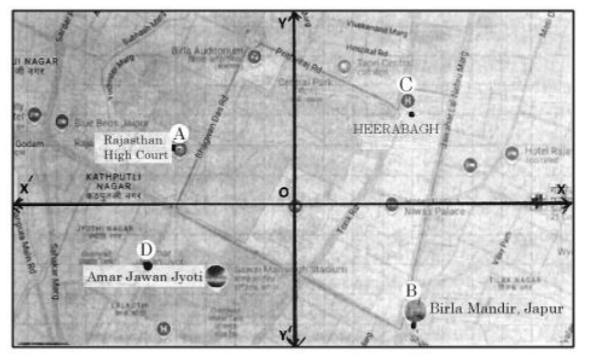
Observe the map of Jaipur city placed on a Cartesian plane. Taking Rambagh Palace as origin, the location of some…
CBSE Class 10 Maths PYQ · Coordinate Geometry · Application · 4 Marks · March 2026 · Standard
Solve it yourself first — then press ↓ or tap Show Solution. Use ←→ for previous / next question.
1784 Marks · March 2026 · Standard
Observe the map of Jaipur city placed on a Cartesian plane. Taking Rambagh Palace as origin, the location of some places are given below : Point A: $(-4, 2)$ Rajasthan High Court Point B: $(4,-4)$ Birla Mandir Point C: $(4, 3)$ Heera Bagh Point D: $(-5, -2)$ Amar Jawan Jyoti Based on the above, answer the following questions : (i) Advocate Rehana stays at Heera Bagh. How much distance she has to cover daily to go to the court and coming back home? (ii) There is a crossing on X-axis which divides AD in a certain ratio. Find the ratio. (iii) (a) Is Birla Mandir equidistant from Heera Bagh and Amar Jawan Jyoti? Justify your answer. OR (b) Using section formula, show that points A, O and B are not collinear.
Show SolutionHide Solution↓
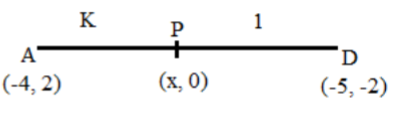
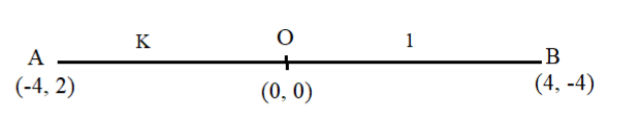
(i) Distance travelled $= 2 AC$ $= 2\sqrt{(-4-4)^2 + (2 - 3)^2}$ (I) ($\frac{1}{2}$ Mark) $= 2\sqrt{64 + 1}$ (II) ($\frac{1}{2}$ Mark) $= 2\sqrt{65}$ Hence, required distance is $2\sqrt{65}$ units. (ii) Let the point $P(x, 0)$ divides $AD$ in the ratio $K : 1$ $\therefore AP: PD = K : 1$ Here, $0 = \frac{-2K+2}{K+1}$ (I) ($\frac{1}{2}$ Mark) $\Rightarrow K = 1$ (II) ($\frac{1}{2}$ Mark) $\therefore$ The required ratio is $1 : 1$ (iii) (a) $BC = \sqrt{(4 - 4)^2 + (-4 - 3)^2} = 7$ units (I) (1 Mark) $BD = \sqrt{(4 + 5)^2 + (-4 + 2)^2} = \sqrt{85}$ units (II) (1 Mark) $\therefore BC \neq BD$ $\therefore$ Birla Mandir is not equidistant from Heera Bagh and Amar Jawan Jyoti. OR (b) Let us assume that points $A, O, B$ are collinear and $AO : OB = K : 1$ Here, $0 = \frac{4K-4}{K+1}$ (I) ($\frac{1}{2}$ Mark) $\Rightarrow K = 1$ (II) ($\frac{1}{2}$ Mark) Also, $0 = \frac{-4K+2}{K+1}$ (III) ($\frac{1}{2}$ Mark) $\Rightarrow K = \frac{1}{2}$ (IV) ($\frac{1}{2}$ Mark) Since the value of $K$ is different in the above two cases, so points $A, O$ and $B$ are not collinear.